Old Dhaka does not reveal itself through one monument.
You understand it gradually—through the bell of a passing rickshaw, the faded details of an old building above a crowded shopfront, the smell of biryani drifting into a narrow lane, and wooden boats crossing the Buriganga while the city moves around them.
This historic part of Bangladesh’s capital is crowded, unpredictable and intensely alive.
For international travelers wondering about the best things to do in Old Dhaka, the answer goes far beyond visiting Lalbagh Fort and Ahsan Manzil. The real experience comes from combining architecture, Mughal and colonial history, religious heritage, traditional neighborhoods, food, rickshaws and river life.
Here is how to experience Old Dhaka without reducing it to a checklist of attractions.
Old Dhaka at a Glance
Location: Southern historic area of Dhaka, Bangladesh
Best for: History, architecture, food, culture and street photography
Recommended time: Half day minimum; full day preferred
Best comfortable season: November to February
Getting around: Walking, rickshaw and short vehicle transfers
Major attractions: Lalbagh Fort, Ahsan Manzil, Star Mosque, Armenian Church, Shankhari Bazaar and Buriganga riverfront
Guide recommended: Particularly useful for first-time international visitors
Photography: Excellent, with permission and cultural awareness
Travel style: Slow exploration works better than rushing between attractions
Why Visit Old Dhaka?
Modern Dhaka spreads far beyond its historic center, but Old Dhaka preserves many of the layers that explain how the city became what it is today.
Mughal monuments sit within neighborhoods transformed by later periods of trade and colonial influence. Mosques, temples and churches reveal the city’s diverse communities. Markets continue traditions that cannot be understood from museum displays alone.
Then there is the Buriganga.
Dhaka developed in close relationship with the river, and that connection remains visible around the old city.
Most importantly, Old Dhaka is not an open-air museum.
People live, work, worship, trade, eat and raise families here.
That distinction matters.
The best way to experience Old Dhaka is therefore not to rush from landmark to landmark but to observe what happens between them.
1. Explore the Mughal History of Lalbagh Fort
For travelers interested in history, Lalbagh Fort is one of the essential places to visit in Old Dhaka.
Construction of the fort complex began in 1678 under Prince Muhammad Azam, son of Mughal emperor Aurangzeb. The project later came under Shaista Khan, the Mughal governor of Bengal, but the complex was never completed according to its original plan.
Today, its surviving structures and landscaped grounds provide a striking contrast with the dense city surrounding them.
Among its notable features are the mosque, the Diwan-i-Aam and the tomb associated with Pari Bibi, daughter of Shaista Khan.
But Lalbagh Fort becomes much more meaningful when you understand the city beyond its walls.
During the Mughal period, Dhaka developed into an important administrative and commercial center. Its connection with Bengal’s textile trade and river networks helped shape the city that eventually expanded around the fort.
Why Visit Lalbagh Fort?
Visit for more than architecture.
It provides one of the clearest starting points for understanding Mughal Dhaka and gives historical context to the neighborhoods you will encounter later in the day.
Allow yourself time to walk rather than simply photographing the main structures and leaving.
2. Visit Ahsan Manzil, Dhaka’s Pink Palace
Move from Mughal Dhaka toward a later period of the city’s history at Ahsan Manzil.
Known widely as the Pink Palace, this striking building beside the Buriganga River was associated with the Nawabs of Dhaka.
Its pink façade, dome and riverfront location make it one of the most recognizable historic buildings in Bangladesh.
Today, the palace operates as a museum, helping visitors understand the lives and influence of Dhaka’s Nawab family.
For international travelers, however, its surroundings are just as important as its interior.
Stand outside and look toward the river.
The contrast between the palace, nearby commercial activity and the Buriganga helps explain how wealth, political influence and river-based commerce were connected in historic Dhaka.
Photography Tip
Do not photograph only the front façade.
Step back where access permits and look for compositions that show the palace in relationship with the surrounding city and river environment.
That tells a much stronger story of Old Dhaka.
3. Step Inside the Armenian Church
One of the more unexpected things to do in Old Dhaka is visit the Armenian Church of the Holy Resurrection in Armanitola.
Its presence tells a story many first-time visitors know little about.
Armenian merchants once formed an important community in Dhaka and participated in the commercial networks connecting Bengal with other parts of Asia and beyond.
The church and its historic cemetery preserve traces of that community.
After navigating some of Old Dhaka’s busiest streets, stepping into the church compound can feel remarkably quiet.
Historic gravestones, architecture and the surrounding courtyard create a completely different atmosphere from the nearby bazaars.
More importantly, the church demonstrates why Dhaka’s history cannot be explained through only Mughal rulers or British colonialism.
Merchants and communities from different cultural and religious backgrounds also shaped the city.
Visitor note: Access conditions can vary. Confirm current arrangements rather than assuming the church will always be open to visitors.
4. See the Decorative Beauty of Star Mosque
Star Mosque, locally known as Tara Masjid, offers another architectural experience.
The mosque is known for its elaborate decoration, including star-shaped motifs and extensive tile work.
Rather than the monumental scale of Lalbagh Fort, the attraction here is detail.
Slow down enough to examine the decorative surfaces.
This is also an active mosque, not simply a heritage attraction.
Visitors should dress appropriately, remove shoes where required and avoid entering or photographing worshippers in ways that interrupt prayer.
If prayer is underway, give the congregation space.
Experiencing Old Dhaka respectfully sometimes means deciding that a photograph can wait.
5. Walk Through Shankhari Bazaar
If you visit only monuments, you will miss a major part of Old Dhaka.
Shankhari Bazaar provides a very different experience.
The narrow historic street is traditionally associated with the Shankhari community and conch-shell craftsmanship. Shops, temples, residences and historic buildings occupy an extraordinarily compact urban space.
Look upward while walking.
Old balconies, façades, windows and decorative details are easily overlooked when your attention is fixed on navigating the busy street below.
Unlike a restored palace, Shankhari Bazaar demonstrates what living heritage actually means.
This is not a neighborhood preserved exclusively for visitors.
Families live here. People worship here. Businesses operate here.
Treat it accordingly.
Ask before photographing people closely, particularly craftspeople at work, residents inside their homes and religious activities.
6. Experience the Buriganga River
You can learn about Old Dhaka’s history inside a museum.
But the Buriganga River helps explain why the city developed here in the first place.
For centuries, waterways played a fundamental role in the movement of people, goods and commerce across Bengal.
The river remains an active part of Dhaka.
Around the Sadarghat area, passenger vessels, small boats, traders, workers and commuters create one of the city’s most visually intense environments.
It can be fascinating.
It can also be overwhelming.
This is not a carefully staged tourist waterfront. People are trying to work, travel and move goods.
Stay aware of your surroundings and avoid obstructing passengers or workers for photographs.
Should You Take a Boat Ride on the Buriganga?
A short local boat experience can provide a dramatically different perspective of Old Dhaka when local conditions are appropriate.
From the water, the scale and density of the riverfront become much easier to understand.
However, safety should come before the experience.
Boat conditions, weather, river traffic and local circumstances should always be considered before deciding whether to go onto the river.
7. Take a Rickshaw Ride Through Old Dhaka
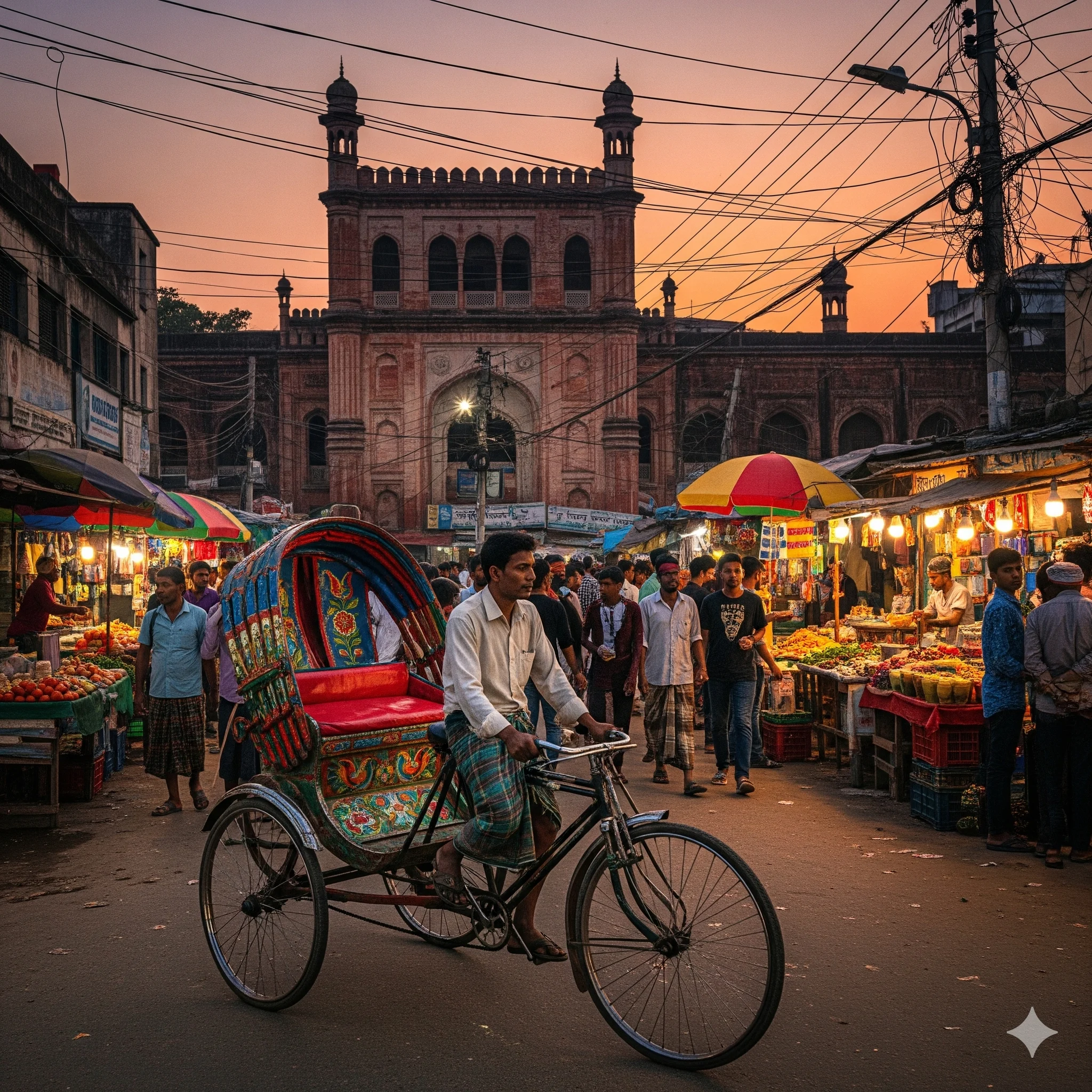
You have not really observed Dhaka until you have watched its rickshaws move through streets that appear to have no remaining space.
A short rickshaw ride can be one of the most memorable things to do in Old Dhaka.
Rickshaws are not simply transportation.
Their painted panels and decorative details are connected to a distinctive form of Bangladeshi folk art and the visual identity of Dhaka itself.
In Old Dhaka, they are also practical.
Some distances are tiring to walk, while cars can be inefficient in narrow or congested streets.
The most enjoyable approach is often a combination of walking and short rickshaw journeys.
Sit back occasionally instead of photographing everything.
Watching the street unfold from a moving rickshaw is an experience in itself.
8. Discover the Food of Old Dhaka
You cannot separate Old Dhaka from food.
Its culinary traditions reflect generations of local Dhakaiya culture alongside Mughal and Bengali influences.
One of the best-known dishes is kacchi biryani.
Fragrant rice, meat and spices are cooked into a rich dish closely associated with celebrations and traditional dining in Dhaka.
Pairing a heavy meal with borhani, a spiced yogurt-based drink, is another familiar local combination.
But Old Dhaka’s food story does not stop with biryani.
Depending on where you explore, you may encounter kebabs, fuchka, jilapi, traditional sweets, breads, tea and countless small snacks.
Should Foreign Visitors Try Old Dhaka Street Food?
Yes, but use judgment.
Choose busy vendors and restaurants where food turnover is high. Freshly cooked food served hot is preferable to items that have been sitting exposed.
Pay attention to water and hygiene if your stomach is not accustomed to local conditions.
If food is one of the main reasons you are visiting Dhaka, consider experiencing it separately and more slowly rather than trying to squeeze several dishes between sightseeing stops.
9. Look for Old Dhaka’s Hidden Architecture
Some of Old Dhaka’s most interesting architecture does not have an entrance ticket.
Walk through older neighborhoods and look above modern signs.
You may notice weathered balconies, ornate windows, narrow façades, decorative doorways and traces of buildings from different periods of the city’s development.
Not all of them are restored.
Some are deteriorating.
Others have been heavily modified.
That is precisely why they are interesting.
Old Dhaka demonstrates how architecture changes when generations continue living and working around it.
For architecture enthusiasts, these unnamed buildings can sometimes become as memorable as the famous monuments.
10. Observe Everyday Life in the Bazaars
Old Dhaka’s markets are not designed around tourists.
That makes them particularly revealing.
Depending on your route, you may encounter wholesale goods, spices, textiles, household products, food, religious items and traditional crafts being moved through streets that seem impossibly narrow.
The experience is less about shopping and more about observation.
Watch how goods move.
Notice how businesses use every available meter of space.
Listen to the negotiation happening around you.
But remember that markets are workplaces.
Do not block entrances or interrupt workers simply to create a photograph.
11. Try Street Photography in Old Dhaka
Old Dhaka is one of Bangladesh’s richest environments for street and documentary photography.
The visual possibilities are almost endless: rickshaws, river activity, markets, architecture, workshops, food preparation and everyday interactions.
But strong photography here requires patience.
Instead of constantly chasing faces, find a scene and observe how people move through it.
Use layers.
Look for the relationship between people and architecture.
Wait for moments rather than manufacturing them.
For close portraits, ask permission.
Be particularly respectful when photographing children, religious activities, people in vulnerable circumstances or anyone inside a private space.
Old Dhaka gives photographers plenty.
There is no need to take what someone does not want to give.
12. Experience Old Dhaka as a Neighborhood, Not a Checklist
This may be the most important recommendation in this guide.
Leave some space in your itinerary for nothing in particular.
You might discover a tiny sweet shop.
A craftsman may invite you to look at his work.
You may find an architectural detail you had never seen in a guidebook.
Or you may simply stand for ten minutes watching rickshaws negotiate an intersection.
Those experiences are difficult to rank as “attractions.”
Yet they often become the memories travelers describe when they return home.
Old Dhaka rewards curiosity more than speed.
How Much Time Do You Need in Old Dhaka?
Allow at least half a day.
However, a full day is considerably better if history, architecture, photography or food genuinely interests you.
A half-day itinerary requires prioritization. You may need to choose between deeper monument visits and spending more time in neighborhoods.
With a full day, you can move more slowly, stop for a proper meal, explore on foot and finish around the river without constantly checking the time.
Do not underestimate Dhaka traffic when planning your arrival and departure.
Suggested Half-Day Old Dhaka Itinerary
If you have limited time, focus on one coherent story rather than attempting every attraction.
You might begin with Lalbagh Fort for Mughal history, continue through selected historic neighborhoods and religious architecture, experience a short rickshaw journey and finish near Ahsan Manzil or the Buriganga.
Alternatively, travelers primarily interested in everyday life and photography may spend less time inside monuments and more time walking through neighborhoods and the riverfront.
A half day should provide an introduction.
It should not pretend to show you everything.
Suggested Full-Day Old Dhaka Itinerary
Morning: Begin with Mughal Dhaka
Start at Lalbagh Fort while the day is relatively comfortable.
Take time to understand the fort rather than simply walking around its grounds.
Late Morning: Explore Historic Neighborhoods
Continue toward areas containing religious and community heritage, potentially including Star Mosque, Armenian Church and surrounding streets depending on current access and opening times.
Lunch: Taste Old Dhaka
Stop for a traditional meal rather than treating lunch as wasted sightseeing time.
Food is part of the history you came to experience.
Afternoon: Shankhari Bazaar and Street Life
Explore historic neighborhoods slowly on foot and by rickshaw.
This is a good period for observing architecture, shops, crafts and everyday life.
Late Afternoon: Ahsan Manzil and the Buriganga
Finish around the riverfront.
Changing afternoon light can transform both Ahsan Manzil and scenes along the Buriganga.
The river provides a fitting conclusion because it connects so much of Old Dhaka’s history.
Do You Need a Guide to Explore Old Dhaka?
You can explore Old Dhaka independently.
However, first-time international visitors often gain much more from a knowledgeable local guide.
The value is not simply navigation.
Anyone with a map can locate Lalbagh Fort.
The harder questions are different.
Why did this neighborhood develop here?
Who were the Armenian merchants of Dhaka?
Why was the Buriganga so important?
What are you looking at when you see an old building with no tourist sign?
Which streets make sense to walk today given traffic, crowds and opening schedules?
That context turns sightseeing into understanding.
A local guide can also help communicate with residents and adjust the route when conditions change.
What Should You Wear in Old Dhaka?
Wear lightweight, breathable and reasonably modest clothing.
Dhaka can be hot and humid, while Old Dhaka involves considerable walking.
Comfortable shoes are essential.
Women may find carrying a lightweight scarf useful when visiting religious sites.
Both men and women should dress respectfully when entering mosques, temples, churches or other places of worship.
Shoes need to be removed in certain religious spaces.
Best Time to Visit Old Dhaka
November to February
These are generally the most comfortable months for extensive walking and outdoor exploration.
Morning
Morning can offer more comfortable temperatures and interesting street activity as neighborhoods begin their day.
It also gives you more flexibility if traffic causes delays later.
Late Afternoon
Late-afternoon light can be particularly attractive around Ahsan Manzil, historic streets and the Buriganga.
However, traffic may become heavier.
Monsoon
Old Dhaka during rain can be extraordinarily atmospheric, particularly for photographers.
But heavy rainfall can also create waterlogging, traffic disruption and difficult walking conditions.
If traveling during monsoon, build flexibility into your itinerary.
Is Old Dhaka Safe for International Visitors?
Old Dhaka is a dense, working part of a major city rather than a controlled tourism district.
Use normal city precautions.
Keep phones, wallets and cameras secure in crowded places. Avoid displaying large amounts of cash. Pay close attention while crossing roads and moving through traffic.
For many first-time foreign visitors, navigating vehicles, rickshaws and crowds can be a greater immediate challenge than sightseeing itself.
Local political events, large gatherings or security situations can occasionally affect movement through parts of Dhaka.
Check current travel advice and local conditions before your visit.
Is Old Dhaka Worth Visiting?
If you want to understand Dhaka, absolutely.
But come with the right expectations.
Old Dhaka is not polished.
It can be hot, crowded, noisy and exhausting.
Some heritage buildings show their age. Traffic rarely behaves according to the expectations of first-time visitors. Plans sometimes need to change.
And yet, within a single day you can encounter Mughal architecture, the history of Armenian merchants, Hindu neighborhoods, Islamic architecture, the legacy of Dhaka’s Nawabs, rickshaw art, traditional food and one of Bangladesh’s most important urban rivers.
Few places compress so many layers of Dhaka into such a small area.
The imperfections are not separate from the experience.
They are part of the city you came to understand.
Explore Old Dhaka with Bangladesh Explore
Exploring Old Dhaka independently is possible, but understanding what you are seeing often requires local context.
Bangladesh Explore creates guided experiences for international travelers who want to explore the historic city beyond a checklist of attractions.
Depending on your interests and current local conditions, an experience can combine historic architecture, neighborhood walks, rickshaw travel, traditional food, photography and the Buriganga riverfront.
History enthusiasts can spend more time understanding Mughal and colonial-era Dhaka.
Photographers can move more slowly and work with changing light.
Travelers interested in local culture can focus more closely on neighborhoods, markets and everyday life.
The objective is not to show you the greatest possible number of places.
It is to help you understand the stories connecting them.
Frequently Asked Questions About Things to Do in Old Dhaka
What are the best things to do in Old Dhaka?
Some of the best things to do in Old Dhaka include visiting Lalbagh Fort and Ahsan Manzil, seeing Star Mosque and Armenian Church, walking through Shankhari Bazaar, taking a rickshaw ride, tasting traditional food and experiencing the Buriganga riverfront.
What are the best places to visit in Old Dhaka?
Lalbagh Fort, Ahsan Manzil, Armenian Church, Star Mosque, Shankhari Bazaar and the Buriganga riverfront are among the most rewarding places for first-time visitors.
How long should I spend in Old Dhaka?
Allow at least half a day. A full day is better if you want to combine historic sites, neighborhoods, local food, photography and the river without rushing.
Can foreigners visit Old Dhaka?
Yes. International travelers can explore Old Dhaka, although normal urban precautions and awareness of current local conditions are important. A local guide can make navigation and cultural interpretation considerably easier.
Can I explore Old Dhaka on foot?
Walking is one of the best ways to experience individual neighborhoods, but Old Dhaka is too extensive and crowded to rely exclusively on walking for every route. Combining walking with rickshaw rides and appropriate vehicle transfers usually works better.
What food should I try in Old Dhaka?
Kacchi biryani is one of the area’s best-known dishes. Borhani, kebabs, fuchka, jilapi and traditional sweets are also worth exploring depending on your interests and dietary needs.
Is Old Dhaka good for street photography?
Yes. Old Dhaka offers exceptional opportunities for street, architecture, documentary and travel photography. Photographers should ask before taking close portraits and remain respectful around religious activities, children and private spaces.
What is the best time of day to visit Old Dhaka?
Morning is comfortable for walking and provides interesting street activity. Late afternoon offers attractive light around historic architecture and the Buriganga. A full-day visit allows you to experience both.
Do I need a tour guide in Old Dhaka?
A guide is not mandatory, but it is particularly valuable for first-time international visitors. A knowledgeable guide can explain the historical context, help navigate narrow neighborhoods, communicate locally and adapt the route around traffic and opening conditions.