Some buildings are impressive because of their size. Others stay with you because they make you look at space differently.
Bangladesh’s National Parliament Building does both.
Known in Bangla as Jatiya Sangsad Bhaban (জাতীয় সংসদ ভবন), the monumental complex at Sher-e-Bangla Nagar is the home of the Bangladesh Parliament and one of Dhaka’s most recognizable architectural landmarks.
Designed by American architect Louis I. Kahn, the building transforms concrete, water, geometric openings and natural light into an architectural language unlike almost anything else in the city.
For an international traveler interested in architecture, photography or the story of modern Bangladesh, the National Parliament Building deserves more than a quick photograph from a moving car. Even when interior access is unavailable, experiencing the building from its surroundings helps explain why it became one of the defining works associated with Kahn.
National Parliament Building at a Glance
Official name: Jatiya Sangsad Bhaban
English name: National Parliament Building / National Parliament House
Location: Sher-e-Bangla Nagar, Dhaka, Bangladesh
Architect: Louis I. Kahn
Construction period: 1962–1982
Complex area: Approximately 215 acres
Function: Home of the Bangladesh Parliament
Current parliamentary composition: 350 members
Known for: Monumental concrete architecture, geometric openings, natural light and surrounding water
Best for: Architecture, history, urban photography and understanding modern Bangladesh
Visitor note: Do not assume unrestricted interior access; verify current security and visitor arrangements before planning a visit.
Why Is the National Parliament Building Famous?
The National Parliament Building is famous because Louis Kahn turned a government complex into something far more ambitious than an administrative building.
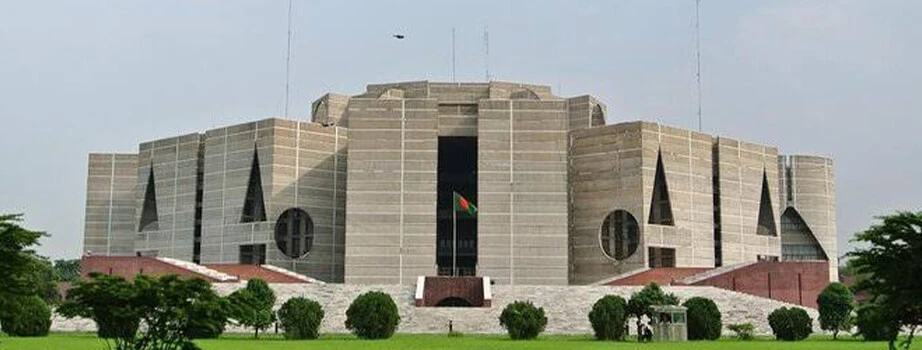
From a distance, its massive concrete walls appear almost fortress-like. Move closer, however, and circles, triangles, rectangles and deep openings begin to break apart that weight.
Then there is the water.
The main building rises beside an artificial lake, allowing its monumental geometry to reflect across the surface. Depending on the hour, sunlight can make the same concrete appear warm, pale, shadowed or almost sculptural.
Kahn’s design was not simply about creating an unusual exterior. Light, circulation, proportion and the relationship between individual spaces were fundamental to the building.
That combination has made Jatiya Sangsad Bhaban an important destination for architects, students and travelers interested in twentieth-century design.
Who Designed the National Parliament Building?
The National Parliament Building was designed by Louis Isadore Kahn (1901–1974), one of the most influential architects of the twentieth century.
Kahn was born in what is now Estonia and later became an American citizen. His architecture became known for monumental forms, powerful use of natural light and materials that were allowed to express their own character.
Bangladesh’s Parliament complex became one of the defining projects of his career.
Kahn did not live to see the completed building. He died in 1974, while the project was still under construction.
Today, the Parliament complex remains inseparable from his architectural legacy.
History of Jatiya Sangsad Bhaban
The story of the National Parliament Building began before Bangladesh became an independent country.
The project was initiated during the period when present-day Bangladesh was East Pakistan. Louis Kahn was brought into the project in the early 1960s, and construction began during that decade.
Then history changed around the building.
Bangladesh’s Liberation War took place in 1971, creating an independent state while the Parliament complex remained unfinished.
Construction subsequently continued under Bangladesh.
The completed National Parliament Building was inaugurated in January 1982, and Parliament began sitting in the new building that year.
This history gives the complex an unusual significance. It was conceived under one political reality but completed as the legislature of an independent Bangladesh.
Architecture of the National Parliament Building
Geometry on a Monumental Scale
The first feature most visitors notice is geometry.
Large circles, triangles, rectangles and other openings are cut into the massive exterior surfaces. These are not simply decorative patterns added to concrete.
They help organize light, openings and the relationship between the building’s interior and exterior.
From different viewpoints, one geometric form can disappear behind another. The composition therefore changes as you move around the complex.
That makes the building particularly rewarding to observe slowly rather than from one fixed photographic position.
Concrete, Marble and Light
Concrete gives the Parliament Building much of its visual strength.
Instead of concealing the material beneath elaborate decoration, Kahn made the mass of the structure part of its identity. Bands and details provide visual contrast while the large surfaces emphasize solidity.
Yet the building does not rely on concrete alone.
Natural light is one of its most important architectural materials.
Deep openings, shafts and courts allow daylight to enter in controlled ways, creating a changing relationship between brightness and shadow.
The result is architecture that can feel monumental without being visually static.
Water Around the Parliament Building
Water is another essential part of the design.
An artificial lake surrounds significant portions of the main building, separating the structure visually from its surroundings and producing some of its most recognizable reflections.
This relationship between architecture and water is particularly meaningful in Bangladesh, a country shaped by rivers and seasonal waterways.
The lake also creates breathing space around an exceptionally large building. Instead of meeting roads and surrounding development directly, the Parliament appears to rise from a carefully composed landscape.
Inside Jatiya Sangsad Bhaban
The Parliament complex is organized around the central Assembly Chamber and the spaces required for the country’s legislative work.
The main building contains parliamentary offices, committee rooms, circulation areas and facilities serving members and officials.
According to Bangladesh Parliament’s official description, the structure is composed of nine major blocks. Eight peripheral blocks surround a taller central octagonal block.
These individual components are connected through corridors, stairs, lifts, light courts and other circulation spaces, but the exterior composition allows them to read as a unified monumental structure.
The Assembly Chamber
At the heart of the complex is the main parliamentary chamber.
This is where members of Parliament meet for legislative proceedings.
Rather than treating the chamber as an isolated hall, Kahn organized the surrounding building around it, reinforcing the symbolic importance of parliamentary deliberation within the overall complex.
Natural light from above is one of the defining characteristics of the space.
For architecture enthusiasts, the chamber is among the most significant parts of Kahn’s design. However, international visitors should never assume that ordinary tourist access to the interior or chamber is available.
Main Plaza, South Plaza and Presidential Plaza
The Parliament complex contains several major functional areas.
Main Building
The Main Building contains the principal parliamentary functions, including the Assembly Chamber, offices and committee spaces.
Its monumental geometric composition creates the image most commonly associated with the National Parliament Building.
South Plaza
The South Plaza faces Manik Mia Avenue, one of the best-known roads beside the Parliament complex.
This side contributes to the ceremonial and public approach to the building and offers important exterior views of the architecture.
Presidential Plaza
The Presidential Plaza occupies another formal side of the complex and was designed for ceremonial and official functions.
Together, these spaces demonstrate that Kahn was designing an entire civic complex rather than a single isolated building.
How Big Is the National Parliament Complex?
The Parliament complex covers approximately 215 acres at Sher-e-Bangla Nagar.
That area includes far more than the central building.
Water bodies, landscaped grounds, roads, plazas and supporting facilities all form part of the larger composition.
The scale is one reason photographs can be misleading. A close photograph may emphasize an individual circle or wall, while a distant view reveals how the main building relates to water and open space.
Both perspectives are necessary to appreciate the design.
How Many Members Sit in Bangladesh Parliament?
Bangladesh Parliament is a unicameral legislature with 350 members.
Of these, 300 members are directly elected from territorial constituencies, while 50 seats are reserved for women under the country’s constitutional and electoral arrangements.
Because political officeholders and parliamentary composition can change, a travel article about the building should avoid attaching the architecture to a particular prime minister, speaker or governing party unless that information is necessary and actively maintained.
The enduring subject of this page is the building itself.
Can Tourists Visit the National Parliament Building?
This is one of the most important practical questions for foreign visitors.
The National Parliament Building is an active government and legislative complex, not a conventional tourist attraction.
Security arrangements can therefore affect where visitors may walk, stop, photograph or enter.
Do not assume that seeing photographs of the interior online means tourists can freely enter the building.
Foreign visitors who specifically want interior access should check current arrangements with the appropriate authority before their visit. Parliamentary sessions, official events and security conditions may affect access.
Even without entering the building, its exterior remains worthwhile for travelers interested in architecture.
Where to See the National Parliament Building from Outside
The area around Manik Mia Avenue provides some of the most familiar public perspectives of the Parliament complex.
From accessible public areas, visitors can observe the building’s scale, geometric openings, landscape and relationship with the surrounding city.
Conditions can change during major political events, parliamentary sessions or security operations, so follow police barriers and local instructions.
Never attempt to cross a restricted perimeter simply to obtain a better photograph.
Photography at the National Parliament Building
Jatiya Sangsad Bhaban is one of Dhaka’s strongest architectural photography subjects.
Morning and late-afternoon light can emphasize the depth of the geometric openings and produce stronger shadows across the concrete.
A wide-angle lens helps establish the building within its landscape, while a moderate telephoto lens can isolate circles, triangles, wall details and repeating patterns.
The surrounding water can create striking reflections when conditions are calm.
However, this is a sensitive government site.
Respect all security instructions and posted restrictions. Avoid photographing checkpoints, security personnel, surveillance infrastructure or controlled entrances at close range.
Drone photography should never be attempted without clear authorization from the relevant authorities.
Best Time to Visit the National Parliament Building Area
November to February
Dhaka’s cooler months are generally the most comfortable for exploring the Parliament area on foot.
Lower temperatures make it easier to spend time observing and photographing the exterior.
Early Morning
Morning can provide softer light and comparatively comfortable temperatures.
It is also useful for travelers who want to combine the Parliament area with a longer day exploring Dhaka.
Late Afternoon
Late afternoon is particularly attractive for architecture photography.
As the sun lowers, shadows strengthen the building’s geometric forms and the concrete can take on warmer tones.
Public access conditions and security requirements remain more important than photographic timing, so always follow current local restrictions.
How to Get to the National Parliament Building
The National Parliament Building is located at Sher-e-Bangla Nagar in central Dhaka.
It is bordered by major roads, including Manik Mia Avenue, and is accessible from many parts of the city by private car, ride-hailing service, CNG auto-rickshaw and other local transport.
Dhaka traffic is highly variable.
A short distance on a map can take considerably longer during commuting hours, political events or heavy rain. International visitors should therefore plan by travel time rather than distance alone.
If you are exploring Dhaka with a guide, the Parliament Building can be incorporated into a broader route focused on the city’s architecture, political history and modern development.
What to See Near the National Parliament Building
The Parliament area sits within a busy part of Dhaka rather than an isolated monument zone.
Depending on your itinerary and current access conditions, a visit can be combined with other parts of the capital that reveal different chapters of Bangladesh’s history and architecture.
The contrast is particularly interesting.
Old Dhaka presents Mughal, colonial and vernacular layers within dense historic neighborhoods. The Parliament Building represents a very different architectural moment: monumental twentieth-century modernism created for the institutions of a modern state.
Seeing both provides a more complete understanding of Dhaka than visiting either in isolation.
Why Architecture Travelers Should Not Miss It
Bangladesh is often introduced internationally through rivers, villages, textiles or the crowded streets of Dhaka.
Jatiya Sangsad Bhaban challenges that limited picture.
Here is a work of monumental modern architecture created by one of the twentieth century’s most influential architects, shaped by Bangladesh’s landscape and completed during the early years of the independent country.
Yet its impact is not dependent on architectural knowledge.
Stand across the water and watch the building change as the light moves.
Walk far enough to see how circles and triangles interrupt the enormous concrete walls.
Then move closer and notice how something that initially appeared severe begins to reveal rhythm and detail.
That experience explains the building more effectively than simply calling it a masterpiece.
National Parliament Building and the Story of Modern Bangladesh
Jatiya Sangsad Bhaban represents more than architectural ambition.
Its timeline crosses the political transformation of the region itself.
The building was conceived before Bangladesh existed as an independent nation, survived the disruption surrounding the Liberation War and was eventually completed as the home of the country’s national legislature.
As a result, its meaning changed while it was being built.
Today, the complex functions simultaneously as architecture, a working institution and part of Bangladesh’s modern national story.
For travelers interested in history, that context makes the Parliament Building especially valuable.
Visit the National Parliament Building with Bangladesh Explore
The National Parliament Building works best as part of a carefully planned exploration of Dhaka rather than as an isolated photo stop.
Bangladesh Explore can incorporate the exterior of Jatiya Sangsad Bhaban into a private Dhaka itinerary alongside historic neighborhoods, architectural landmarks and places connected to Bangladesh’s political and cultural history.
For international visitors, a knowledgeable local guide also helps explain what is visible from outside: Kahn’s geometric language, the role of water, the building’s unusual construction history and its place within modern Bangladesh.
Any visit remains subject to current security restrictions and official access rules.
Frequently Asked Questions About the National Parliament Building
What is the National Parliament Building of Bangladesh called?
The official Bangla name is Jatiya Sangsad Bhaban (জাতীয় সংসদ ভবন). In English, it is commonly called the National Parliament Building, National Parliament House or Bangladesh Parliament Building.
Where is the National Parliament Building?
The National Parliament Building is located at Sher-e-Bangla Nagar in Dhaka, Bangladesh. Manik Mia Avenue runs along the southern side of the complex.
Who designed the National Parliament Building in Bangladesh?
American architect Louis I. Kahn designed the National Parliament Building. It became one of the most important projects associated with his career.
When was the National Parliament Building built?
Construction began in the early 1960s and continued through major political changes, including Bangladesh’s independence in 1971. The completed building was inaugurated in January 1982.
Why is the National Parliament Building famous?
It is internationally known for Louis Kahn’s monumental modernist architecture, geometric openings, dramatic use of natural light, exposed concrete and the integration of water and landscape around the main structure.
How large is the National Parliament complex?
Bangladesh Parliament’s official information describes the entire complex as approximately 215 acres, including the main Parliament Building, water, landscaped areas and supporting facilities.
Can tourists go inside the National Parliament Building?
Do not assume general tourist access to the interior. Jatiya Sangsad Bhaban is a functioning and highly secured government complex. Foreign visitors should verify current access requirements before planning an interior visit.
Can tourists photograph Jatiya Sangsad Bhaban?
Exterior photography from permitted public locations is possible subject to current security restrictions. Visitors should obey police instructions and avoid photographing checkpoints, sensitive security installations or restricted areas.
What is the best time to see the National Parliament Building?
November through February offers the most comfortable weather for exploring Dhaka. Early morning and late afternoon generally provide attractive light for exterior architectural photography.