Dhaka has a habit of making carefully planned itineraries irrelevant.
A place that looked ten minutes away on the map may take much longer to reach. You may set out for a famous monument and become more interested in the neighborhood around it. In Old Dhaka, particularly, the journey between two places can be every bit as interesting as the places themselves.
You notice an old balcony above a row of shops. A rickshaw disappears into a lane that seems too narrow for traffic. Someone is preparing lunch beside a busy market. A mosque, church or temple appears where you weren’t expecting one.
The difficulty is that much of this means very little without context.
That is one reason travelers consider hiring a tour guide in Dhaka. Not because the city is impossible to explore independently—it isn’t—but because some of its best stories are difficult to discover from a map.
Do You Really Need a Tour Guide in Dhaka?
Not everyone does.
If you have plenty of time, are comfortable navigating a very busy South Asian city and enjoy figuring things out as you go, exploring independently can be rewarding.
Dhaka has ride-sharing services, local transport and enough English spoken in hotels and many restaurants to make independent travel possible.
The experience changes, however, once you move deeper into the old city.
Knowing where Lalbagh Fort is does not explain why it was never completed. Looking at Ahsan Manzil does not immediately tell you how the Nawabs fitted into Dhaka’s history. Walking through Armanitola without knowing about the Armenian merchants who once lived there means passing through an important chapter of the city’s commercial history without realizing it.
Then there are the practical things.
Which places are actually realistic to combine in one morning? When is walking quicker than sitting in traffic? Is the building you are about to enter an attraction or an active place of worship? Is it appropriate to take a photograph here?
This is where a good local guide earns their place.
What Exploring Dhaka with a Local Guide Actually Looks Like
There shouldn’t be one answer to this because there isn’t one version of Dhaka that suits everybody.
For someone interested in history, a day might begin around Lalbagh and gradually follow the development of the old city toward the Buriganga. An architecture enthusiast may want considerably more time around individual buildings and neighborhoods. A photographer might spend twenty minutes at an intersection that another visitor would cross without stopping.
Food changes the pace again.
If you become interested in a biryani shop, sweet maker or tea stall, there is little reason to rush away simply because an itinerary says the next attraction should begin at 1:30.
That flexibility matters in Dhaka.
Traffic, weather, opening hours and the sheer unpredictability of a crowded city mean that a sensible route at breakfast may need adjusting by lunchtime. Someone who knows the city can make those changes without making the day feel as though something has gone wrong.
Often, nothing has gone wrong. It is simply Dhaka being Dhaka.
Old Dhaka Is Where Local Knowledge Matters Most
If you have only one day in the capital, there is a good chance that much of it will be spent in Old Dhaka.
This is where several versions of the city’s history overlap.
Lalbagh Fort takes you into Mughal Dhaka. Ahsan Manzil introduces another period through the story of the Nawabs. The Armenian Church is evidence of a merchant community many visitors do not expect to find here. Star Mosque, Shankhari Bazaar and the neighborhoods around them add religious, architectural and community histories of their own.
Then you reach the Buriganga, and another part of the story begins.
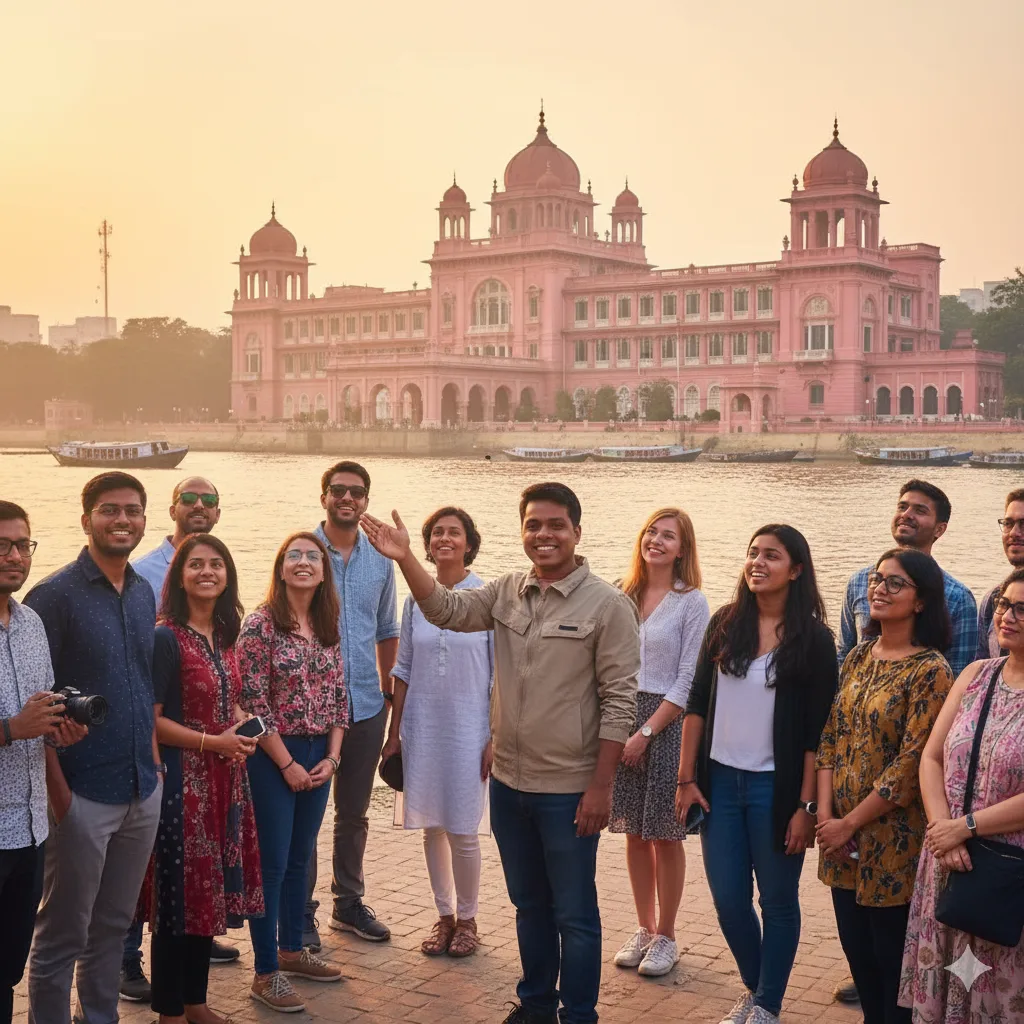
The river helps explain why Dhaka developed where it did. Even today, standing around the riverfront and watching boats, passengers, traders and goods moving across the water gives you a very different understanding of the city from anything seen through a car window.
A local guide should connect these places rather than simply announce their names.
You don’t need someone beside you saying, “This is Ahsan Manzil.”
You can read that on your phone.
What you need is someone who can explain why the building matters, what was happening around it, what has changed and what traces of that history can still be seen in the neighborhood.
Sometimes the Street Is More Interesting Than the Attraction
This is something we notice repeatedly in Dhaka.
Visitors arrive with a list: Lalbagh Fort, Ahsan Manzil, Star Mosque, Sadarghat.
Those places deserve to be seen. But by the end of the day, the story they tell most enthusiastically may be about something that wasn’t on the list.
Perhaps it was the first rickshaw ride through a crowded lane.
Perhaps someone stopped to explain what was being cooked outside a shop.
Perhaps it was a craftsman working in a tiny workshop, an old building hidden behind newer signs, or five quiet minutes inside a religious compound after spending the morning surrounded by traffic.
A rigid sightseeing schedule leaves very little room for those moments.
A good guide knows when to keep moving and when not to.
A Guide Should Help You Meet Dhaka, Not Insulate You from It
There is a version of guided travel where the visitor moves from an air-conditioned vehicle to an attraction, listens to a rehearsed explanation, takes photographs and gets back into the vehicle.
You can certainly see Dhaka that way.
You will also miss a lot of it.
Some walking is necessary, especially in the old city. So is the occasional rickshaw ride. You should hear the markets rather than only pass them through a window. If you are curious about local food, there should be time to sit down and eat it.
A guide is most useful when they make those experiences easier to understand, not when they create a barrier between you and everyday life.
Language is part of this.
English will take you a long way in Dhaka, but Bangla opens conversations that might otherwise never begin. A guide can help when you want to speak with a shopkeeper, understand what a craftsman is making, order something unfamiliar or simply ask whether someone is comfortable being photographed.
The interaction should still belong to you.
The guide just makes it possible.
If You’re Interested in Photography, Say So Before the Day Begins
Dhaka is a remarkable city to photograph, but a photographer and a conventional sightseer rarely move at the same pace.
Street photography requires waiting.
You may find the right background and stay there until something happens. You may want to return to the river later because the light is better. A market that takes another visitor fifteen minutes to walk through could occupy a photographer for an hour.
Tell your guide beforehand.
It also helps to be clear about what kind of photography interests you. Architecture, street life, markets, rickshaws and river activity require different locations and different timing.
There is another side to this that matters just as much.
People are not photographic props.
A local guide may help you communicate, but their presence does not give automatic permission to photograph someone closely. Ask before portraits. Be particularly thoughtful around children, religious activity, people at work and anyone in a vulnerable situation.
Some of the strongest photographs of Dhaka do not require invading anyone’s privacy.
Food Can Be Part of Understanding the City
Old Dhaka and food are difficult to separate.
You will hear about kacchi biryani before long, and there is good reason for that. But limiting the food experience to one famous dish misses the point.
Depending on where you are walking, there may be kebabs coming off a grill, fresh bread, jilapi being fried, traditional sweets behind a glass counter or a cup of tea arriving at exactly the moment you need to sit down.
A local guide becomes useful here in a very ordinary way.
What is this?
How spicy is it?
Does it contain something I don’t eat?
Is this where locals actually come?
For international visitors, those questions can make the difference between looking curiously at a food stall and actually trying something.
There is no need to turn every guided day into a food tour, though. If food is your main interest, give it the time it deserves rather than squeezing five dishes between monuments.
What About Modern Dhaka?
Old Dhaka tends to dominate first-time itineraries because its historical density is difficult to match.
But it is not the whole city.
Depending on your interests and available time, exploring Dhaka can extend into places associated with the Language Movement, Bangladesh’s independence, university life, modern architecture, museums and the city’s newer neighborhoods.
This is particularly worthwhile when you have more than one day.
It also prevents a common mistake: leaving Bangladesh with the impression that Dhaka is primarily a historic city of rickshaws, bazaars and old buildings.
It isn’t.
Dhaka is a rapidly changing megacity where the old and new often exist uncomfortably close together. Seeing some of that contrast makes the historic center easier to understand too.
Half a Day or a Full Day?
A half day can work very well when you know what you want.
Perhaps you are interested mainly in architecture. Perhaps you have already seen parts of Dhaka and want to explore Old Dhaka more closely. Perhaps you are in the city for work and have only one free morning.
What doesn’t work particularly well is trying to “see Dhaka” in a few hours.
The city is too large, and traffic makes ambitious itineraries frustrating.
For a first visit, a full day gives the experience room to breathe. You can spend time inside the places that interest you, stop for food, walk where walking makes sense and change the route without feeling that the entire schedule has collapsed.
Even then, don’t try to see everything.
Dhaka will win that argument.
How to Choose a Tour Guide in Dhaka
The most important question is not whether someone knows the dates attached to famous buildings.
Those facts are easy to memorize.
Ask instead how they would plan your day.
A good guide should want to know what interests you, where you are staying, how much time you have and whether this is your first visit to Bangladesh. The answers should affect the route.
If you are passionate about architecture, your day shouldn’t look identical to the itinerary of someone primarily interested in food.
There should also be clarity before you book.
Know what the guiding service includes and what it does not. Ask about transportation if you need it. Confirm the meeting point and approximate duration. If there are particular attractions you consider essential, mention them beforehand.
And be cautious about anyone promising that every place will definitely be accessible.
Dhaka changes.
Religious sites have prayer schedules. Museums and historic properties have opening days and hours. Traffic can alter plans. Public events can affect movement.
Flexibility is a sign of realistic guiding, not poor organization.
Can Solo Travelers Explore Dhaka with a Guide?
Yes, and solo travelers are often the people who appreciate local guidance most.
There is no group itinerary to negotiate, so the day can follow your interests closely.
It can also make the first encounter with Dhaka less demanding. Instead of simultaneously figuring out transport, directions, local etiquette and what you are looking at, you have someone to help with the parts that aren’t obvious.
After a day or two, you may feel comfortable exploring other parts of the city independently.
That is a good outcome.
A guide should make you more confident in the destination, not more dependent on being guided.
A Few Things Worth Discussing Before You Book
Tell the guide or tour operator if you have mobility limitations. Old Dhaka can involve uneven surfaces, crowded streets and considerable walking.
Mention dietary requirements before planning food stops.
If you are traveling with children, say so. The pace and transport choices may need to change.
Photographers should explain the kind of work they want to create.
And if you have only a few hours between flights or business commitments, provide your actual available time rather than an optimistic estimate.
In Dhaka, where you are staying can be almost as important as what you want to visit.
Is Dhaka Safe to Explore with a Local Guide?
A local guide can make navigation easier and help you understand situations that may be unfamiliar, but normal travel precautions still apply.
Crowded places require awareness of phones, wallets and camera equipment. Crossing roads can take some getting used to. Religious and government locations may have photography restrictions. Large gatherings or political events are best avoided.
Conditions can also change, so international travelers should check current official travel advice close to their departure date rather than relying on an old blog post—including this one—for real-time security information.
For everyday sightseeing, listening to local advice and remaining aware of your surroundings goes a long way.
So, Is Hiring a Tour Guide in Dhaka Worth It?
It depends on what you want from the city.
If your priority is simply reaching several famous attractions, you can organize much of that yourself.
If you want to understand why those places matter, find the stories between them, communicate more easily and spend less of your limited time solving navigation problems, hiring a local guide becomes much more valuable.
This is especially true on a first visit.
Dhaka is not always an easy city to read. Much of its history is hidden beneath the noise of the present, and some of its most interesting experiences are found in places that barely register on a conventional sightseeing map.
Someone local can help you notice them.
Explore Dhaka with Bangladesh Explore
At Bangladesh Explore, we prefer to begin with a simple question:
What kind of Dhaka do you want to see?
Maybe this is your first morning in Bangladesh and you want an introduction to the city.
Maybe you have been reading about Mughal Dhaka and want to spend more time around its surviving architecture.
You might be carrying a camera and care more about street life than monuments. Or perhaps you have one free day before traveling elsewhere in Bangladesh and simply don’t want to waste it sitting in traffic between badly planned stops.
Tell us that first.
From there, we can help arrange an English-speaking local guide and build a realistic route around your available time, interests and current conditions in the city.
You don’t need to arrive with a finished itinerary.
That is part of what local knowledge is for.
Frequently Asked Questions on Tour Guide in Dhaka
Can I hire an English-speaking tour guide in Dhaka?
Yes. English-speaking local guides are available in Dhaka for private sightseeing and customized experiences. When booking, confirm your date, available time, meeting location and the kind of places you are interested in visiting.
Do I need a guide to visit Old Dhaka?
No. Old Dhaka can be explored independently. A guide becomes useful for historical interpretation, navigating the older neighborhoods, communicating locally and adjusting the route around traffic and opening conditions.
What can I see with a local guide in Dhaka?
A guided day may include historic Old Dhaka, Lalbagh Fort, Ahsan Manzil, religious architecture, traditional neighborhoods, markets, the Buriganga riverfront, local food and other parts of the city. The exact route should depend on your interests and available time.
Is half a day enough to explore Dhaka?
Half a day is enough for a focused area or theme, but not for the whole city. If this is your first visit and you have the time, a full day allows for a more relaxed introduction.
Can a Dhaka tour be customized?
Yes. A private guide experience can be shaped around interests such as history, architecture, food, photography or everyday city life. Tell the guide or operator what matters to you before the day is planned.
Where should I meet my guide?
That depends on your hotel and planned route. Agree on the meeting point beforehand rather than assuming every guide service includes hotel pickup or transportation.
Is a local guide useful for photography in Dhaka?
Yes, particularly for navigation, timing and communication. However, a guide cannot provide consent on behalf of the people you photograph. Permission should still be requested for close portraits and sensitive situations.
Should I book a Dhaka guide in advance?
Advance booking is sensible if you have fixed travel dates, limited time or specific interests. It gives the guide time to plan a realistic route and confirm any locations where opening conditions need to be checked.