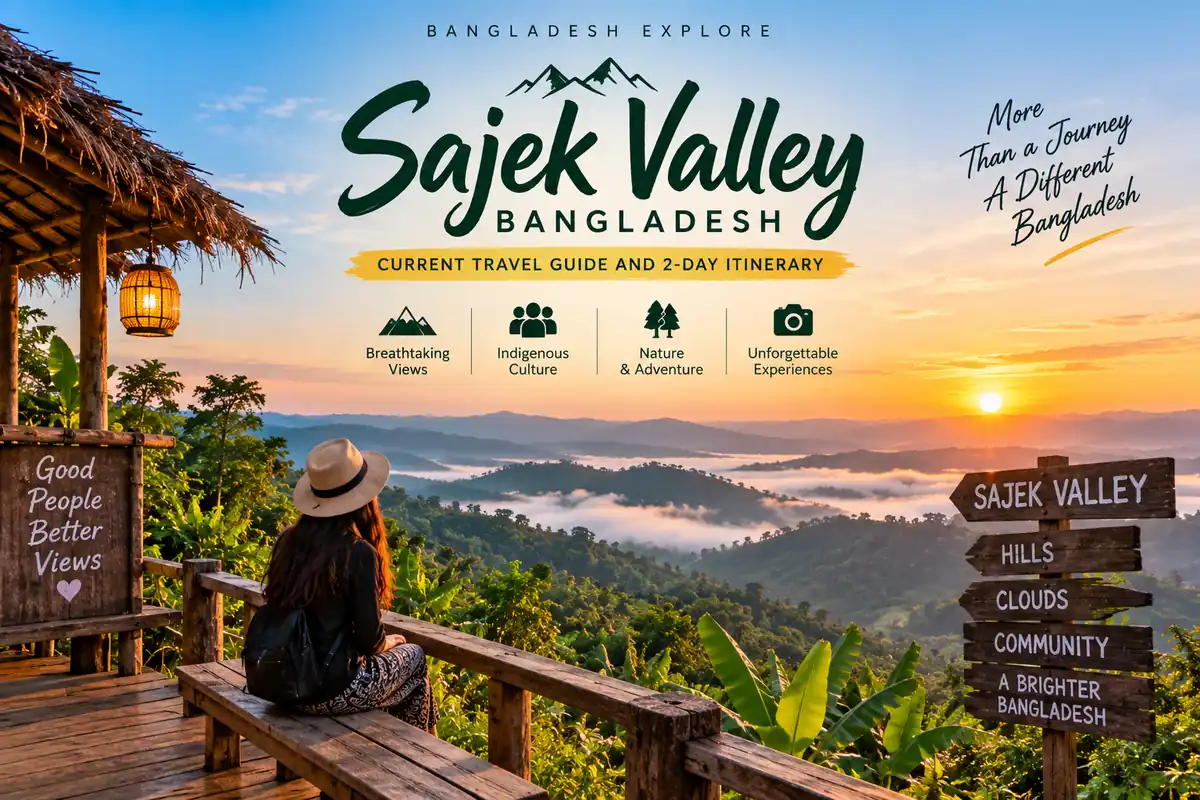
Sajek Valley is one of Bangladesh’s most recognizable hill destinations: a high ridge of viewpoints, cottages and villages above the forests of the Chittagong Hill Tracts. Sunrise can reveal layers of green hills toward India, while monsoon mist can move across the road within minutes. The scenery is real, but so are the logistical and security questions that many short guides overlook.
This Sajek travel guide is written for visitors from the United States and other international markets. It explains how to go to Sajek through Khagrachari, how checkpoints and controlled vehicle movements work, what foreign visitors must verify, where to stay, what the trip may cost, how to behave respectfully in Indigenous communities and how to organize a realistic two-day route.
Important for U.S. travelers: as of the research check on September 8, 2026, the U.S. Department of State classifies the Chittagong Hill Tracts—including Khagrachari and Rangamati—as Level 4, “Do Not Travel,” because of unrest, crime, terrorism and kidnapping risk. Sajek lies in that region. This guide does not override official advice. Check the current U.S. advisory, your insurer’s exclusions and Bangladesh’s access decision before committing money.
Sajek Valley at a Glance
Is Sajek Valley Open to Foreign Tourists?
There is no permanent yes-or-no answer. Sajek has repeatedly closed and reopened because of local security incidents, weather, landslides and administrative orders. Local tourism businesses were advertising future Sajek trips during the September 2026 research check, but a commercial listing is not proof that a foreign visitor has permission to travel on a particular date.
Foreign nationals should assume advance approval is required for the Chittagong Hill Tracts. The current U.S. advisory says prior approval from Bangladesh’s Ministry of Home Affairs is required, while Australian advice directs travelers to apply through the relevant Deputy Commissioner’s office. The correct authority, documents, lead time and permitted route must be confirmed for the actual journey. A reputable local operator should obtain written clarification rather than relying on a checkpoint conversation.
Where Is Sajek Valley?
Sajek is in Sajek Union, Baghaichhari Upazila, Rangamati Hill District. The practical road approach, however, is through Khagrachari and Dighinala. This is why searchers see both Rangamati and Khagrachari associated with the destination: Sajek is administratively in Rangamati, but most visitors reach it from Khagrachari.
The Bangladesh Tourism Board describes Sajek as a highland destination known for its hills, forest and cloud views. Elevation figures differ across travel pages, so the useful planning fact is not a disputed number—it is the exposed ridge environment, steep access road and rapid weather change.
Quick Planning Facts
- Administrative location: Baghaichhari Upazila, Rangamati Hill District
- Usual gateway: Khagrachari town via Dighinala and Baghaihat
- Typical stay: Two days and one night in Sajek, plus overnight road travel from Dhaka when applicable
- Local vehicle: Reserved four-wheel-drive jeep or pickup commonly called a Chander Gari
- Main experiences: Sunrise, sunset, ridge views, Ruilui Para and a walk toward Konglak Para
- Best comfortable season: Generally November through February
- Cloud and green season: Monsoon, with materially higher rain, landslide and road-disruption risk
- Cash: Carry sufficient Bangladeshi taka; do not depend on an ATM in Sajek
- Utilities: Confirm power, hot water, drinking water, Wi-Fi and mobile coverage with the property
- Foreign visitor requirement: Verify written permission, route authorization and current opening status before travel
Why Sajek Requires More Planning Than a Normal Hill Resort
Sajek is remote, close to international borders and reached through a security-sensitive region. The road is steep and controlled at checkpoints. Weather can block or delay access, while local violence has previously led administrators to suspend tourism at short notice. Medical facilities and evacuation options are limited compared with Dhaka.
This does not mean every visit is chaotic. It means the itinerary must remain conditional. A foreign visitor needs a plan for permission, vehicle coordination, a missed movement window, a closure after booking and an early return if officials advise it.
Competitor content often describes Sajek as a simple “land of clouds” package. That imagery helps inspiration but does not answer the decisions an international traveler must make. The strongest content opportunity for Bangladesh Explore is a transparent destination guide that separates beautiful scenery from the access, safety and community responsibilities attached to it.
How to Go to Sajek Valley
Step 1: Travel from Dhaka to Khagrachari
Most itineraries begin with an overnight bus from Dhaka to Khagrachari. A private vehicle is possible, although the final hill route should still be planned with an operator familiar with current checkpoint procedures. There is no direct train to Sajek and no airport at the destination.
Bus schedules, boarding points and fares change. Confirm the exact counter, departure time, luggage allowance and arrival point directly with the operator. Road journeys may take longer than expected because of congestion, breaks, security checks or weather. Avoid placing a nonrefundable international flight immediately after the return from the hills.
A traveler spending time in the capital first can use Discover Dhaka City as the separate urban part of the itinerary. Keep Dhaka sightseeing and Sajek access on different pages and different days; one serves city-search intent, while the other requires dedicated transport and security planning.
Step 2: Continue from Khagrachari via Dighinala
From Khagrachari, the established route runs toward Dighinala and then along the hill road through the Baghaihat area to Sajek. Travel pages commonly describe the route as roughly 65–70 kilometers and about three hours, but road, checkpoint and convoy conditions can extend the trip.
Eat breakfast, purchase water and complete vehicle arrangements in Khagrachari. The operator should check whether the area is open before leaving town. Never treat a social-media post from the previous week as current authorization.
Step 3: Use an Authorized Local Vehicle
The familiar Chander Gari is a modified four-wheel-drive jeep or pickup used for the steep road. Private SUVs may sometimes travel when suitable and permitted, but vehicle acceptance, registration requirements and route rules should be confirmed locally.
Before paying, agree in writing on the vehicle type, passenger number, pickup and return, overnight waiting, sightseeing stops, luggage, driver expenses and what happens if the road closes. Inspect tires and basic condition where possible. Passengers should remain seated, keep hands inside and avoid standing in an open vehicle on bends.
Step 4: Follow Checkpoint and Controlled-Movement Instructions
Travelers commonly pass checkpoints and may be required to move during organized or controlled departure windows. Older guides publish fixed daily convoy times, but those figures can become unsafe or simply wrong when conditions change. Confirm the day’s window with the district administration, checkpoint and driver on the same day.
Carry the documents specified in the approval: usually passport identification and copies of relevant visa and itinerary details. The booking name should match the passport. Be patient during checks, do not photograph security posts and follow instructions without argument.
Permission and Checkpoint Rules for Foreign Visitors
What Permission May Be Required?
The U.S. State Department states that travel to the Chittagong Hill Tracts requires prior approval from Bangladesh’s Ministry of Home Affairs. Australia’s Smartraveller advises applying through the Office of the Deputy Commissioner. These sources use different administrative wording, which is precisely why a foreign visitor should not submit an informal application based on a blog template.
Ask Bangladesh Explore or another qualified operator to confirm the current process with the responsible authority. The operator should explain where the application is filed, who issues the approval, the required lead time, whether a guide or security arrangement is mandatory and which locations the permission covers.
Documents to Prepare
Requirements can change, but travelers should be ready to provide clear passport and visa copies, Bangladesh contact details, travel dates, route, accommodation, vehicle information and an emergency contact. Do not send passport scans through an unverified messaging account. Ask how personal data will be stored and who will receive it.
Carry printed and digital copies of the approval. Keep the original passport secure but accessible if officials require inspection. A photocopy alone may not satisfy every checkpoint.
What If Permission Is Delayed or Refused?
Do not attempt to bypass the process or persuade a driver to use an unofficial route. Move the trip to an approved destination and request the refund or rebooking available under the written terms. Bangladesh Explore should offer a clearly defined alternative before accepting payment from an international guest.
Travel permission and a resort reservation are separate. A confirmed room does not guarantee the road is open, and permission does not guarantee good weather. Cancellation terms should address both risks.
Current Safety Context for USA Visitors
U.S. Government Advice
The U.S. travel advisory issued July 30, 2026 tells travelers not to visit the Chittagong Hill Tracts for any reason. It identifies unrest, crime, terrorism and kidnapping and notes the limited ability of the U.S. government to provide emergency help outside Dhaka.
For a USA-focused page, this warning should appear near the top—not hidden in a generic safety paragraph. A U.S. traveler who follows the advisory should choose another Bangladesh destination. If the advisory later changes, update both the introduction and FAQ, record the review date and retain a link to the live source.
Advice from Other Governments
Australia currently advises travelers to reconsider their need to visit the Chittagong Hill Tracts because of kidnapping, politically motivated violence and the possibility of clashes. Advice for Canada, the United Kingdom, New Zealand and European countries may use different levels. Travelers should consult the government that supports their passport and residency.
Travel insurance can exclude destinations visited against official advice. Obtain written confirmation of medical, evacuation, cancellation and high-risk-area coverage rather than assuming a worldwide policy applies.
Temporary Closures
Sajek and Khagrachari reopened on November 5, 2024 after a restriction lasting more than a month, according to Bangladesh Sangbad Sangstha and other national reporting. Separate short closures have occurred after security incidents. These examples show why “Sajek is open” should always include a date.
Before leaving Dhaka and again before leaving Khagrachari, check the district administration, accommodation, driver and credible local news. If the sources disagree, pause the journey.
Best Things to Do in Sajek Valley
Watch Sunrise from an Open Viewpoint
Sunrise is Sajek’s signature experience, but clouds are never guaranteed. Ask the resort which public viewpoint is suitable under current access conditions and leave enough time to walk safely in low light. Carry a small flashlight, wear shoes with grip and stay away from unprotected edges.
The best sunrise is not always the most crowded platform. A quieter legal viewpoint near the accommodation can offer a better experience than rushing through darkness for a famous photograph.
See Sunset from the Ridge
Late afternoon brings warm light across the hills when the sky is clear. The helipad areas are widely associated with Sajek views, but operational restrictions or crowd controls may change access. Follow signs and local instructions; a helipad is infrastructure, not a guaranteed public photo studio.
Arrive early enough to choose a safe position. Mist and darkness can fall quickly. Avoid using a drone without written authorization, particularly in a sensitive border region.
Walk Through Ruilui Para Respectfully
Ruilui is a living settlement, not a themed attraction. Its residents include Indigenous communities with their own languages, faiths and traditions. Walk on public routes, buy locally made products from willing sellers and ask before entering yards or photographing people.
Avoid labeling residents as exhibits or using vague captions such as “tribal people.” When a person’s community identity is relevant and freely shared, use the name they use. Otherwise, a respectful caption can simply describe the place and activity.
Hike Toward Konglak Para
Konglak is commonly reached by a short but steep walk from the main Sajek area. Older guides often promise a fixed 30–40 minute trek; actual time depends on fitness, mud, heat and the starting point. The route may not be appropriate during heavy rain or for travelers with knee, balance or cardiac limitations.
Ask whether the path is open and whether a local guide is recommended. Carry water, return before dark and never continue toward border areas or unapproved paths. A viewpoint is not worth violating the permitted route.
Notice the Journey, Not Only the Viewpoints
The road through Dighinala, rivers, farms and forested hills is central to the experience. Stops must remain within the driver’s and security authorities’ instructions. Do not pressure the driver to halt near a checkpoint, sensitive installation or unsafe bend for a photograph.
Travelers interested in living traditions can place Sajek within a Cultural Tour, but the itinerary must avoid reducing communities to entertainment. The strongest encounters come through consent, conversation and locally retained economic benefit.
Where to Stay in Sajek
Choose Location Before Luxury Labels
Resort categories in Sajek are not standardized. “Premium” may describe the view rather than service level. Ask for the exact room location, bed arrangement, private bathroom, balcony barrier, generator or solar schedule, water availability and walking distance from the vehicle drop-off.
A valley-facing room can be scenic but exposed to wind and stairs. A central property may be easier for food and pickup. Travelers with limited mobility should request recent photos or video of the entrance, path, stairs and bathroom.
Confirm Fire and Emergency Measures
Ask about exits, extinguishers, nighttime staff and the nearest point accessible by vehicle. A major fire in February 2025 destroyed numerous cottages, homes, restaurants and shops in Sajek, demonstrating that fire planning is not theoretical.
Avoid candles, unauthorized cooking and overloaded charging connections. Keep passport, shoes, light and phone within reach at night. Know how to leave the building without relying on a single staircase.
Power, Water and Connectivity
Many guides describe limited grid electricity and reliance on solar power or generators. Conditions differ by property and can improve over time. Confirm the current charging schedule, backup power, hot water and fan or air-conditioning arrangement directly with the hotel.
Mobile and data coverage can be patchy. Do not promise a specific network will work in every room. Download maps, approvals, tickets and emergency contacts before leaving Khagrachari. Carry a charged power bank and enough drinking water without creating unnecessary plastic waste.
Best Time to Visit Sajek Valley
November to February
Cooler and generally drier conditions make this the most comfortable period for walking and road travel. Clearer skies may provide layered hill views, but popular weekends and public holidays can be crowded. Reserve accommodation early and avoid assuming winter guarantees an empty “cloud sea.”
March to May
The pre-monsoon period can be hot, hazy and punctuated by storms. Sunrise visibility may be less reliable. Start walks early, manage heat exposure and confirm water availability at the property.
June to September
Monsoon brings deep green hills, moving mist and the cloud scenes associated with Sajek. It also increases landslide, slippery-road and transport-disruption risks. Australia’s current advice identifies June through September as the monsoon period and warns that flooding and landslides can disrupt services.
Do not choose monsoon only for a social-media photograph. Build a flexible day, use an experienced driver and accept that officials may close the road.
Weekdays Versus Weekends
Weekdays are usually calmer. Friday, Saturday and holiday demand can raise prices, fill the best-located rooms and crowd viewpoints. For an international visitor investing significant travel time, a weekday stay usually provides better value and a more respectful village atmosphere.
Sajek Valley Costs and Budget Planning
Prices below are September 2026 planning ranges, not guaranteed quotes. Group size, room, vehicle, weekend demand and access disruptions materially affect the total.
- Published local package range: competitor packages commonly advertise about BDT 4,200–6,700 per person for shared-group arrangements, with higher prices for smaller groups or upgraded rooms.
- Private or small-group package: online examples reach roughly BDT 10,000–15,000 per couple or BDT 12,000 per person for very small groups, depending on inclusions.
- Accommodation: recent online guides place basic cottages around BDT 2,500–4,000 per room and stronger rooms much higher, but direct resort confirmation is essential.
- Chander Gari: obtain a written current quote based on passenger number, overnight waiting, stops and vehicle type; social posts and old blogs are not dependable tariffs
- Food and water: carry a reasonable cash buffer because remote supplies cost more and electronic payment can fail
- Permission and guide costs: request an itemized explanation; never pay an unofficial “checkpoint fee” without a valid basis and receipt where applicable
For USA travelers, the cheapest published package is not the correct benchmark. Proper permission handling, a suitable vehicle, strong lodging, an English-speaking guide and an evacuation plan carry real value. A Best Tour Agency in Bangladesh decision should compare these safeguards, written terms and local relationships—not only the headline rate.
What to Pack for Sajek
- Passport, visa copies and all written permits
- Cash in Bangladeshi taka plus a separate emergency reserve
- Light rain shell and waterproof bag in any season
- Shoes with grip for steep or muddy paths
- Sun protection, insect repellent and personal medication
- Power bank, charging cables and offline copies of essential documents
- Refillable bottle and purification backup where appropriate
- Warm layer for cooler winter mornings
- Compact first-aid kit and oral rehydration salts
Pack light enough to manage stairs and open vehicles. Large hard-shell suitcases can be awkward at hillside properties. Keep valuables protected from dust and rain.
Community Etiquette and Responsible Travel
Ask Before Photographing
Consent matters even when a person is in a public place. Ask before close portraits, respect a refusal and never offer children money to pose. Obtain additional permission before publishing names or sensitive cultural details.
Do not photograph checkpoints, military facilities or documents. Drone use should be treated as prohibited unless the relevant authorities provide clear written approval.
Dress and Behave Respectfully
Modest clothing is appropriate in villages and places of worship. Avoid loud music, public intoxication and intrusive behavior. Alcohol laws and local rules can differ from a visitor’s home country; do not carry restricted items into the area.
Support Local Benefit
Buy crafts or food directly from local sellers when suitable, choose community-connected guides and do not bargain aggressively over a small amount. Ask the operator how local people benefit from the visit. Tourism should not consume scarce water or leave waste for residents to manage.
Protect the Hills
Carry out plastic, cigarette waste and batteries. Stay on established paths to reduce erosion. Do not pick plants, disturb wildlife or carve names into viewpoints. Refill water where safe and decline unnecessary single-use packaging.
A Practical 2-Day Sajek Itinerary
Before Day 1: Dhaka to Khagrachari
Complete permission before departure and reconfirm the road is open. Take an overnight bus or private vehicle to Khagrachari, allowing sufficient rest and avoiding a tight connection. The local operator should have the passenger list, approval and vehicle ready before arrival.
Day 1: Khagrachari to Sajek, Ruilui and Sunset
Eat breakfast in Khagrachari, buy water and check the day’s controlled movement. Drive through Dighinala toward Sajek with only approved, safe stops. Starting Date and have lunch before exploring Ruilui Para on foot.
In late afternoon, walk to an authorized ridge or helipad viewpoint for sunset. Return before darkness makes uneven roads difficult. Confirm the next morning’s weather, sunrise plan and return movement with the guide.
Do not force Konglak into the afternoon if the arrival is late. The road and checkpoints determine the day, not a prewritten clock.
Day 2: Sunrise, Konglak and Return
Start before sunrise with a flashlight and warm or rain layer. After breakfast, walk toward Konglak Para only if the route, weather and traveler fitness allow. Return to the resort, collect luggage and depart within the instructed window.
Continue to Khagrachari for lunch. Add Alutila, Risang Waterfall or another district attraction only if it is open, permitted and compatible with the return schedule. Waterfalls become riskier during heavy rain, and combining too many stops can lead to unsafe night driving.
Travel back to Dhaka with a generous buffer. If continuing through Bangladesh, use a separate World Heritage and Historical Places Tours page to plan heritage destinations rather than stretching this two-day hill itinerary beyond its clear purpose.
Accessibility and Health Considerations
Sajek is difficult for many travelers with limited mobility. Vehicles can be high, rides rough, hotel paths steep and viewpoints unprotected. Konglak involves a climb, while accessible bathrooms and step-free entries cannot be assumed.
Ask for recent visual evidence of the exact room and route. A modified itinerary centered on a drive-up resort and nearby views may be possible, but it should not be marketed as fully accessible without verification.
Medical facilities outside major cities are limited, and a serious illness or injury may require evacuation. Carry necessary medication, share relevant conditions privately with the operator and confirm insurance. Travelers should seek individualized advice from a qualified travel-health professional.
Why Explore Sajek with Bangladesh Explore
For a foreign visitor, value lies in coordination rather than simply reserving a cottage. Bangladesh Explore should verify permission, district access, vehicle suitability, checkpoint timing, accommodation standards and the fallback route before accepting the final balance.
A responsible proposal should include passenger-document handling, all inclusions, cancellation rules, emergency contacts and a clear response if the U.S. or another relevant government continues to advise against travel. No operator should promise to defeat a closure or bypass a permit.
The content architecture should also remain clear. This article owns informational Sajek travel planning. A separate Sajek tour-product page should own price, dates, inclusions and booking. A Khagrachari destination guide should own town attractions, while individual pages for Konglak or Risang should provide deeper entity information without repeating the full itinerary.
Frequently Asked Questions
Is Sajek Valley Safe for American Tourists?
The U.S. Department of State currently lists the Chittagong Hill Tracts, including Rangamati and Khagrachari, at Level 4: Do Not Travel. Sajek is inside that region. American travelers should follow the live advisory and understand that insurance and consular assistance may be limited.
Do Foreigners Need Permission to Visit Sajek?
Foreign nationals should assume advance approval is required. Current official travel advice refers to authorization through Bangladesh’s Ministry of Home Affairs and/or the relevant Deputy Commissioner’s office. Confirm the exact process for your dates with the responsible authority through a reputable operator.
How Do I Go to Sajek from Dhaka?
The usual route is an overnight bus or private vehicle from Dhaka to Khagrachari, followed by a reserved four-wheel-drive vehicle through Dighinala and Baghaihat to Sajek. Checkpoints and controlled travel windows may apply.
Is Sajek in Rangamati or Khagrachari?
Sajek is administratively in Rangamati District, but the usual road approach is through Khagrachari. Both place names therefore appear in accurate travel directions.
How Many Days Are Enough for Sajek?
Two days and one night in Sajek cover arrival, Ruilui, sunset, sunrise and a possible Konglak walk. International visitors should keep additional buffer time in Khagrachari or Dhaka because access and road conditions can change.
What Is the Best Month to Visit Sajek Valley?
November through February is generally most comfortable. Monsoon from June through September creates green landscapes and mist but also raises landslide and road-disruption risks. No month guarantees clouds or clear views.
What Is a Chander Gari?
A Chander Gari is the local name commonly used for the four-wheel-drive jeep or pickup vehicles that carry travelers on the steep Khagrachari–Sajek road. Vehicle quality varies, so confirm capacity, condition and total price before departure.
Does Sajek Have Reliable Electricity and Internet?
Reliability varies by accommodation. Some properties use solar power or generators, and mobile data can be weak. Confirm charging hours, backup power, water and network performance directly with the property, then download important information offline.
Can I Book Sajek After Arriving in Bangladesh?
It may be possible, but a foreign visitor should not rely on last-minute permission. Begin the process well before the planned date and buy refundable arrangements until written approval and current access are confirmed.
Can I Visit Sajek During the Monsoon?
Only if the authorities permit travel and road and weather conditions are suitable. Heavy rain can cause landslides and closures. Use an experienced driver, keep the itinerary flexible and never pressure an operator to travel against an official instruction.