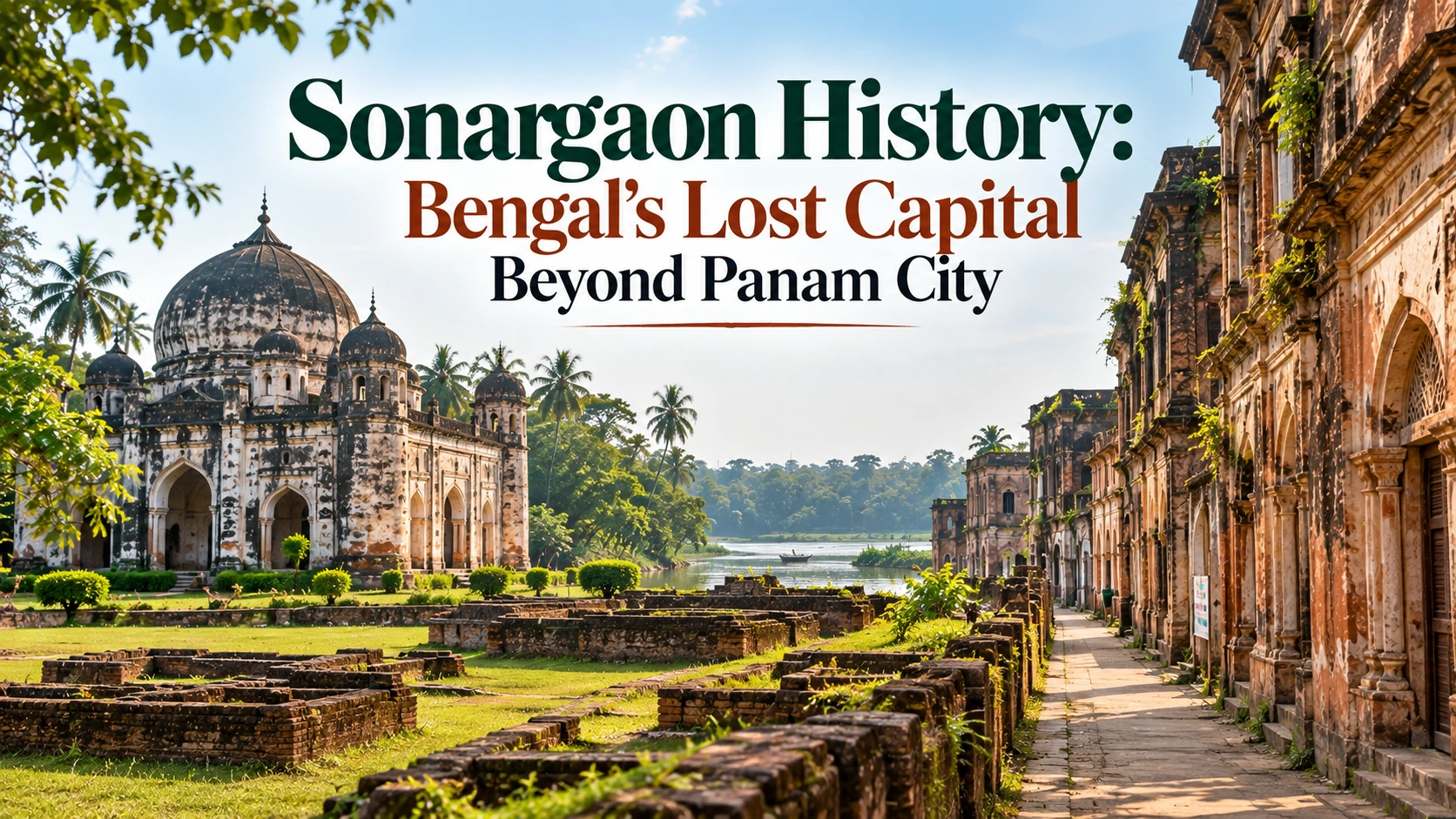
The first thing most travelers see in Sonargaon is a narrow street lined with aging merchant houses. Their faded façades, arched windows, decorative plaster and locked doorways give Panam Nagar the atmosphere of a city suddenly abandoned by time.
It is a powerful scene, but it can also create a misleading impression.
Panam Nagar is only one chapter in the much longer Sonargaon history. Centuries before those merchant residences appeared, the region had already served as a center of political authority, Islamic scholarship, river trade, textile production and resistance to Mughal expansion. Its historical landscape extended through settlements such as Mograpara, Goaldi, Panam, Khasnagar and nearby river communities.
To understand Sonargaon, visitors must look beyond one picturesque street. The real story is spread across mosques, tombs, archaeological fragments, waterways, craft traditions and living villages.
Sonargaon was not one compact city preserved behind a wall. It was a changing regional center whose importance moved between different settlements as rulers, rivers and trading systems changed.
What Is Sonargaon and Why Is It Historically Important?
Sonargaon is a historically significant region in present-day Narayanganj District, southeast of Dhaka. It served at different times as an administrative capital of eastern Bengal, a medieval mint town, a center of Islamic learning, the political base of the Baro-Bhuiyan resistance and an internationally connected textile-trading region.
The short answer
Sonargaon became important because it stood within Bengal’s river network. Its waterways connected political centers, agricultural areas, weaving communities and trade routes. From the medieval Sultanate period through the age of Isa Khan and into the colonial commercial era, Sonargaon repeatedly benefited from its strategic position.
It is often described as an ancient or former capital of Bengal. That description is broadly helpful, but it needs context. Sonargaon’s authority changed across different historical periods, and the historical region was larger than modern Panam Nagar.
Where Does Sonargaon’s Story Begin?
The early history of Sonargaon is difficult to compress into a single foundation date. The region existed within the wider political and cultural landscape of eastern Bengal long before it became a prominent Muslim administrative center.
Its name is commonly connected with Suvarnagrama, often translated as “golden village.” Historical interpretations of the name and its precise geographical application vary, so responsible historical writing should avoid presenting one romantic translation as a complete explanation.
What is clearer is that the area developed around river routes. In deltaic Bengal, waterways carried people, crops, textiles, military forces and information. A settlement with access to navigable rivers could become commercially influential even without the monumental urban form associated with capitals elsewhere.
Sonargaon was a region, not one preserved street
One of the most important facts for foreign visitors is that historical Sonargaon cannot be reduced to Panam City.
Medieval remains are scattered across several settlements. Banglapedia identifies Mograpara and the surrounding villages of Goaldi, Sadipur, Shah Chilapur and Bhagalpur as areas containing surviving traces of the medieval city. These include mosques, tombs, mounds and other archaeological evidence.
This dispersed geography explains why travelers may not encounter a single monumental archaeological zone. The historical city was shaped by waterways, settlement changes and centuries of rebuilding.
Sonargaon Under the Bengal Sultanate
Sonargaon rose to major political importance during the fourteenth century. In 1338, Fakhruddin Mubarak Shah established independent authority in eastern Bengal, with Sonargaon as his capital.
This period matters because Bengal was not merely a distant province governed from elsewhere. Regional rulers developed their own political authority, issued coins, supported institutions and maintained diplomatic and commercial connections.
Sonargaon as a capital of eastern Bengal
During the fourteenth century, Sonargaon became one of Bengal’s major political centers. It functioned alongside other important capitals and administrative cities, including Lakhnauti and Satgaon.
Rather than imagining medieval Bengal as permanently controlled from one capital, it is more accurate to understand it as a region where political authority moved among several important urban centers.
Sonargaon’s river location made it especially valuable for governing eastern Bengal. Rivers provided access to territories that would have been difficult to control overland.
Sonargaon as a mint town
Coins provide some of the strongest physical evidence of political authority. Banglapedia records that Sonargaon functioned as a mint town during the Bengal Sultanate, with rulers issuing coins bearing the city’s name or associated titles.
A mint was not simply a workshop producing currency. It represented sovereignty, administrative organization and commercial confidence. The right to strike coins allowed rulers to communicate their authority across the territories where that money circulated.
For modern visitors, these coins help reconstruct a city whose palaces and defensive structures have largely disappeared.
A center of Islamic education
Sonargaon also gained importance as a center of religious and intellectual life.
The scholar Sharfuddin Abu Tawwama is associated with a khanqah and madrasa established in the region. The institution is believed to have taught religious subjects as well as branches of secular learning.
This part of Sonargaon’s history is often overlooked because it does not leave behind a single dramatic monument. Yet the presence of a major scholar and educational institution indicates that the city was connected to wider intellectual networks across the Islamic world.
People did not arrive in medieval Sonargaon only to trade or govern. They also came to study, teach and participate in religious life.
Sonargaon, Ghiyasuddin Azam Shah and the Wider World
One of the most significant rulers connected with Sonargaon was Sultan Ghiyasuddin Azam Shah, who ruled Bengal near the end of the fourteenth and beginning of the fifteenth century.
His period is remembered for diplomacy, trade and cultural contact. Bengal’s rulers engaged with powers beyond the region, including states and courts linked through the Indian Ocean and overland diplomatic networks.
The tomb of Ghiyasuddin Azam Shah
The sultan’s tomb survives in the Sonargaon region and is one of its most historically important monuments.
Unlike the brick buildings commonly associated with medieval Bengal, the tomb is recognized for its carved stone sarcophagus. Banglapedia describes it as an important example within the architectural history of Bengal.
The monument is comparatively modest in scale. Visitors expecting a grand royal mausoleum may initially overlook it. Its importance lies less in size than in what it represents: the burial place associated with a ruler from a period when Sonargaon participated in a much larger political and cultural world.
History survives unevenly
The tomb also demonstrates a recurring feature of Sonargaon. Some of its most important historical sites do not look monumental by modern tourism standards.
Centuries of environmental change, settlement growth and material reuse have altered the landscape. Understanding such places requires context rather than spectacle.
Sonargaon’s Mosques and Sultanate Architecture
The historic mosques around Sonargaon reveal how architecture in Bengal responded to local materials, rainfall and established regional forms.
Builders relied heavily on brick because large quantities of suitable building stone were not locally available. They used thick walls, curved cornices, terracotta decoration, corner towers and carefully formed domes to create a distinctive architectural language.
Goaldi Mosque
Goaldi Mosque is one of the most important surviving monuments connected with medieval Sonargaon. An inscription dates it to 1519, during the reign of Sultan Alauddin Husain Shah.
The mosque is square and single-domed, with decorative terracotta and carved elements that reflect the mature architectural traditions of Sultanate Bengal. Its curved cornice helped manage rainwater while giving the building a recognizable regional profile.
Goaldi Mosque is particularly valuable because it links Sonargaon’s political history with the craftsmanship of its builders. Decorative panels, arches and surface details reveal a building tradition that adapted Islamic religious architecture to Bengal’s climate and materials.
The Department of Archaeology includes Goaldi Mosque among the protected archaeological sites in Sonargaon.
Fath Shah Mosque
Fath Shah Mosque at Mograpara is another significant structure. Dating from the late fifteenth century, it belongs to the wider group of religious monuments that indicate the importance of the medieval settlement.
The mosque helps visitors understand why Mograpara should not be treated as an optional addition to Panam Nagar. It preserves evidence from a substantially earlier phase of Sonargaon’s history.
Mosques as living heritage
Some historic religious sites continue to hold meaning for surrounding communities. Travelers should therefore approach them as sacred places rather than architectural exhibits.
Visitors should dress modestly, remove shoes where required and avoid entering during congregational prayer without permission. Photographing worshippers requires consent.
Respectful conduct is especially important at smaller sites where local residents, rather than a large tourism staff, may be the primary guardians of the space.
Isa Khan and the Baro-Bhuiyan Resistance
For many Bangladeshis, Sonargaon is closely connected with Isa Khan, one of the most influential regional leaders of sixteenth-century Bengal.
Isa Khan emerged as a leading figure among the Baro-Bhuiyans, a confederation of regional landholders and military leaders who resisted Mughal expansion into eastern Bengal.
Who were the Baro-Bhuiyans?
The term Baro-Bhuiyan is often translated as “twelve landholders,” but the group was not always limited to exactly twelve individuals. It referred more broadly to influential regional chiefs who controlled territories, maintained armed forces and formed alliances.
Their strength came partly from their knowledge of Bengal’s rivers and wetlands. Naval forces could move through channels that were difficult for unfamiliar armies to navigate.
Sonargaon as a center of resistance
Isa Khan’s authority extended across parts of the Bhati region, a river-dominated landscape of eastern Bengal. Sonargaon was part of this political and defensive system.
His opposition to Mughal power was not fought through one decisive land battle. It involved shifting alliances, fortified positions, war boats and control of river routes.
The story makes Sonargaon more than a former administrative capital. It became part of a regional struggle over who would control eastern Bengal.
Musa Khan and the fall of Sonargaon
After Isa Khan’s death in 1599, his son Musa Khan inherited his position and continued resisting Mughal expansion.
Banglapedia records that Musa Khan’s political territory included a considerable part of eastern Bengal and that his military strength relied heavily on war boats and fortified river positions. Banglapedia
Mughal governor Islam Khan Chishti eventually launched a coordinated campaign against the Baro-Bhuiyans. Sonargaon was handed over to Mughal forces around 1611 after Musa Khan’s position weakened.
The defeat represented more than the loss of a city. It marked a decisive change in the political organization of eastern Bengal.
Why Dhaka Replaced Sonargaon
As Mughal control expanded, Dhaka—renamed Jahangirnagar—became the principal provincial capital.
Dhaka offered strategic access to river routes and provided a stronger base for Mughal military and administrative operations. Government institutions, officials and economic activity increasingly concentrated there.
Sonargaon did not immediately vanish. It retained commercial, manufacturing and regional importance. However, its role as the central seat of political power diminished.
Capitals do not disappear overnight
The phrase “lost capital” can make Sonargaon sound as though it was suddenly abandoned. Historical change was more gradual.
Political authority shifted. River channels changed. New commercial centers became dominant. Settlements within the Sonargaon region continued to evolve.
Understanding this transition prevents the history from becoming a simple story of rise, abandonment and rediscovery. Sonargaon remained inhabited and economically active even as its political status declined.
Sonargaon and Bengal’s Muslin Trade
Sonargaon’s fame was not based only on rulers and warfare. The region was closely connected with Bengal’s textile economy, particularly the production and trade of fine cotton fabrics.
European and Asian merchants valued Bengal textiles for their softness, detailed weaving and quality. Weavers, spinners, dyers, merchants and transport workers all participated in the production network.
Muslin was a regional industry
It is misleading to imagine that every stage of muslin production took place within one urban center. Textile production depended on communities spread across a wider landscape.
Sonargaon functioned within this network as a commercial and administrative center connected to weaving areas and river transport. Goods could move through waterways toward Dhaka and international trading routes.
Jamdani as living cultural continuity
Jamdani weaving remains one of the region’s most visible cultural traditions. Although modern Jamdani production should not be presented as an unchanged survival from one specific medieval workshop, it connects present-day craftsmanship with Bengal’s long textile history.
Travelers who visit weaving communities should look beyond the finished fabric. The knowledge required to count threads, form motifs and maintain tension is acquired through sustained practice.
Responsible visits should respect working conditions, ask before photographing artisans and avoid treating production spaces as staged attractions.
Panam Nagar Is Not the Whole Medieval Capital
Panam Nagar is Sonargaon’s most photographed location, but its surviving buildings primarily represent a later commercial period.
The Department of Archaeology identifies 52 structures along the Panam street—31 on one side and 21 on the other—and notes the mixture of European and Mughal artistic influences in their architecture.
The buildings visible today are largely associated with merchant families and commercial prosperity during the nineteenth and early twentieth centuries.
Why the distinction matters
Many tourism pages describe the surviving merchant street as though its present buildings formed the medieval capital of Isa Khan. That collapses several historical periods into one visual story.
A more accurate interpretation separates:
- Medieval Sonargaon as a dispersed political and commercial region
- Sultanate-era religious and administrative sites
- The Baro-Bhuiyan period associated with Isa Khan
- Mughal-era political change
- Later colonial-period merchant architecture in Panam Nagar
Panam’s buildings may contain architectural influences from different traditions, but the street tourists photograph today should not be dated wholesale to the fourteenth-century capital.
Panam’s architectural character
The residences use features drawn from European classical, local Bengali, Mughal and colonial architectural vocabularies. Visitors can observe arched openings, decorative plasterwork, internal courtyards, balconies, ventilated rooms and ornamental façades.
The houses were built for both social status and practical urban living. Their design reflects the ambitions of wealthy commercial families rather than a preserved royal court.
For current access information, transportation, opening times and a complete itinerary, travelers should use the dedicated Panam City and Sonargaon day-trip guide. Keeping that information on the visitor page protects the historical intent of this article.
Sonargaon Architecture Is a Record of Changing Power
Sonargaon’s architectural significance comes from the coexistence of different periods.
Sultanate mosques represent medieval religious patronage and local building methods. Tombs preserve connections with rulers and scholars. Later structures reflect Mughal influence, while Panam Nagar’s merchant buildings reveal the commercial ambitions of the colonial period.
Sultanate architecture
The Sultanate buildings are commonly characterized by brick construction, curved cornices, terracotta ornament, corner towers and compact domed spaces.
These features should not be judged as smaller copies of monuments elsewhere. They reflect regional solutions developed for Bengal’s climate, materials and artistic traditions.
Mughal influence
Mughal rule introduced new administrative systems and architectural preferences, but it did not erase regional building practices. Local builders continued using brick and forms suited to Bengal.
Mughal influence can appear in spatial organization, arches, plaster decoration and later interpretations of elite architecture.
Colonial merchant architecture
Panam Nagar’s surviving residences reflect a commercial class operating under colonial economic conditions. Their façades, proportions and ornament differ from the earlier mosques and tombs scattered around Mograpara and Goaldi.
Reading these layers separately makes Sonargaon more interesting, not less. The region becomes a record of political and economic transformation rather than a single “ancient city.”
The Bangladesh Folk Art and Crafts Museum
The Bangladesh Folk Art and Crafts Foundation was established in Sonargaon through the work of artist Zainul Abedin. Its purpose is connected with preserving and presenting the country’s folk-art traditions.
The museum complex gives travelers an accessible introduction to textiles, pottery, woodwork, metal crafts, household objects and rural artistic expression.
How the museum fits the history
The museum does not recreate medieval Sonargaon. Instead, it broadens the story from rulers and monuments to the creative traditions of ordinary communities.
This distinction matters. Political history explains why Sonargaon became powerful, while craft history helps explain how knowledge and identity were transmitted across generations.
The historic Sardar Bari within the museum area adds another architectural layer to the experience. Its design belongs to a later period than the Sultanate monuments, reinforcing the need to read Sonargaon chronologically.
A detailed description of collections, opening hours and ticket procedures belongs on the museum or practical visitor page rather than this historical article.
How to Experience Sonargaon’s History Without Reducing It to a Checklist
A meaningful visit should move through historical layers rather than treating every location as an unrelated photo stop.
Begin with the wider story
Before entering Panam Nagar, understand that Sonargaon was once a regional network of settlements connected by water. The merchant street is one surviving component, not the entire historical capital.
Compare Panam with Goaldi
Panam’s merchant residences and Goaldi Mosque come from different historical contexts. Visiting both reveals how architecture changed between the Sultanate and colonial-commercial periods.
Include Mograpara when possible
Mograpara helps restore the medieval geography missing from a Panam-only visit. Tombs, mosques and archaeological traces make the political and religious history more tangible.
Look for living craftsmanship
A responsible visit to a weaving community can connect historical textile trade with present-day skilled labor. The value lies in understanding the craft, not simply purchasing a souvenir.
Return to the rivers
Sonargaon’s political and commercial importance becomes clearer when visitors see the surrounding waterways. The rivers were once transportation routes, defensive barriers and economic corridors.
Travelers who want these places interpreted as a connected story can consider Visiting Panam City and Folklore Museum. The product page should own prices, inclusions, transport and booking information; this article should remain historical.
Sonargaon’s Preservation Challenges
Sonargaon’s heritage is vulnerable because it is spread across inhabited communities rather than contained within one archaeological park.
Environmental moisture, salinity, vegetation, development pressure, traffic vibration and inappropriate repairs can damage historic structures. Encroachment can also alter the relationship between monuments and their original surroundings.
Recent reporting has raised concerns about cracks and environmental deterioration affecting Goaldi Mosque, despite its protected status. bssnews.net
Preservation involves communities
Local people live, work and worship around these monuments. Conservation decisions therefore affect homes, businesses, religious practice and land use.
A sustainable preservation approach must include residents instead of treating them as obstacles surrounding a tourism asset.
What responsible visitors can do
Travelers should avoid touching fragile plaster, climbing on structures or entering closed buildings. Drone use should follow local restrictions, and people should never be photographed without consent.
Spending with legitimate local guides, craftspeople and community businesses can also help make heritage tourism economically meaningful to the people living around the sites.
Why Sonargaon Still Matters
Sonargaon’s importance lies in the way several histories meet within one landscape.
It was associated with independent rulers of eastern Bengal, the issuing of coins, Islamic scholarship, regional resistance and the textile economy. Later, merchant communities built the Panam residences that now dominate its visual identity.
The surviving monuments are incomplete, but the historical narrative is not.
Goaldi Mosque preserves the architectural confidence of Sultanate Bengal. The tomb of Ghiyasuddin Azam Shah recalls a court connected to a wider diplomatic world. The Isa Khan story reveals the military importance of rivers. Jamdani links historical textile skill with living craftsmanship. Panam Nagar records a later period of commercial ambition and social change.
For international visitors, this layered character is precisely what makes Sonargaon rewarding. It is not a frozen medieval city or an abandoned capital preserved intact. It is a landscape in which political authority, trade, architecture and craft moved through time.
A visitor who sees only Panam’s empty houses will leave with memorable photographs. A visitor who understands the broader Sonargaon history will see how Bengal’s waterways helped build capitals, sustain resistance, carry textiles and connect communities to the wider world.
Frequently Asked Questions
What is Sonargaon famous for?
Sonargaon is famous for its role as a historic capital and administrative center of eastern Bengal, its connection with Isa Khan and the Baro-Bhuiyans, medieval mosques and tombs, textile trade, folk crafts and Panam Nagar’s later merchant architecture.
Was Sonargaon the capital of Bengal?
Sonargaon served as an important capital of eastern Bengal and was one of Bengal’s major medieval political centers. Bengal had different capitals during different periods, so it is more accurate to describe Sonargaon as a former regional and administrative capital than as the country’s only ancient capital.
Is Panam City the same as Sonargaon?
No. Panam Nagar is located within the historic Sonargaon region, but it represents only one part of the area. Historical Sonargaon also includes sites and settlements around Mograpara, Goaldi and other nearby villages.
Is Panam City a medieval city?
The Sonargaon region has a medieval history, but most of the surviving merchant houses tourists see in Panam Nagar are associated with the nineteenth and early twentieth centuries. Calling all the existing buildings medieval is historically misleading.
Who ruled Sonargaon?
Sonargaon was governed by different Hindu, Sultanate, Afghan, Baro-Bhuiyan and Mughal authorities across different periods. Fakhruddin Mubarak Shah, Ghiyasuddin Azam Shah, Isa Khan and Musa Khan are among the important figures connected with its history.
Who was Isa Khan?
Isa Khan was a powerful sixteenth-century regional leader and a leading figure among the Baro-Bhuiyans. He resisted Mughal expansion in eastern Bengal by using alliances, fortified positions and naval forces adapted to the river landscape.
What are the most important historical sites in Sonargaon?
Important sites include Panam Nagar, Goaldi Mosque, Fath Shah Mosque, the tomb associated with Ghiyasuddin Azam Shah, Mograpara’s archaeological landscape and the Folk Art and Crafts Museum complex.
Why was Sonargaon important for trade?
Its position within Bengal’s river network connected agricultural areas, weaving communities, political centers and regional markets. Sonargaon became especially associated with fine cotton textiles and the wider muslin-trading economy.
What architectural styles can be seen in Sonargaon?
Visitors can encounter Sultanate mosque architecture, regional Bengali brickwork, Mughal influences and later colonial-period merchant architecture. These styles belong to different historical periods and should not be treated as one architectural phase.
Is Sonargaon a UNESCO World Heritage Site?
No. Sonargaon and Panam Nagar are not currently inscribed as UNESCO World Heritage Sites. Avoid describing the site as UNESCO-listed unless its official status changes.
How far is Sonargaon from Dhaka?
Sonargaon is approximately 30 kilometers southeast of central Dhaka, although the actual road journey depends heavily on the starting point and traffic. Detailed transport instructions should be checked on the dedicated Sonargaon travel guide.
Can Sonargaon and Old Dhaka be explored together?
They can be combined when the itinerary is carefully planned, but it creates a long day. An Old Dhaka Tour focuses on the living heritage of the capital, while Sonargaon reveals earlier regional political, architectural and commercial history.