
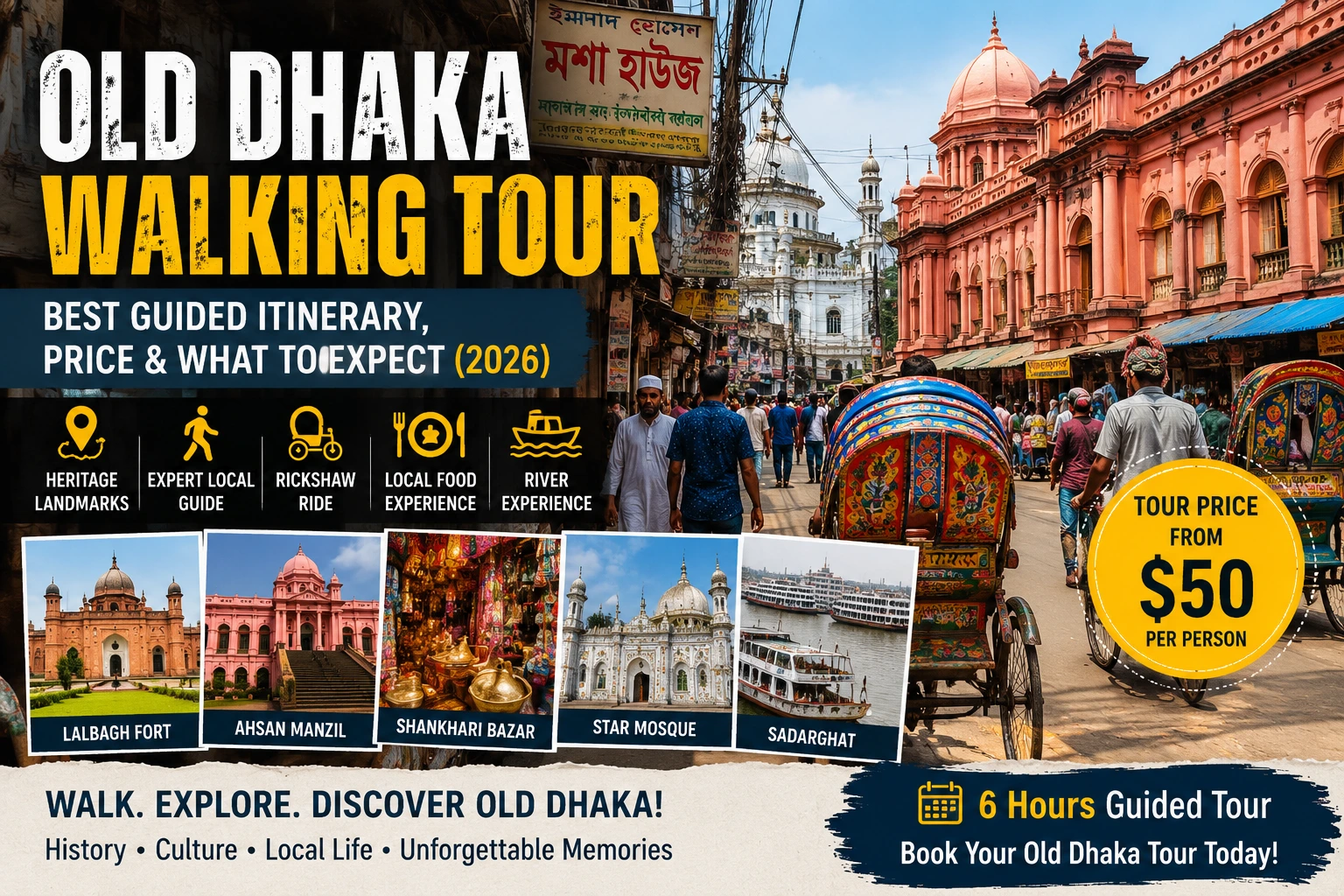
An Old Dhaka walking tour is one of the best ways to experience the historic heart of Bangladesh beyond the usual sightseeing checklist.
Old Dhaka, locally known as Puran Dhaka, is a world of narrow lanes, Mughal-era landmarks, centuries-old neighborhoods, colorful rickshaws, traditional markets, mosques, temples, historic mansions, river life, and some of the country’s most distinctive food.
But Old Dhaka can also be overwhelming for a first-time visitor.
The streets are busy. Traffic patterns are unpredictable. Major landmarks are spread across a dense urban landscape, and some of the most interesting places are hidden inside lanes that many independent travelers would never discover.
That is where a guided walking experience can make a real difference.
A well-planned Old Dhaka Walking Tour combines history, culture, local life, food, rickshaw rides, and heritage landmarks into one experience. Instead of simply moving from one attraction to another, you get the context that explains why Old Dhaka looks, feels, and functions the way it does today.
For travelers from the United States and other international destinations, this guide explains exactly what to expect, including the best places to visit, how long the tour takes, what an Old Dhaka walking tour may cost, what to wear, safety considerations, and whether booking a local guide is worth it.
Old Dhaka Walking Tour: Quick Answer
An Old Dhaka Walking Tour typically explores the historic neighborhoods and cultural landmarks of Puran Dhaka through a combination of walking, rickshaw rides, and, depending on the itinerary, local boat travel.
A good guided itinerary may include:
- Lalbagh Fort
- Dhakeshwari Temple
- Shankhari Bazar
- Star Mosque
- Armenian Church
- Ahsan Manzil
- Sadarghat
- Buriganga River
- Local markets
- Traditional food stops
- Historic streets and hidden neighborhoods
Most guided experiences take between four and eight hours, depending on the route and how much time is spent at each location.
The Old Dhaka walking tour price can vary significantly based on whether the experience is private, the number of travelers, the duration, transportation, food, entrance fees, and additional activities.
For travelers looking for a more complete cultural experience rather than simply walking around independently, a local guide can help turn a busy and unfamiliar part of Dhaka into a much more meaningful journey.
Why Take an Old Dhaka Walking Tour?
Old Dhaka is not a place that reveals everything immediately.
You can visit Lalbagh Fort independently. You can find Ahsan Manzil on a map. You can walk through a market without a guide.
But the experience becomes very different when someone explains the stories connecting these places.
An Old Dhaka Walking Tour helps you understand how Mughal rulers, merchants, artisans, religious communities, colonial influences, river trade, and modern urban life shaped the city.
You are not simply seeing buildings.
You are seeing the layers of history that created modern Dhaka.
Walking also allows you to experience details that are easy to miss from inside a private vehicle.
You may notice:
- Traditional workshops
- Small neighborhood mosques
- Historic architecture
- Local markets
- Artisan communities
- Food preparation
- Rickshaw-filled streets
- Family-run businesses
- Everyday life inside centuries-old neighborhoods
That is the real advantage of exploring Old Dhaka slowly.
What Is the Best Old Dhaka Walking Tour Itinerary?
The best itinerary should balance famous landmarks with the parts of Old Dhaka that give the city its personality.
Trying to visit every attraction in one day can turn the experience into a checklist.
A better approach is to combine major historical sites with local streets, markets, transportation, food, and time to actually observe what is happening around you.
Here is an ideal guided itinerary.
Start With Lalbagh Fort
Lalbagh Fort is one of the most recognizable landmarks in Dhaka and an excellent starting point for understanding the Mughal history of the city.
The unfinished 17th-century complex remains one of the most important historical sites in Bangladesh.
Walking through the grounds gives visitors a contrast to the intensity of the surrounding city.
The fort also creates a useful historical starting point for understanding Old Dhaka.
From here, a guide can explain how Dhaka developed as an important center during the Mughal period and how political and commercial power influenced the city’s architecture and neighborhoods.
For many travelers, Lalbagh Fort is the first major stop that transforms the tour from a simple walk into a historical experience.
Visit Dhakeshwari Temple
Dhakeshwari Temple represents another important layer of Dhaka’s cultural identity.
Bangladesh is often understood internationally through a narrow perspective, but Old Dhaka reveals a much more complex historical and religious landscape.
A visit to Dhakeshwari Temple can help travelers understand the Hindu heritage of the region and the long history of religious communities that have shaped the city.
The temple also provides an important contrast to the mosques, churches, markets, and Mughal monuments found elsewhere on the route.
For a traveler interested in culture rather than simply architecture, these contrasts make the experience much richer.
Walk Through the Historic Streets of Old Dhaka
This is where the Old Dhaka Walking Tour becomes different from a standard city sightseeing trip.
The route between major landmarks matters.
Walking through Old Dhaka means moving through streets where daily life continues alongside centuries of history.
You may pass:
- Traditional shops
- Small workshops
- Residential neighborhoods
- Local markets
- Religious sites
- Street-food vendors
- Rickshaw garages
- Old merchant buildings
The atmosphere can change dramatically from one street to another.
A wide and crowded commercial road may suddenly lead into a narrow alley where families and artisans have lived for generations.
These are often the moments travelers remember most.
Explore Shankhari Bazar
Shankhari Bazar is one of the most distinctive areas of Old Dhaka.
The narrow historic lane is closely associated with the Hindu artisan community known for traditional conch-shell craftsmanship.
The area is visually striking, culturally significant, and completely different from the modern image many visitors have of Dhaka.
Walking through Shankhari Bazar gives travelers an opportunity to observe a neighborhood where cultural traditions remain closely connected to everyday life.
The architecture, workshops, temples, shops, and narrow streets all contribute to the experience.
This is also one of the strongest places for travelers who enjoy documentary photography and street photography.
However, this article focuses on the guided experience itself rather than treating Old Dhaka as a self-guided photography destination.
A knowledgeable guide can help visitors understand the cultural context of what they are seeing while encouraging respectful behavior in residential and religious areas.
Visit Star Mosque
Star Mosque, also known as Tara Masjid, is one of the most visually distinctive religious buildings in Old Dhaka.
The mosque is particularly known for its decorative design and detailed ornamentation.
A guided visit can provide historical context while helping international travelers understand appropriate etiquette when visiting an active religious site.
It is also an important example of why Old Dhaka should not be reduced to one historical period.
Mughal, colonial, religious, commercial, and local influences all exist within a relatively compact area.
The more you walk, the more visible these layers become.
Discover the Armenian Church
The Armenian Church is another reminder of Old Dhaka’s international past.
It represents the presence of an Armenian merchant community that once played an important role in regional trade.
For many visitors, the church is surprising.
It does not fit the simplified image of what they expect to find in Bangladesh.
That surprise is part of the appeal of an Old Dhaka heritage tour.
The city’s history is more diverse and internationally connected than many first-time visitors realize.
Experience the Streets Between the Landmarks
A good guided walking itinerary should not rush continuously from one famous attraction to the next.
Some of the most interesting experiences happen in between.
You may stop to watch:
- Rickshaws navigating narrow streets
- Street vendors preparing food
- Craftsmen working
- Local shoppers
- Small markets
- Historic buildings hidden behind newer structures
This is where local knowledge becomes valuable.
A guide can identify places that might otherwise look ordinary to an international visitor.
The goal is not to turn every street into a tourist attraction.
It is to understand the living city.
Old Dhaka is not a museum.
People live, work, pray, trade, eat, and travel here every day.
See Ahsan Manzil, the Pink Palace
Ahsan Manzil is one of the most recognizable landmarks along the Old Dhaka heritage route.
Often referred to as the Pink Palace, the building reflects an important chapter in the history of Dhaka and Bengal.
Its location near the Buriganga River also helps explain the importance of waterways in the development of the city.
A visit here works particularly well after walking through the denser inner neighborhoods.
The transition from narrow lanes to the larger architectural presence of Ahsan Manzil creates a strong visual contrast.
For history lovers, this is usually one of the essential stops on an Old Dhaka guided tour.
Experience Sadarghat and the Buriganga River
No exploration of Old Dhaka feels complete without experiencing the river.
Sadarghat is one of the most energetic parts of the city.
The movement of passengers, boats, ferries, traders, workers, and local transport creates a completely different atmosphere from the historic streets further inland.
A short boat experience can provide another perspective on Dhaka.
From the water, you can observe:
- River transport
- Launch terminals
- Traditional boats
- Commercial activity
- The city skyline
- Everyday life along the riverbanks
For international travelers, this can be one of the most visually memorable parts of the day.
It also explains why Dhaka’s history cannot be separated from its waterways.
The river was not simply part of the landscape.
It was part of the city’s economic and social development.
Add a Rickshaw Ride to the Experience
You may walk much of Old Dhaka, but a complete experience does not necessarily mean walking every kilometer.
Rickshaws are an important part of the city’s visual and cultural identity.
Using local transportation can help connect different parts of the itinerary while also becoming part of the experience itself.
A rickshaw ride through narrow streets is very different from traveling through Dhaka in an air-conditioned vehicle.
You are closer to the sounds, movement, and everyday life around you.
For many visitors, the ride itself becomes one of the highlights of the tour.
What Food Should You Expect on an Old Dhaka Walking Tour?
Food is an important part of Old Dhaka’s cultural identity.
Depending on the itinerary, travelers may have the opportunity to try:
- Biryani
- Bakarkhani
- Kebabs
- Fuchka
- Chotpoti
- Traditional Bangladeshi sweets
- Lacchi
- Tea
- Seasonal snacks
A guided walking experience does not need to become a dedicated food tour to include meaningful culinary stops.
Even one traditional lunch or a few carefully selected snacks can help travelers understand another side of Dhaka.
Food often provides a natural break between sightseeing and walking.
It also gives travelers an opportunity to experience places where local people eat every day.
Those who want food to be the main focus of their visit may prefer a dedicated Dhaka Food Tour, while travelers looking for a broader combination of history, heritage, culture, local life, and food may find an Old Dhaka walking experience more suitable.
How Much Does an Old Dhaka Walking Tour Cost?
The Old Dhaka walking tour price depends on several factors.
These include:
- Tour duration
- Private or shared experience
- Number of travelers
- Transportation
- Entrance fees
- Food and drinks
- Hotel pickup and drop-off
- Rickshaw rides
- Boat rides
- English-speaking guide
- Customization
In the current market, guided Old Dhaka experiences can range from budget-friendly group or short private options to more comprehensive full-day private tours.
A shorter or simpler experience may cost less, while a private tour with transportation, food, entrance fees, rickshaw travel, and river activities will generally cost more.
For Bangladesh Explore, the key advantage is value transparency.
The listed Old Dhaka Tour starts from $50 and includes a structured cultural experience with an English-speaking guide and several important inclusions.
However, travelers should always confirm the current price, availability, itinerary, and any special requirements before booking because tour rates can change based on group size and customization.
What Should Be Included in the Price?
Before comparing one Old Dhaka guided tour with another, look beyond the headline price.
A lower-priced tour may not include transportation, entrance tickets, food, or local activities.
A more comprehensive package may initially appear more expensive but offer better overall value.
Ideally, check whether the price includes:
- Professional English-speaking guide
- Transportation
- Hotel pickup
- Entrance fees
- Rickshaw rides
- Boat rides
- Lunch or food tastings
- Bottled water
- Snacks
- Taxes or service charges
For first-time visitors, an all-inclusive structure can also reduce the stress of managing multiple small payments during the day.
Is an Old Dhaka Walking Tour Worth It?
Short Answer: Yes, Especially for First-Time Visitors
You can certainly explore parts of Old Dhaka independently.
However, navigating the area alone can require significant planning.
The streets are dense, some attractions are difficult to connect efficiently, and important historical context is not always obvious.
The value of a guided experience comes from more than transportation.
You are paying for:
- Local knowledge
- Historical interpretation
- Route planning
- Cultural context
- Language support
- Time efficiency
- Easier navigation
- Local recommendations
- Access to stories and details you may otherwise miss
For travelers visiting Dhaka for only a few days, this can make a guided experience particularly valuable.
Instead of spending hours trying to design the perfect route, you can focus on actually experiencing the city.
How Long Is an Old Dhaka Walking Tour?
The ideal duration depends on your interests.
Half-Day Experience: 3 to 5 Hours
A shorter tour is suitable for travelers who want to focus on a few major landmarks and selected historic streets.
This option works well if you have limited time in Dhaka.
Standard Guided Experience: 5 to 7 Hours
This is often the best balance for first-time visitors.
You have enough time to combine:
- Walking
- Heritage landmarks
- Local transportation
- Food
- Cultural neighborhoods
- A river experience
Full-Day Experience: 7 to 9 Hours
A longer itinerary allows for a more relaxed pace and additional attractions.
It may also include areas outside the traditional Old Dhaka core.
For travelers who want a shorter introduction to the capital, a Half-Day Tour Dhaka may be the better choice.
Is Old Dhaka Safe for American and International Tourists?
Old Dhaka is busy, crowded, and sometimes chaotic, which can feel intimidating to first-time visitors.
However, the main challenge for most tourists is navigation and unfamiliarity rather than the idea that the area should automatically be avoided.
A local guide can help visitors move through busy areas more comfortably.
Travelers should still follow common travel precautions.
Practical Safety Tips
- Keep valuables secure.
- Avoid displaying large amounts of cash.
- Stay aware of traffic and rickshaws.
- Follow your guide in crowded areas.
- Wear comfortable shoes.
- Carry bottled water.
- Dress respectfully when visiting religious sites.
- Ask before photographing people in sensitive or private situations.
- Keep your phone and camera secure in crowded locations.
The best approach is not fear.
It is awareness and preparation.
A guided tour can make the first experience significantly easier, particularly for travelers unfamiliar with Dhaka’s transportation and street layout.
What Should You Wear on an Old Dhaka Walking Tour?
Comfort matters.
You may spend several hours walking, standing, entering historical sites, riding rickshaws, and moving through crowded streets.
Good choices include:
- Lightweight clothing
- Comfortable walking shoes
- Breathable fabrics
- Sun protection
- A hat when appropriate
- A light layer during cooler months
When visiting mosques, temples, and other religious sites, respectful clothing is recommended.
You do not need to dress formally, but modest clothing is generally appropriate.
Avoid wearing expensive jewelry or carrying unnecessary valuables during a long day of sightseeing.
Best Time of Year for an Old Dhaka Walking Tour
For many international travelers, the cooler and drier months are generally the most comfortable for extended walking.
Dhaka’s weather can be hot and humid, particularly during warmer periods.
The best time of day also depends on your preferred experience.
Morning
Best for:
- Cooler temperatures
- Historical sightseeing
- Markets beginning their daily activity
- Photography
Afternoon
Best for:
- Combining heritage and food
- Exploring local neighborhoods
- A flexible half-day itinerary
Late Afternoon
Best for:
- Street life
- Food
- Changing light
- A more energetic atmosphere
Traffic conditions should also be considered when planning pickup and return times.
Dhaka is a major city, and travel between neighborhoods can take longer than the distance on a map suggests.
A Sample Old Dhaka Walking Tour Itinerary
Here is an example of how a well-balanced guided day could work.
9:00 AM – Hotel Pickup and Introduction
Meet your English-speaking guide and discuss the day’s route, interests, and any special requirements.
9:30 AM – Lalbagh Fort
Begin with Mughal history and explore one of Dhaka’s best-known heritage landmarks.
10:30 AM – Dhakeshwari Temple
Learn about the religious and cultural diversity that has shaped Dhaka.
11:15 AM – Walk Through Historic Streets
Explore Old Dhaka’s lanes, markets, workshops, and everyday street life.
12:00 PM – Shankhari Bazar
Discover one of the city’s most distinctive heritage neighborhoods.
1:00 PM – Traditional Lunch
Take a break and experience authentic Bangladeshi food.
2:00 PM – Star Mosque and Historic Architecture
Continue exploring religious and architectural heritage.
2:45 PM – Armenian Church
Learn about Dhaka’s historical connection with international trade and merchant communities.
3:30 PM – Ahsan Manzil
Visit the famous Pink Palace and explore another important chapter of Dhaka’s history.
4:30 PM – Sadarghat and Buriganga River
Experience one of the busiest and most visually dynamic parts of Old Dhaka.
5:00 PM – Rickshaw or Boat Experience
Finish the cultural journey with a different perspective on the city.
This itinerary can be adjusted depending on traffic, opening schedules, weather, traveler interests, and the pace of the group.
Guided Tour vs. Exploring Old Dhaka on Your Own
Both options have advantages.
Self-Guided Exploration May Be Better If You:
- Have plenty of time in Dhaka
- Enjoy navigating independently
- Are comfortable with unfamiliar transportation
- Prefer complete flexibility
- Want to focus primarily on photography
A Guided Old Dhaka Tour May Be Better If You:
- Are visiting Dhaka for the first time
- Have limited time
- Want historical explanations
- Prefer a planned route
- Want help navigating busy streets
- Are interested in hidden local experiences
- Want to combine food, heritage, transportation, and culture
- Prefer an English-speaking local guide
For most first-time international visitors, the second option provides a more efficient introduction to the city.
Why Choose a Local Guide for Old Dhaka?
A local guide does not simply know where the landmarks are.
The real value comes from understanding the relationships between them.
Why is one neighborhood associated with a particular community?
Why did trade develop around the river?
Why does a street have a particular name?
Why is a small building historically important?
Why do local people eat certain foods in certain areas?
These details turn sightseeing into interpretation.
A good guide should also adapt the experience to the traveler.
A history enthusiast may want more time at heritage sites.
A photographer may want to slow down in visually interesting streets.
A food lover may want to include more culinary stops.
A family may prefer a more comfortable pace.
This flexibility is one of the biggest advantages of booking a private or professionally guided experience.
Old Dhaka Walking Tour for US Travelers
Travelers visiting Bangladesh from the United States should prepare for an environment that may feel very different from major American cities.
That difference is part of the experience.
Old Dhaka is dense, energetic, loud, historic, and deeply human.
You are unlikely to find perfectly organized pedestrian routes or a tourist infrastructure designed around every international expectation.
Instead, you encounter a working historic city.
Before booking, consider:
Walking Conditions
Sidewalks and roads can be uneven and crowded. Comfortable shoes are essential.
Weather
Dhaka can be hot and humid. Carry water and dress appropriately.
Traffic
Travel time can be unpredictable. Avoid planning an important flight or appointment immediately after the tour.
Cash
Keep some Bangladeshi Taka available for personal purchases, even if major tour costs are prepaid.
Cultural Etiquette
Dress respectfully and follow guidance when entering religious or residential spaces.
Photography
Always use good judgment. Some people may not want to be photographed, and certain locations may have restrictions.
These small preparations can make your Old Dhaka experience much more comfortable.
What Makes Old Dhaka Different From the Rest of Dhaka?
Modern Dhaka is a rapidly developing megacity.
Old Dhaka feels different.
The pace is still fast, but the visual environment contains deeper layers of history.
You can move from a Mughal fort to a historic market, from a Hindu neighborhood to a mosque, from a colonial-era church to a river terminal, all within the wider fabric of the old city.
That concentration of history is what makes an Old Dhaka Walking Tour unique.
It is also why Old Dhaka should be experienced slowly.
You do not need to rush.
The most memorable moment may not be the famous monument.
It might be a conversation, a food stall, a rickshaw ride, an old workshop, or simply watching the city move around you.
How to Get the Best Value From an Old Dhaka Walking Tour
Before booking, ask these questions:
- How long is the tour?
- Is the experience private or shared?
- Is hotel pickup included?
- Are entrance fees included?
- Will I walk the entire route?
- Are rickshaw rides included?
- Is a boat ride included?
- Is lunch or food included?
- Is the guide fluent in English?
- Can the itinerary be customized?
- What happens if weather or traffic affects the route?
- Are there additional charges?
The best value is not necessarily the cheapest option.
A tour that includes transportation, entrance fees, food, local activities, and an experienced guide may provide better overall value than a cheaper experience with multiple additional costs.
Extend Your Bangladesh Experience Beyond Old Dhaka
Old Dhaka is an excellent introduction to Bangladesh, but it is only one part of the country.
Travelers with more time can continue their journey into Bangladesh’s tea country, heritage destinations, mangrove forests, archaeological sites, and rural landscapes.
After exploring the capital, you may want to consider a Sreemangal and Sylhet Tour for tea gardens and natural landscapes, a Sundarbans and Bagerhat Tour for wildlife and heritage, or a World Heritage and Historical Places Tours experience for a broader journey through Bangladesh’s history.
For travelers interested in combining Dhaka with the country’s former capital and historic merchant settlements, an Old Dhaka and Sonargao Tour can provide a deeper look at the evolution of Bengal’s urban and cultural history.
Choosing the right itinerary depends on how much time you have and what type of Bangladesh experience you want.
Is an Old Dhaka Walking Tour Worth Booking in 2026?
For travelers who want to see more than a list of famous landmarks, the answer is yes.
An Old Dhaka Walking Tour provides something that maps and guidebooks cannot easily deliver.
Context.
You understand why places matter.
You move through neighborhoods with greater confidence.
You discover streets and stories that may not appear in standard itineraries.
You can combine heritage, food, local transportation, architecture, religion, river life, and everyday culture into one experience.
For a first-time visitor to Bangladesh, Old Dhaka can initially feel intense.
But with the right guide and itinerary, that intensity becomes one of the destination’s greatest strengths.
The streets are crowded because people live and work there.
The markets are noisy because commerce is still happening.
The river is busy because it remains part of the city’s daily life.
And the historic buildings are meaningful because they are part of a much larger story about how Dhaka became the city it is today.
That is what makes a guided walking experience worthwhile.
You are not simply walking through Old Dhaka.
You are learning how to read the city.
FAQ
How much does an Old Dhaka Walking Tour cost?
The Old Dhaka walking tour price varies depending on the duration, group size, whether the experience is private, and what is included. Costs can range from budget-friendly shorter tours to higher-priced private and full-day experiences. Check the latest price, group-size rate, and inclusions before booking.
How long is an Old Dhaka Walking Tour?
Most guided Old Dhaka experiences take between four and eight hours. A half-day itinerary is suitable for travelers with limited time, while a full-day tour allows for a more relaxed pace and additional cultural experiences.
What places are included in an Old Dhaka Walking Tour?
A typical itinerary may include Lalbagh Fort, Dhakeshwari Temple, Shankhari Bazar, Star Mosque, Armenian Church, Ahsan Manzil, Sadarghat, the Buriganga River, local markets, and traditional food stops.
Is Old Dhaka safe for tourists?
Old Dhaka is busy and crowded, so travelers should follow normal safety precautions. Keeping valuables secure, staying aware of traffic, dressing respectfully, and using a knowledgeable local guide can help make the experience more comfortable.
Can you walk around Old Dhaka?
Yes, but not every part of the itinerary needs to be completed on foot. A good Old Dhaka walking tour may combine walking with rickshaw rides, local transportation, and sometimes a short boat experience.
What should I wear for an Old Dhaka Walking Tour?
Wear lightweight and comfortable clothing with good walking shoes. Modest clothing is recommended when visiting religious sites. A hat, sun protection, and a light layer during cooler months can also be useful.
What is the best time to visit Old Dhaka?
The cooler and drier months are generally more comfortable for walking. Morning and late afternoon can also provide more comfortable temperatures and interesting street activity.
Is an Old Dhaka guided tour worth it?
For first-time visitors, a guided tour can be highly valuable because it provides local knowledge, route planning, cultural context, historical explanations, language support, and easier navigation through busy areas.
Does an Old Dhaka Walking Tour include food?
Some guided experiences include traditional lunch, snacks, or food tastings, while others focus primarily on history and sightseeing. Always check the specific itinerary before booking.
Can I take photographs during an Old Dhaka Walking Tour?
Yes, Old Dhaka offers many interesting photography opportunities. However, travelers should respect local people, religious sites, private spaces, and any photography restrictions.
Is Old Dhaka suitable for American travelers?
Yes. Old Dhaka can be an exciting cultural experience for American travelers, particularly those interested in history, local life, architecture, food, and photography. First-time visitors may find a guided experience more comfortable and efficient.
Should I book an Old Dhaka Walking Tour in advance?
Booking in advance is recommended if you want a specific date, a private guide, a customized itinerary, or hotel pickup. Advance booking also gives you time to discuss dietary needs, accessibility concerns, and personal interests.