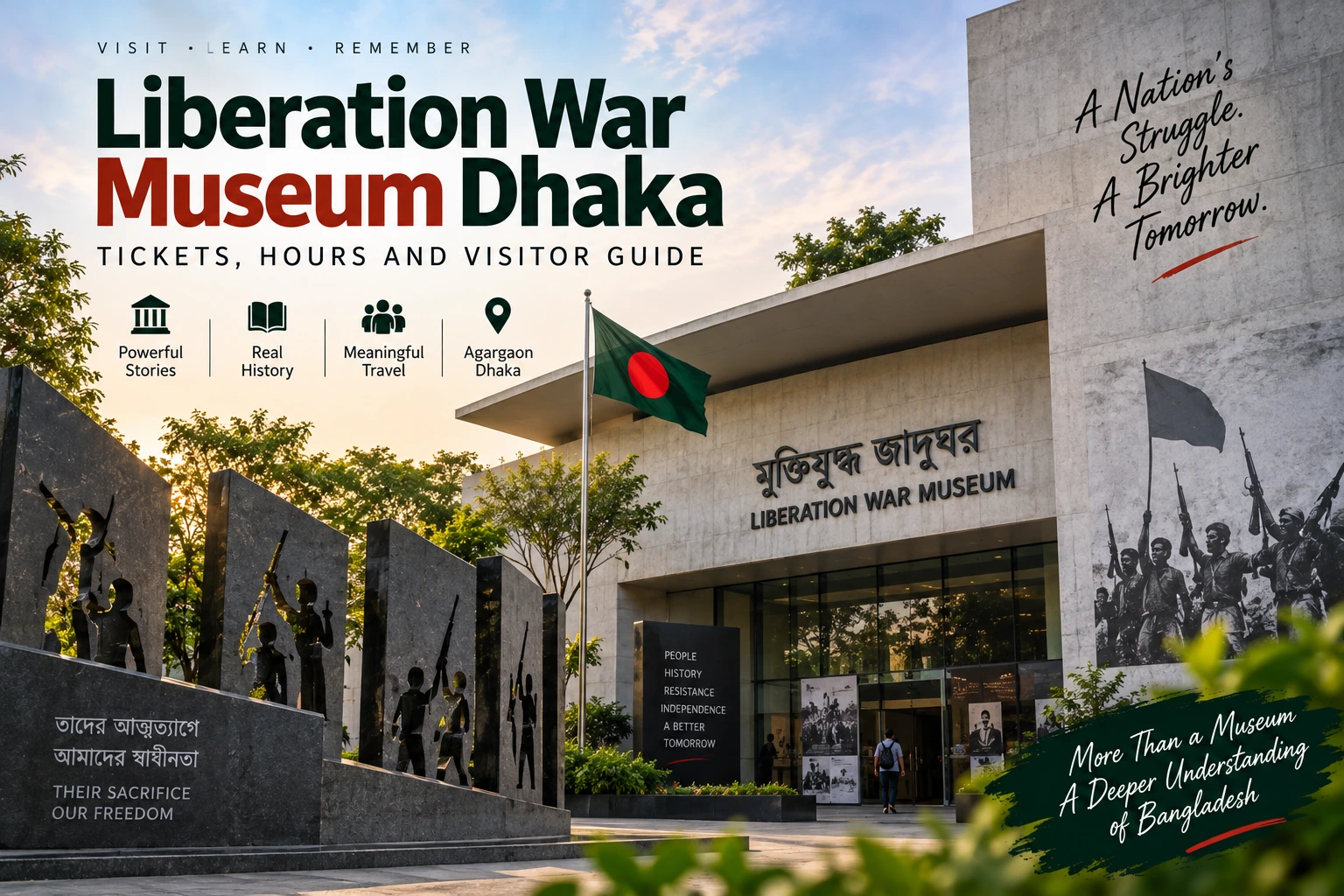
The Liberation War Museum Dhaka is one of the capital’s most important places for understanding how Bangladesh emerged as an independent country in 1971. Known in Bangla as Muktijuddho Jadughar, the museum preserves documents, photographs, personal possessions, testimony and material evidence connected with the Liberation War.
For visitors from the United States and other international markets, this is not simply another stop on a sightseeing list. It is a national memory institution. The galleries explain political events, resistance, displacement, mass violence, international involvement and the human cost of the war through objects and individual stories. Some material is emotionally difficult, so a thoughtful visit deserves both time and sensitivity.
This independent visitor guide covers the museum’s official address, current ticket prices, opening hours, transport, expected visit length, accessibility questions, photography etiquette and nearby Agargaon attractions. Operational details were checked against the museum’s official website on September 5, 2026, but travelers should verify them again before departure because schedules and policies can change.
Quick Answer: Is the Liberation War Museum Worth Visiting?
Yes. The Liberation War Museum is worth visiting for international travelers who want meaningful context for modern Bangladesh. It is especially valuable before visiting national memorials, historic sites or communities elsewhere in the country because it gives names, chronology and human stories to events that continue to shape Bangladeshi identity.
Allow two to three hours for a considered first visit. A quick 60-minute walk-through is possible, but it will leave little time to read documents, follow the chronology or pause after the more distressing displays. The museum is in Agargaon, not Old Dhaka, and the official e-ticket page currently lists Sunday as the weekly closing day.
Liberation War Museum Dhaka Visitor Information
Essential Details at a Glance
- Official name: Liberation War Museum
- Bangla name: Muktijuddho Jadughar
- Address: Plot F11/A and F11/B, Sher-e-Bangla Nagar Civic Centre, Agargaon, Dhaka, Bangladesh
- Regular hours listed by the museum: 10:00 AM to 5:00 PM
- Ramadan hours listed by the museum: 10:00 AM to 4:00 PM
- Weekly closing day: Sunday
- Foreign visitor ticket: BDT 500 plus the stated online service charge
- Recommended visit time: Two to three hours
- Best time of day: Soon after opening on a weekday
- Official website: liberationwarmuseumbd.org
These facts are a planning snapshot verified on September 5, 2026. Check the museum’s official e-ticket page on the day before visiting, particularly around Ramadan, Eid, public holidays, national observances or special programs.
Liberation War Museum Tickets
The official e-ticket portal displayed the following Liberation War Museum tickets when this guide was researched:
- Foreign visitor: BDT 500
- SAARC visitor: BDT 50
- Bangladeshi adult: BDT 50
- Bangladeshi child: BDT 20
- Online service charge: 4%
For a traveler from the United States, the applicable category is normally “Foreign Visitor.” Carry a passport copy or another form of identification in case staff need to confirm the ticket category, but avoid handing over an original passport unless an authorized official requires it.
The official portal asks for a name and phone number or email before purchase. If an international phone number causes difficulty, contact the museum or ask a hotel or local operator for assistance. Save the confirmation offline because mobile data can be inconsistent at exactly the wrong moment.
Prices found on older travel blogs, review sites and map listings are often obsolete. Some still quote the former premises, earlier hours or tickets costing only a fraction of the official 2026 foreign-visitor rate. Use the museum’s own e-ticket page as the primary source rather than a cached search result.
Liberation War Museum Opening Hours
The museum’s official site lists:
- March through September: 10:00 AM to 5:00 PM
- October through February: 10:00 AM to 5:00 PM
- Ramadan: 10:00 AM to 4:00 PM
- Weekend or weekly closure: Sunday
In practical terms, the regular schedule is 10:00 AM–5:00 PM throughout the year, with a shorter closing time during Ramadan. “Weekend: Sunday” on the official site means Sunday is the closing day; it should not be interpreted as a special weekend opening schedule.
Do not plan to enter just before closing. Ticketing, security screening and gallery access may stop earlier than the building’s published closing time. Arriving between 10:00 and 10:30 AM usually gives a calmer start and leaves room for a nearby attraction afterward.
What Is the Liberation War Museum?
The Liberation War Museum is a citizen-founded institution dedicated to preserving the memory and material record of Bangladesh’s struggle for democratic and national rights and the 1971 Liberation War. It opened on March 22, 1996, originally operating from a house in Segunbagicha. The purpose-built Agargaon complex was inaugurated on April 16, 2017.
The official museum overview reported more than 21,000 items in its archive as of August 2016, with only part of the collection displayed. That distinction matters: visitors see a curated narrative, while the institution also functions as an archive, education center and venue for research and public programs.
Why the Museum Matters
Bangladesh’s Liberation War is not distant history to many families. Personal loss, migration, resistance and survival remain part of living memory. The museum brings national events down to a human scale through letters, household items, photographs, newspaper reports, oral histories and possessions donated by individuals and families.
For a foreign visitor, the museum also explains references encountered across Bangladesh: the Language Movement, the Six-Point demand, the 1970 election, the March 1971 crackdown, the Mukti Bahini, the refugee crisis, mass killings, international solidarity and Victory Day on December 16.
This article intentionally gives only the context required to understand the visit. Bangladesh Explore’s broader Independence Day and Victory Day articles should remain the main resources for national-history and commemoration searches. This page owns the practical attraction intent: where the museum is, what it contains, how much it costs and how to visit responsibly.
From Segunbagicha to Agargaon
Travelers sometimes encounter two locations in old guidebooks. The original museum operated in Segunbagicha, but the current permanent museum is at Sher-e-Bangla Nagar Civic Centre in Agargaon. The larger complex provides substantially more gallery and program space; reporting at its opening described approximately 3,500 square meters of gallery area.
Use the full Agargaon address in a map app and check that the pin says Liberation War Museum or Muktijuddho Jadughar. If a driver recognizes only the Bangla name, pronounce it roughly as “Mook-ti-jud-dho Ja-du-ghor.”
What to See Inside Muktijuddho Jadughar
The permanent displays use objects, text, images and audiovisual material to build a chronological and thematic account. Exhibits can rotate, and rooms may close temporarily, so this is a guide to the core experience rather than a guaranteed object-by-object inventory.
The Road to 1971
The opening sections establish why the conflict occurred. They connect the end of British colonial rule and the creation of Pakistan with the political, economic and linguistic inequalities experienced in East Pakistan. The Language Movement of 1952 is important because language became inseparable from cultural rights and political representation.
Read this section instead of rushing directly to the war galleries. Without it, international visitors may understand the violence but miss the decades of political struggle that preceded it. Look for maps, newspaper extracts, campaign material and photographs that show how public movements developed.
Political Crisis and Operation Searchlight
The narrative then moves toward the 1970 election, the transfer-of-power crisis, the civil-disobedience movement and the military crackdown that began on the night of March 25, 1971. Displays may include testimony and evidence relating to attacks on civilians, students, intellectuals and minority communities.
The material is presented from a Bangladeshi national-memory perspective. Visitors who want to study competing historiographies should use the museum as a primary cultural institution, read its labels carefully, and then consult scholarly sources from multiple archives. A respectful traveler can recognize the museum’s commemorative purpose while continuing wider research.
Resistance, the Mukti Bahini and Everyday Life
Objects connected with freedom fighters make the conflict tangible. Equipment, clothing, communications, documents and personal belongings show that a liberation struggle is experienced not only through military strategy but also through uncertainty, improvisation and sacrifice.
Pay attention to ordinary objects. A letter, notebook or damaged possession can communicate more than a large weapon because it restores individuality to a history often summarized in numbers. Where labels provide donor names or provenance, read them; provenance is part of the object’s meaning.
Refugees, International Response and Solidarity
The conflict displaced millions of people, many of whom crossed into India. Photographs and records address the humanitarian emergency, foreign reporting, diplomatic responses and solidarity campaigns. This section can help U.S. visitors connect the museum to debates within American government, media and civil society during 1971.
Avoid reducing the international story to a simple list of governments. Journalists, aid workers, artists, activists and members of diaspora communities also influenced how the crisis was understood abroad.
Victory, Loss and the Birth of Bangladesh
The final movement of the permanent narrative addresses the December war, surrender on December 16 and the emergence of Bangladesh. Yet the museum does not treat independence as an uncomplicated ending. Evidence of killing, the targeting of intellectuals, missing family members and destroyed communities keeps the cost of victory visible.
Give yourself a few quiet minutes before leaving. Moving immediately from atrocity-related exhibits into a rushed selfie or loud phone call can feel jarring both to other visitors and to the meaning of the institution.
Emotional Content and Suitability for Children
The Liberation War Museum includes evidence of mass violence and human suffering. Visitors may encounter photographs of victims, descriptions of torture and killing, personal effects of people who died, and human remains recovered from mass graves. This content can be upsetting.
What Sensitive Visitors Should Know
If you are sensitive to graphic material, ask staff which galleries or cases contain the most difficult content. Move at your own pace, step into a quieter transition space when needed, and do not feel obliged to examine every image closely.
People with personal experience of war, forced migration or bereavement may find particular sections emotionally intense. Visiting with a trusted companion can help. The museum’s seriousness is part of its value, but self-care and respectful distance are legitimate.
Is the Museum Suitable for Children?
Older children and teenagers studying history may find the museum educational when an adult prepares them beforehand and discusses the visit afterward. For younger children, the most graphic content may be inappropriate. Age alone is not the only factor; maturity, prior knowledge and sensitivity matter.
Parents should avoid presenting the museum as entertainment. Explain that it remembers real people and that voices should remain low. Ask staff about an age-appropriate route and be willing to skip displays. A shorter, carefully guided visit is better than forcing a child through material they are not ready to process.
How Long to Spend at the Liberation War Museum
Most foreign visitors should plan two to three hours. That is enough to follow the narrative, read selected labels and pause at significant objects without trying to absorb everything.
A One-Hour Focused Visit
If time is limited, begin with the introductory timeline, follow the main chronological route, select a few personal stories, and reserve ten minutes for the final galleries. Do not attempt to read every label. A one-hour visit provides orientation, not a comprehensive understanding.
A Two- to Three-Hour Visit
This is the best choice for first-time visitors. Read the political background, spend time with original documents and testimony, and take a short pause midway. Travelers who enjoy museums, oral history or archival material may need longer.
A Research-Oriented Visit
Researchers should contact the museum before arriving. Exhibition access does not automatically include archival or library access, and collections may require appointments or permissions. State your institution, topic, dates and language needs clearly. Do not assume that material can be photographed or reproduced for publication.
How to Get to the Liberation War Museum
The museum is in Agargaon within the Sher-e-Bangla Nagar civic district. Dhaka traffic is highly variable, so distance alone is a poor predictor of travel time.
By Dhaka Metro
Agargaon station on MRT Line 6 is the most useful mass-transit reference point. From the station, complete the journey on foot where conditions and luggage permit, or take a short rickshaw, CNG auto-rickshaw or app-based car. Footpaths, crossings, heat and rain can make a route that looks short on a map less comfortable in practice.
Check the current metro operating schedule, station access and ticket method before travel. Large public events or maintenance can affect service. Keep small-denomination taka for the last-mile ride.
By App-Based Car or Taxi
Enter the full museum name and Agargaon address, then compare the map pin with the official location. Build a generous buffer into the journey. From central Dhaka, the same trip may take under half an hour in lighter traffic or considerably longer at peak time.
At pickup, message the driver with “Muktijuddho Jadughar, Agargaon” if the English place name causes confusion. Ask to be dropped at the visitor entrance, not merely on a nearby main road.
By CNG Auto-Rickshaw or Rickshaw
A CNG can be practical from nearby districts, but agree on a fare or insist on the meter where appropriate. A cycle rickshaw is most useful for the short final connection within Agargaon rather than a cross-city journey.
Roadside air pollution and heat can be tiring. Travelers with respiratory conditions may prefer an enclosed vehicle and an early arrival.
From Old Dhaka or the Airport
Old Dhaka and Agargaon belong to different sightseeing clusters. Combining them is possible, but traffic can turn a neat itinerary into a hurried day. From Old Dhaka, allow a substantial travel buffer and avoid scheduling a fixed flight or train connection immediately after the museum.
From Hazrat Shahjalal International Airport, travel time changes sharply by hour and road conditions. Visit after hotel check-in rather than treating the museum as an airport layover unless a local professional has checked live conditions and luggage storage.
Accessibility and Visitor Comfort
The Agargaon building is a modern, purpose-built museum, but international accessibility expectations vary and facilities can change. Third-party guides report ramps and wheelchair provision; however, the official pages reviewed for this guide did not publish a complete accessibility statement.
What to Confirm Before Visiting
Contact the museum in advance if anyone in the group requires:
- Step-free access from vehicle drop-off to every intended gallery
- A loan wheelchair
- Accessible restrooms
- Elevator dimensions or weight limits
- Seating at regular intervals
- Assistance for low vision or hearing loss
- A quiet route or sensory accommodation
- Permission for a medical bag, mobility aid or service animal
Language and Interpretation
Bangla is central to the story, and English interpretation is important for foreign visitors. The depth of translation may vary by gallery, object or temporary exhibition. If detailed English guidance is essential, ask in advance whether an English-speaking guide is available and whether it must be booked.
Use a phone translation tool only where photography and device use are allowed. Download language data offline and keep the screen dim. Never block another visitor while translating a label.
Photography, Bags and Security
The museum pages reviewed for this article did not provide a definitive, gallery-by-gallery public photography policy. Do not assume that photography is allowed simply because visitor photos exist online.
Ask Before Taking Photos
Confirm the current rule at the ticket desk. Flash, tripods, video, commercial photography, document reproduction or photography of human remains may be prohibited even if casual phone photos are allowed elsewhere. A “no photography” symbol applies regardless of what other visitors are doing.
If photography is permitted, avoid posing playfully beside evidence of violence or photographing grieving visitors. Do not use a person’s face in published content without consent. The ethical question is larger than the technical rule.
Security Screening and Bags
Expect a routine security check at a major public institution. Carry a compact day bag and leave nonessential equipment at the hotel. Ask before bringing large camera cases, food, beverages or oversized luggage.
Keep your ticket and identification accessible. Follow staff instructions calmly; security procedures can become stricter during national days, official visits or large events.
Respectful Museum Etiquette
Dress comfortably and modestly, speak quietly and silence alerts. Do not touch objects or lean on display cases. Food and drinks should remain outside galleries unless staff indicate a designated area.
Language also matters. Refer to people represented in the exhibits as individuals, not visual curiosities. Avoid turning traumatic material into social-media spectacle. If you share a post, add accurate context, identify the museum and link to an authoritative resource.
Foreign visitors may have questions about contested numbers, terminology or political interpretations. Ask respectfully and distinguish between an exhibition guide’s role and an academic debate. The best museum conversations begin with curiosity rather than demands for a simplified verdict.
Best Time to Visit
A weekday morning is usually the most comfortable choice. Temperatures are lower, traffic may be more manageable after the first commute peak, and school groups may be easier to navigate than on a major commemorative date.
National Days and Special Periods
Independence Day on March 26 and Victory Day on December 16 give the museum added significance, but they may also bring ceremonies, groups, traffic controls or adjusted access. International travelers interested in public memory may value that atmosphere; travelers who want quiet label-reading may prefer another date.
During Ramadan, the official site lists closing at 4:00 PM. Around Eid and government holidays, verify the schedule directly. In the June-to-September monsoon, protect electronics and documents and allow extra road time. From November through February, cooler weather makes a combined outdoor-and-indoor itinerary more comfortable.
Nearby Places to Visit in Agargaon
Keep the day geographically coherent. The museum works best with modern Dhaka, civic architecture or science-related attractions rather than a rushed transfer to Old Dhaka.
National Parliament Complex Exterior
Louis I. Kahn’s National Parliament complex is one of Dhaka’s defining works of modern architecture. Public access and photography zones are controlled, so view it only from permitted public areas and follow security instructions. A local guide can help choose an appropriate viewpoint without promising interior entry.
Novo Theatre and Science Museum
The planetarium commonly known as Novo Theatre and the National Museum of Science and Technology are in the wider Agargaon–Bijoy Sarani area. Session times, weekly closures and ticket systems differ from the Liberation War Museum, so confirm each venue independently before constructing a combination day.
Bangladesh Air Force Museum
The Bangladesh Air Force Museum near Bijoy Sarani displays aircraft and aviation-related objects. It can appeal to families, but it creates a different emotional tone from the Liberation War Museum. Put a meal or quiet break between them rather than moving directly from atrocity evidence into amusement-style activities.
Suggested Half-Day Agargaon Itinerary
Morning Plan
- 9:15 AM: Leave the hotel with traffic buffer.
- 10:00 AM: Arrive, pass security and purchase or validate tickets.
- 10:15 AM–12:30 PM: Follow the permanent exhibition at a measured pace.
- 12:30–12:45 PM: Pause, review notes and check whether temporary exhibitions are open.
- 1:00 PM: Lunch in Agargaon or Sher-e-Bangla Nagar.
- 2:00 PM: View the Parliament area from an authorized public location or visit one nearby museum after checking its schedule.
This can be adapted into a Half-Day Tour Dhaka for travelers with limited time, but it should not be marketed as a rapid photo circuit. The Liberation War Museum needs at least two protected hours.
Full-Day Cultural Plan
Start at the museum, take an unhurried lunch, then explore modern architecture and civic Dhaka. A broader Discover Dhaka City program can place the museum within the capital’s contemporary geography while preserving a separate day for Old Dhaka.
Travelers seeking interpretation across several heritage sites may prefer A Cultural Tour with a trained local guide. When selecting the Best Tour Agency in Bangladesh for this subject, ask how the guide handles historical sources, sensitive content, accessibility and schedule verification—not only transport price.
Practical Advice for U.S. and International Visitors
Money and Payments
Carry Bangladeshi taka for tickets, short rides and small purchases even if the e-ticket is paid online. Do not expect a U.S. card to work at every local payment gateway. Keep cash discreetly divided and use established exchange or ATM facilities.
The BDT 500 foreign-visitor ticket is priced in local currency. Exchange rates fluctuate, so avoid printing a permanent U.S.-dollar equivalent in the article; it becomes inaccurate quickly.
Clothing and Climate
Lightweight, modest clothing works well in Dhaka. Indoor air-conditioning can feel cool after humid streets, so a thin layer is useful. Wear shoes suitable for standing and walking for several hours. During monsoon season, bring a compact umbrella in a bag and follow staff instructions about wet items.
Connectivity
Save the address in English and Bangla, download the map area and screenshot the e-ticket. A local SIM or roaming data helps with ride pickup, but offline information prevents a dead zone from becoming a missed visit.
Health and Safety
The main practical risks are traffic, heat, dehydration, air pollution and ordinary urban petty theft rather than the museum itself. Use seat belts when available, cross busy roads cautiously and keep phones secure near traffic. Follow current U.S. Department of State guidance and local authority instructions for nationwide conditions.
Do not schedule an emotionally heavy museum visit immediately after an overnight flight if fatigue affects concentration. Eat beforehand, hydrate and leave space afterward to decompress.
Common Planning Mistakes
Using the Old Segunbagicha Address
The permanent museum is in Agargaon. Old articles may still refer to Segunbagicha, where the institution began in 1996.
Trusting an Old Ticket Price
The official 2026 foreign visitor price is BDT 500 plus the portal’s stated service charge. Third-party prices can be years out of date.
Arriving on Sunday
The official e-ticket page lists Sunday as the weekly closing day. Verify again before travel, but do not build an itinerary around Sunday opening.
Treating the Museum as a Photo Stop
This is a content-rich and emotionally serious institution. Two to three hours is a better first-visit allowance than 30 minutes.
Combining Too Many Parts of Dhaka
Old Dhaka, Agargaon and the airport may appear close on a map but operate as different traffic zones. Cluster nearby stops and protect the museum’s time allocation.
Why Visit with Bangladesh Explore
Independent visitors can reach the museum by metro or car, but good interpretation adds value. Bangladesh Explore can arrange a route that checks current access, protects enough gallery time and connects the museum to modern Dhaka without repeating the company’s broader national-history content.
A responsible guide should explain unfamiliar terms, distinguish documented fact from interpretation, translate where necessary and give visitors space during difficult displays. The goal is not to deliver a memorized speech over every object. It is to help travelers understand what they are seeing and where to learn more.
Frequently Asked Questions
Where is the Liberation War Museum in Dhaka?
The current museum is at Plot F11/A and F11/B, Sher-e-Bangla Nagar Civic Centre, Agargaon, Dhaka. Do not use the former Segunbagicha location found in older guidebooks.
How much is a Liberation War Museum ticket for foreigners?
The official e-ticket portal listed BDT 500 for a foreign visitor, plus a 4% service charge, when checked on September 5, 2026. Verify the official portal before visiting because prices can change.
What are the Liberation War Museum opening hours?
The official website lists 10:00 AM to 5:00 PM from March through September and from October through February. During Ramadan, it lists 10:00 AM to 4:00 PM.
Is the Liberation War Museum open on Sunday?
No. The museum’s official e-ticket page identifies Sunday as its weekly closing day. Check for exceptional holiday or event notices before departure.
How long should I spend at Muktijuddho Jadughar?
Plan two to three hours for a first visit. One hour can provide a rapid overview, while researchers and museum enthusiasts may need longer.
Is the museum suitable for children?
It can be educational for prepared older children and teenagers, but some displays address mass killing, torture and human remains. Parents should ask staff about an age-appropriate route and be ready to skip graphic sections.
Can visitors take photographs inside?
The official pages reviewed did not state one comprehensive public photography policy. Ask at the ticket desk and obey signs; flash, video, tripods, commercial use or photography of sensitive material may be restricted.
Is the Liberation War Museum wheelchair accessible?
The purpose-built museum is reported by third-party guides to have ramps and wheelchair support, but the official pages reviewed did not publish full accessibility specifications. Contact the museum before visiting to confirm step-free routes, elevator access, wheelchair availability and accessible restrooms.
What is the nearest metro station?
Agargaon station on MRT Line 6 is the most useful metro stop. Depending on walking conditions and mobility, continue from the station on foot or by a short rickshaw, CNG or app-based ride.
What else can I visit nearby?
Possible combinations include the National Parliament exterior from permitted public areas, Novo Theatre, the National Museum of Science and Technology and the Bangladesh Air Force Museum. Verify each venue’s schedule separately.