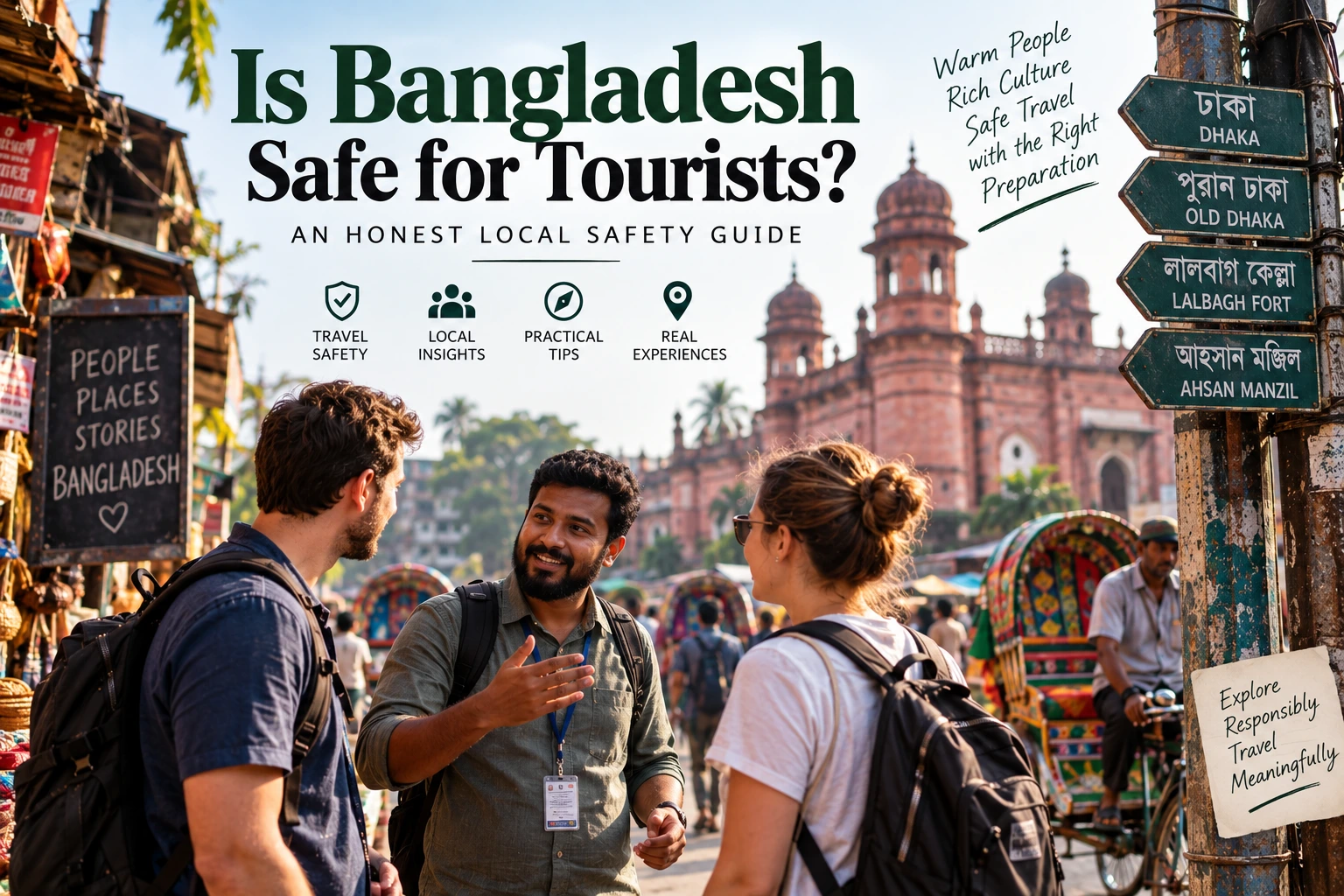
The first thing many foreign visitors notice in Bangladesh is not danger. It is attention.
People may look in your direction, ask where you are from, offer tea or try to help before you have requested assistance. In an Old Dhaka lane, a shopkeeper might leave his counter to point you toward a mosque. At a railway station, several people may offer conflicting directions at once. The experience can feel warm, confusing and overwhelming in the same five minutes.
That intensity is one reason international travelers ask: Is Bangladesh safe for tourists?
The honest answer is that Bangladesh can be visited safely by well-prepared travelers, but it should not be treated as a risk-free destination. Most tourist journeys are completed without a serious incident. Nevertheless, visitors need to consider political demonstrations, traffic conditions, theft, harassment, terrorism concerns, extreme weather, health limitations and regional travel restrictions.
Conditions also vary considerably. Walking through a busy heritage neighborhood in daylight is different from using an isolated road late at night. Traveling with a reliable local professional is different from following an unknown person who approaches you at an airport. Central Dhaka is not governed by the same risk considerations as parts of the Chittagong Hill Tracts.
This guide explains those differences without exaggerating the danger or offering false reassurance.
Quick answer: Bangladesh is possible to visit safely, but foreign tourists should exercise heightened awareness, avoid political gatherings, arrange dependable nighttime transport, protect their belongings and check official travel advisories before entering remote or restricted regions.
Current Bangladesh Travel-Safety Situation
Travel advice is time-sensitive. Political conditions, weather, regional access and security instructions can change between booking and arrival.
As of the review date of this article, official foreign-government guidance continues to warn travelers about crime, political unrest, terrorism, transportation risks and specific regional concerns.
The UK Foreign, Commonwealth & Development Office currently advises against all but essential travel to the Chittagong Hill Tracts, covering Rangamati, Khagrachari and Bandarban. Its guidance also warns that political rallies can become violent and that security restrictions may be introduced at short notice.
That does not mean every part of Bangladesh carries the same level of risk. It means travelers must make decisions by destination, date and activity instead of relying on a general statement that the entire country is either “safe” or “unsafe.”
Check your own government’s advice
Before booking and again shortly before departure, consult the advisory issued for your nationality:
- United States Department of State
- Government of Canada Travel Advice
- Australian Smartraveller
- New Zealand SafeTravel
- UK Foreign Travel Advice
Travelers from European countries should also check their own foreign ministry’s advice. An advisory can affect insurance coverage even when travel remains legally possible.
A practical Bangladesh risk overview
| Risk | Where or when it matters most | Sensible response |
| Political demonstrations | Dhaka and other cities during rallies, strikes or elections | Avoid gatherings and change routes early |
| Traffic accidents | Roads nationwide, especially at night | Use dependable vehicles and avoid unnecessary night travel |
| Theft and robbery | Crowds, stations, transport hubs and poorly lit streets | Keep valuables concealed and use secure transport |
| Harassment | Crowded or isolated areas, particularly for women | Dress respectfully, maintain boundaries and avoid isolation |
| Terrorism | Public places, gatherings and religious locations | Stay alert and follow official security instructions |
| Floods and cyclones | Monsoon season and exposed coastal or low-lying regions | Monitor forecasts and keep flexible travel plans |
| Regional access concerns | Chittagong Hill Tracts and other controlled areas | Check current government advice and permission requirements |
| Health problems | Nationwide, with fewer advanced facilities outside Dhaka | Carry insurance, medication and a medical plan |
Is Dhaka Safe for Tourists?
Dhaka is intense, crowded and often difficult to read on a first visit. It is also where many international travelers begin to understand Bangladesh.
The city’s principal challenge is not usually a dramatic confrontation. More often, it is the combination of dense traffic, unfamiliar transport, heat, noise, air pollution, crowds and uncertainty about where to go.
Foreign visitors regularly explore central Dhaka, Old Dhaka, university areas, museums, markets and riverfront neighborhoods. Daytime travel with sensible planning is generally easier than unplanned movement after dark.
Safer ways to explore Dhaka
For a more controlled experience:
- Begin early in the day.
- Keep your daily route geographically compact.
- Avoid displaying expensive watches, jewelry or camera equipment.
- Carry only the cash and cards you need.
- Keep your passport secured at the hotel unless it is specifically required.
- Use a cross-body bag that closes securely.
- Arrange a trusted vehicle for nighttime journeys.
- Avoid empty roads, parks and riverfront areas after dark.
- Ask your hotel or host about same-day political activity.
- Leave crowded situations if the atmosphere changes.
Dhaka traffic can delay journeys far beyond the estimate shown on a map. Allow generous time before trains, flights and fixed appointments.
Visitors who want historical interpretation and organized transportation can consider a professionally planned Discover Dhaka City experience. The corresponding service page should retain booking and city-tour intent; this safety article should only explain why guided orientation can be valuable.
Is Old Dhaka safe?
Old Dhaka is crowded, layered and visually fascinating. It contains historic buildings, river trade, religious sites, food traditions and some of the most energetic street life in the country.
Crowding creates practical risks. A visitor can become separated from a companion, lose awareness of a phone or bag, enter a lane with no easy vehicle access or unintentionally photograph someone who does not want attention.
During an Old Dhaka Tour, foreign visitors should:
- Keep cameras secured between photographs.
- Avoid blocking active roads and shop entrances.
- Ask before photographing people at close range.
- Follow local guidance around religious buildings.
- Avoid carrying unnecessary valuables.
- Be cautious near the river and busy launch terminals.
- Leave before late-night transport becomes complicated.
Most attention directed toward foreign visitors is curiosity rather than hostility. Even so, travelers should maintain control of their movement and belongings.
Is Bangladesh Safe for Solo Female Travelers?
Women do travel independently in Bangladesh, but solo female travel requires additional preparation.
A woman may receive prolonged attention, personal questions, requests for photographs or unsolicited offers of assistance. Some interactions are motivated by curiosity. Others may become intrusive.
Official foreign-travel guidance also warns that female visitors can experience verbal harassment, physical harassment and sexual assault. It would therefore be irresponsible to describe solo female travel in Bangladesh as effortless or universally comfortable.
That does not mean women cannot visit. It means planning should be deliberate.
Practical advice for solo female travelers
Women traveling alone should consider the following:
- Arrive during daylight where possible.
- Prearrange airport pickup with a traceable hotel or operator.
- Stay in well-reviewed accommodation with a staffed reception.
- Share the vehicle registration and live location with a trusted contact.
- Avoid isolated areas, particularly after dark.
- Sit near women or families on public transport when possible.
- Use a local SIM or dependable roaming service.
- Keep accommodation details private from strangers.
- Avoid accepting spontaneous rides from unknown people.
- Have a clear exit plan if an interaction becomes uncomfortable.
- Trust discomfort early instead of waiting for a situation to escalate.
Conservative clothing can reduce unwanted attention, although clothing never makes harassment the traveler’s fault. Loose trousers or long skirts, covered shoulders and a light scarf are practical in many settings. A head covering is generally not required for non-Muslim visitors, except where a religious site establishes its own expectations.
Handling unwanted attention
A calm, direct response is often more effective than a prolonged explanation. Useful boundaries include:
- “No, thank you.”
- “Please do not take my photograph.”
- “I am meeting my guide.”
- “I need to leave now.”
Move toward a staffed hotel, family group, shop, security point or busy public place if someone continues following or pressuring you.
When a journey involves isolated sites, early departures or complicated connections, a verified guide or driver can provide logistical support. However, travelers must still check the individual or company rather than assuming anyone using the word “guide” is qualified.
Common Tourist Scams and Uncomfortable Situations
Bangladesh is not dominated by elaborate tourist scams in the way some heavily visited destinations are. However, foreign visitors may encounter opportunistic overcharging, unofficial assistance and misleading transport offers.
Airport taxi overcharging
At Dhaka and Sylhet airports, unofficial drivers or touts may approach arriving passengers. A tired traveler carrying luggage is easier to pressure into an unclear fare.
Arrange pickup before arrival whenever possible. If using airport transportation, confirm:
- The driver’s name
- The vehicle registration
- The agreed fare or payment method
- Whether parking and waiting charges are included
- The exact hotel destination
Do not hand your luggage to an unknown person simply because they behave confidently.
Unofficial guides
Someone may begin helping informally and later request payment. This can happen around transport hubs, heritage sites or busy public places.
Decline politely at the beginning if you do not want assistance. For a planned tour, verify the operator’s website, contact details, reviews, guide identity and stated inclusions.
Rickshaw and CNG fare disputes
Meters are not always used consistently, and travelers may be quoted higher fares than residents. Ask a hotel, guide or local contact for a realistic estimate and agree on the amount before beginning the ride.
A modest visitor premium is different from intimidation. If a dispute becomes aggressive, prioritize safety over winning an argument about a small sum.
Photography requests
People may ask to take a photograph with a foreign visitor. Many such requests are harmless, but participation is optional.
Women traveling alone should be particularly cautious about sharing personal details, contact information or accommodation locations during these interactions.
Begging and emotional pressure
Visitors may encounter adults or children asking for money. Giving cash directly to children can reinforce school absence or organized begging.
Travelers who want to help should consider supporting a credible local organization rather than making decisions under pressure in the street.
Transportation Safety in Bangladesh
Road safety is one of the most important Bangladesh travel-safety concerns.
Traffic may include buses, cars, trucks, CNG auto-rickshaws, motorcycles, cycle rickshaws, pedestrians and animals sharing the same space. Lane discipline and pedestrian priority may differ greatly from what visitors expect in the United States, Canada, Australia, New Zealand or Europe.
Crossing roads safely
Do not assume a vehicle will stop because you have stepped onto a crossing. When possible:
- Use a footbridge or controlled crossing.
- Cross with a local group.
- Avoid sudden movements.
- Maintain awareness of motorcycles moving between vehicles.
- Put your phone away while crossing.
- Ask a guide or trusted local person for assistance.
Choosing a private vehicle
Before a longer road journey, look for:
- Working seat belts
- A rested driver
- A roadworthy vehicle
- Functioning air conditioning where needed
- Clear luggage storage
- A realistic travel schedule
- No pressure to speed
Avoid encouraging a driver to make up lost time by driving faster. Bangladesh road journeys are often unpredictable, and arriving late is preferable to creating additional risk.
Traveling at night
Where possible, avoid unnecessary intercity road travel late at night. Visibility, fatigue, speeding and access to emergency assistance can all be more problematic.
If overnight travel is necessary, use an established operator and select the safest practical service—not simply the cheapest ticket.
Train safety
Train travel can be a comfortable alternative to road transport, but stations can be crowded. Keep valuables close, verify the train and carriage before boarding, and avoid leaving a bag unattended.
Travelers should book through legitimate channels. Do not share passport details or payment information with an unknown online seller claiming access to scarce tickets.
Boats and launches
Bangladesh is a river country, and boat travel can be a memorable part of the journey. Before boarding, consider:
- Weather conditions
- Boat condition
- Availability of life jackets
- Passenger capacity
- Crew experience
- Cabin security
- Night visibility
- Emergency communication
Small craft and overnight launches involve different levels of risk. If conditions look unsafe, do not board simply because the booking has already been paid.
Political Demonstrations, Strikes and Public Gatherings
Political events can disrupt Bangladesh travel with little warning. Demonstrations may begin peacefully and then become confrontational. Strikes, locally called hartals, can affect road transport, businesses and access to particular neighborhoods.
Foreign visitors should never approach a political gathering for photographs or curiosity.
What to do when a demonstration is nearby
- Leave the area before the crowd grows.
- Do not stop to record close-up video.
- Avoid political slogans, flags and confrontations.
- Follow hotel and local-authority instructions.
- Change routes rather than attempting to pass through.
- Keep family or travel companions informed.
- Monitor reputable local reporting.
- Allow additional time for airport and station transfers.
An empty road during a strike should not automatically be interpreted as a safe road. Ask a trusted local contact before traveling.
Terrorism and Security Awareness
Foreign-government advisories identify terrorism as a continuing risk in Bangladesh. Potential targets can include public places, transport systems, religious locations, security facilities and gatherings.
Travelers should not become alarmed by every visible security measure, but they should remain attentive.
Practical precautions include:
- Notice exits when entering a crowded venue.
- Avoid unattended bags.
- Cooperate with security checks.
- Do not photograph military or sensitive government facilities.
- Limit time around demonstrations and politically significant gatherings.
- Follow official instructions if access is restricted.
- Leave an area when security activity increases unexpectedly.
No tour operator, hotel or guide can guarantee complete security. Responsible travel planning reduces exposure; it does not eliminate risk.
Regional Safety and the Chittagong Hill Tracts
Bandarban, Rangamati and Khagrachari contain some of Bangladesh’s most dramatic landscapes and culturally distinct communities. They also require a different safety decision from mainstream city travel.
As of 22 September 2026, the UK FCDO advises against all but essential travel to the Chittagong Hill Tracts. Foreign-national access requirements and local restrictions can also change.
Travelers should not rely on an old blog post, social-media video or hotel advertisement as proof that a route is currently open.
Before considering the region:
- Check your government’s current advisory.
- Confirm whether insurance remains valid.
- Verify foreign-national permission requirements.
- Ask whether the intended route is officially open.
- Use a reputable operator with recent regional knowledge.
- Avoid improvised changes to remote routes.
- Respect checkpoints and local instructions.
- Leave a detailed travel plan with someone outside the area.
Bangladesh Explore should update any Bandarban or Hill Tracts content whenever official access conditions change. A disclaimer alone is not enough if a page promotes a route that is no longer considered appropriate.
Weather, Flooding and Natural Hazards
Bangladesh’s rivers and monsoon landscapes are part of its character, but weather can disrupt transportation rapidly.
Seasonal flooding can affect roads, railways, river transport, electricity and access to medical care. Coastal regions may face cyclones and storm surges. Hilly areas can experience landslides after heavy rainfall.
Monsoon travel precautions
During periods of heavy rain:
- Monitor official weather information.
- Do not walk or drive through moving floodwater.
- Avoid unnecessary river travel in poor conditions.
- Protect passports and electronics in waterproof bags.
- Carry backup medication.
- Keep additional food and drinking water available.
- Leave flexibility around flights and intercity connections.
- Confirm road conditions before departure.
A weather delay is inconvenient. Pressuring a boat operator or driver to continue in unsafe conditions is considerably worse.
Health and Medical Preparedness
Medical standards vary. Dhaka has private hospitals and specialist facilities, but advanced care may be limited or difficult to reach elsewhere.
Travel insurance should cover medical treatment, evacuation and disruption. Travelers with ongoing health conditions should carry enough medication for the complete journey, plus a reasonable reserve.
Before departure
Consult a qualified travel-health professional, ideally several weeks before travel. Discuss:
- Routine vaccinations
- Destination-specific vaccination recommendations
- Mosquito-borne illnesses
- Food and water precautions
- Heat and dehydration
- Air pollution
- Prescription medication
- Medical evacuation coverage
Health advice must come from an appropriate medical professional, not solely from a tourism website.
Food and water safety
Choose food that is freshly cooked and served hot. Be more cautious with raw salads, unpeeled fruit, ice from an unknown water source and food that has remained uncovered.
Drink sealed bottled water or appropriately treated water. Check the cap before drinking.
A carefully organized Dhaka Food Tour should prioritize reputable vendors, food-handling judgment and dietary communication—not simply the largest possible number of tastings.
Air pollution and heat
Dhaka’s air quality can be difficult for visitors with asthma or respiratory conditions. Heat and humidity can also cause fatigue faster than expected.
Plan breaks, drink water and avoid treating a packed schedule as a test of endurance.
Cultural Awareness and Local Laws
Bangladesh is a Muslim-majority country with diverse religious and cultural communities. Visitors are not expected to behave exactly like residents, but respectful conduct reduces misunderstanding.
Clothing and public behavior
Modest clothing is practical, particularly outside international hotels and resorts. Public displays of affection may attract discomfort or attention.
During Ramadan, visitors should be considerate when eating, drinking or smoking publicly, especially in conservative settings.
Religious sites
Before entering a mosque, temple, church or shrine:
- Ask whether visitors are permitted.
- Remove shoes when required.
- Dress appropriately.
- Avoid interrupting worship.
- Ask before taking photographs.
- Do not photograph people during private prayer without permission.
Alcohol and drugs
Alcohol availability is restricted and subject to local law. Illegal drugs can result in severe penalties. Never carry a package for another person without knowing exactly what it contains.
LGBTQ+ travelers
LGBTQ+ visitors should research current law, social conditions and official travel guidance before departure. Public attitudes can be conservative, and discretion may be necessary.
Bangladesh Explore should address this subject factually and respectfully without making promises about individual safety.
Ethical Photography and Personal Safety
Bangladesh is visually powerful: river ports, workshops, markets, historic architecture and densely layered streets all attract documentary photographers.
A dramatic image is never more important than a person’s dignity or the photographer’s safety.
Photographing people
Ask permission before making an identifiable close portrait. This is especially important with:
- Children
- Workers
- Patients
- People in distress
- Religious worshippers
- People in private homes
- Women in conservative communities
Parental or responsible-adult permission should be obtained before photographing children. A child’s curiosity is not informed consent for publication.
Factories and workplaces
Do not enter a factory, workshop, shipyard or industrial facility without authorization. These locations may contain machinery, chemicals, restricted processes or vulnerable workers.
Secretly photographing child labor or poverty can endanger the subject and turn a serious social issue into visual entertainment. Ethical documentary work requires context, permission, safeguarding and an honest understanding of how the material will be used.
A responsible Street Photography Tour in Dhaka should teach photographers when not to take a photograph—not merely where to find visually striking scenes.
Protecting camera equipment
Keep equipment discreet when moving between locations. Avoid changing lenses in the middle of a crowd, placing a bag on the road or walking backward into traffic while composing a frame.
Photography can narrow situational awareness. A guide or companion should watch the surroundings when a photographer is deeply focused on a scene.
Choosing Safe Accommodation, Guides and Tour Operators
A professional website is useful, but it is not enough by itself.
Before booking, look for:
- A verifiable business identity
- A working local telephone number
- A physical address
- Recent, detailed reviews
- Clear cancellation terms
- Named inclusions and exclusions
- Secure payment arrangements
- An emergency-contact process
- Guides with relevant destination experience
- Honest answers about access restrictions
Be cautious if an operator dismisses official travel advice, guarantees total safety or pressures you to pay immediately.
Questions to ask before confirming
Ask the hotel or operator:
- Who will meet me at the airport?
- How will I identify the driver?
- Does the vehicle have working seat belts?
- Who do I contact outside office hours?
- Are there current political or regional disruptions?
- Is any permission required for this destination?
- What happens if weather prevents travel?
- Is the guide experienced with international visitors?
- Are insurance and medical costs included?
- How are solo female travelers supported?
Trust is built through specific answers, not slogans such as “completely safe.”
What to Do in an Emergency
Bangladesh uses 999 for police, fire and ambulance emergencies. Response capability can differ by location, and in some medical situations reaching a suitable hospital by a dependable vehicle may be faster.
Before traveling, save:
- Your embassy or consular emergency number
- Your travel insurer’s assistance number
- Your hotel’s reception number
- Your tour operator’s emergency contact
- A trusted local contact
- Copies of your passport and visa
- Your medication information
- Your emergency contact at home
Keep digital copies in protected cloud storage and offline copies on your phone. Carry a paper copy separately from your passport.
If a passport is lost or stolen, contact the police and your embassy or consulate. Do not rely on an unofficial intermediary who claims the document can be recovered for a fee.
A Simple Safety Routine for Foreign Visitors
Travel safety often depends on small habits repeated consistently.
Before leaving the hotel
- Check the weather and local news.
- Confirm the destination with the driver.
- Carry a charged phone and power bank.
- Take only necessary cash.
- Secure passport and backup cards.
- Tell someone where you are going.
- Save the hotel address in Bangla and English.
While exploring
- Keep your bag closed.
- Remain aware when using a camera or phone.
- Avoid political gatherings.
- Ask before entering private spaces.
- Drink enough water.
- Reconsider a plan if conditions feel different from what was expected.
Before evening
- Confirm return transportation.
- Avoid becoming stranded after public transport slows.
- Do not follow strangers to an unknown secondary location.
- Return earlier if there is heavy rain, unrest or unusual security activity.
These precautions are not intended to create fear. They preserve the freedom to notice the country instead of constantly solving avoidable problems.
Frequently Asked Questions
Is Bangladesh safe for American tourists?
Americans can travel to Bangladesh, but they should review the current US Department of State advisory, register for relevant security updates and use increased situational awareness. Political events, regional restrictions, crime and transportation safety require advance planning.
Is Dhaka safe at night?
Some well-trafficked areas remain active after dark, but tourists should avoid isolated streets and unnecessary public-transport journeys late at night. Arrange a trusted car or driver and confirm the destination before departure.
Is Bangladesh safe for solo female travelers?
Solo female travel is possible, but women may experience staring, personal questions, verbal harassment or unwanted attention. Daylight arrival, reputable accommodation, reliable transport and avoiding isolated areas can reduce exposure.
What are the most common tourist scams in Bangladesh?
Potential issues include airport-taxi overcharging, unofficial guides, unclear transport fares and unsolicited help followed by demands for payment. Confirm services and prices before accepting assistance.
Is public transport safe in Bangladesh?
Public transport is widely used, but crowding, road conditions, driving standards and nighttime security may concern foreign visitors. Trains and reputable intercity services can be practical, while private transportation may be preferable in unfamiliar areas or after dark.
Is Old Dhaka safe for tourists?
Old Dhaka can be explored safely with appropriate awareness. Visit during daylight, protect valuables, ask before photographing people and use a well-planned route. First-time visitors may benefit from an experienced local guide.
Is Bandarban safe for foreign tourists?
Bandarban forms part of the Chittagong Hill Tracts. As of 22 September 2026, the UK FCDO advises against all but essential travel to the region. Access conditions and permission requirements can change, so check your own government’s advice and insurance before planning a visit.
Should tourists avoid political demonstrations?
Yes. Foreign visitors should avoid rallies, protests, strikes and large political gatherings. These situations can change quickly, and nearby transportation may also be disrupted.
What emergency number should tourists use in Bangladesh?
Call 999 for police, fire or ambulance assistance. Travelers should also save their embassy, insurer, hotel and local operator contacts.
Do tourists need travel insurance for Bangladesh?
Comprehensive travel insurance is strongly recommended. It should cover medical care, evacuation, cancellation and activities included in the journey. Check whether government travel warnings or restricted regions affect coverage.
Can tourists photograph people in Bangladesh?
Photography is common, but permission should be obtained for identifiable close portraits, children, private homes, religious activity and workplaces. Avoid photographing security installations or sensitive facilities.
Is Bangladesh safe to visit during the monsoon?
Travel remains possible, but flooding, landslides, transport disruption and cyclones can affect particular regions. Monitor forecasts, keep schedules flexible and never pressure a driver or boat operator to travel in unsafe conditions.