
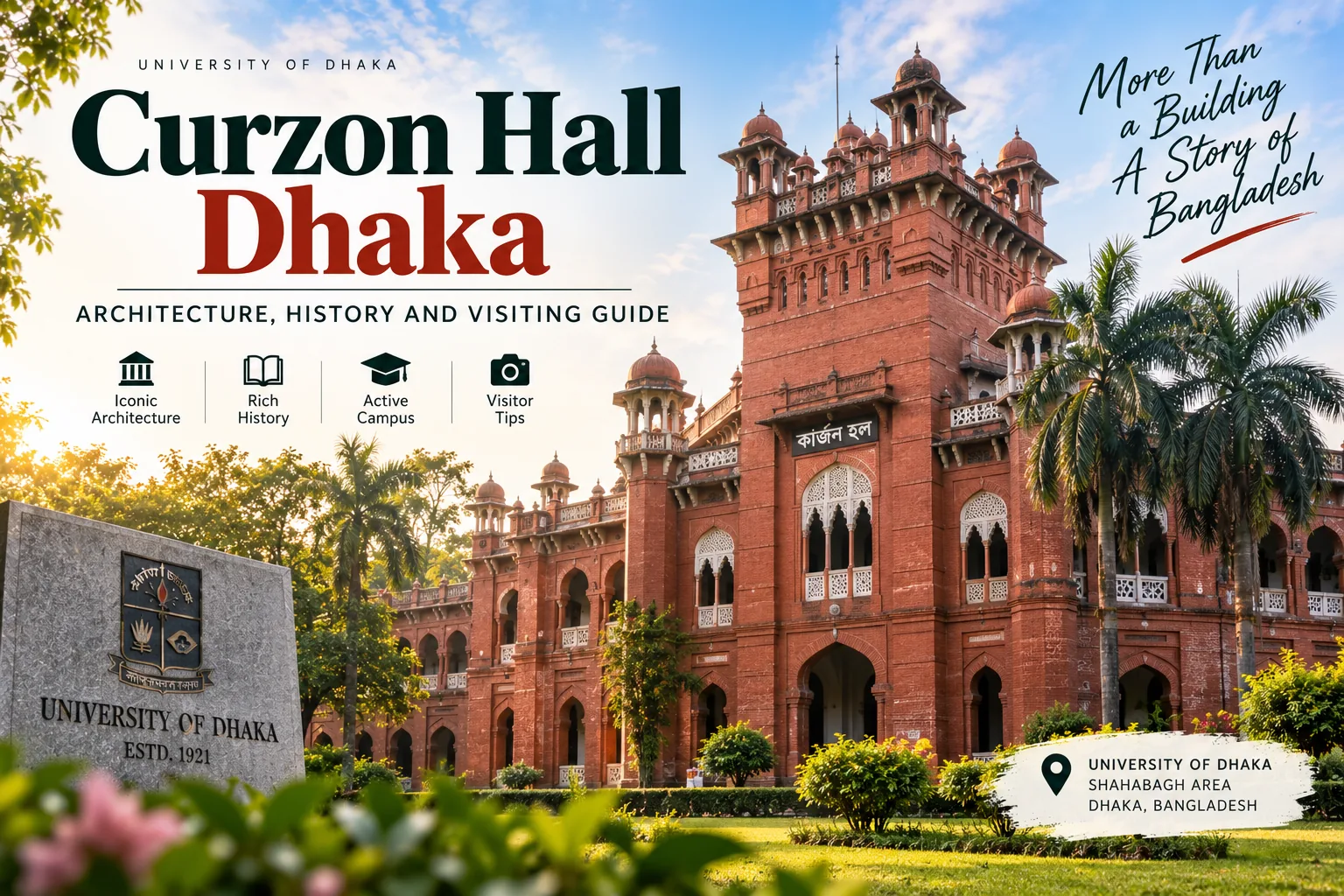
Curzon Hall is one of Dhaka’s most recognizable historic buildings: a red-brick landmark where European planning meets Mughal and Indo-Islamic architectural detail. Located within the University of Dhaka campus, it remains an active academic building associated with the Faculty of Sciences rather than a conventional tourist museum.
For international visitors, that distinction shapes the experience. There is generally no museum-style ticket, fixed sightseeing circuit or guaranteed interior tour. The most respectful visit focuses on the exterior, courtyards and permitted campus areas without interrupting classes, research or student life.
Curzon Hall also carries meaning beyond its architecture. The building is linked to the early Bengali Language Movement, including Muhammad Ali Jinnah’s March 1948 address at the University of Dhaka and the student opposition to his state-language position. A well-planned visit therefore connects architecture, education and cultural history in one compact part of the city.
This Curzon Hall visiting guide is designed for travelers from the United States and other international markets. It covers architectural features, historical context, campus etiquette, photography, accessibility questions, the best exterior viewpoints and a practical walking route through the surrounding University of Dhaka area.
Quick Answer: Can Tourists Visit Curzon Hall?
Visitors can usually view and photograph the exterior of Curzon Hall from publicly accessible or permitted parts of the University of Dhaka campus. However, Curzon Hall is a functioning academic building, not a dedicated tourist attraction. Interior access, classrooms, laboratories, corridors, gardens and departmental areas should never be assumed to be open.
There is no reliable official tourist timetable or standard admission ticket published for Curzon Hall. Campus access may change during examinations, political events, official programs, security alerts, university holidays or construction. Visit during daylight, follow gate and security instructions, and ask permission before entering any interior space.
Allow 30 to 45 minutes for the building and exterior details. A compact walk linking Curzon Hall with Doyel Chattar, the Musa Khan Mosque area and the Central Shaheed Minar can take 90 minutes to two hours, depending on campus access, traffic crossings and photography stops.
Curzon Hall Visitor Information
Essential Details at a Glance
- Official name: Curzon Hall
- Common alternative spelling: Karjon Hall
- Location: University of Dhaka, Shahbagh area, Dhaka, Bangladesh
- Current use: Faculty of Sciences and university academic activities
- Visitor format: Exterior and permitted campus viewing
- Museum ticket: No standard tourist ticket identified
- Guaranteed interior access: No
- Recommended time: 30–45 minutes; longer with nearby sites
- Best period: Weekday daylight outside examination or major event periods
- Photography: Ask when people, classes, entrances or interiors are involved
This information was researched on September 8, 2026. Conditions on an active university campus can change without the advance notice expected from a formal attraction.
Is Curzon Hall Free to Visit?
There is no standard Curzon Hall entrance fee comparable to a museum ticket. Exterior viewing from an accessible campus area is ordinarily treated as part of visiting the University of Dhaka environment, but access remains subject to university and security control.
Do not interpret “free” as permission to enter every door, laboratory or garden. If a guard, teacher or departmental employee limits access, accept the instruction. Tour operators should not advertise guaranteed interiors unless the university has specifically authorized the visit.
Curzon Hall Visiting Hours
Curzon Hall does not publish conventional tourist opening hours because it is an educational building. Academic schedules, office hours and campus gate access are not the same as visitor hours.
Daylight is the safest planning window. A weekday morning can provide active campus context, while a quieter weekend may involve reduced access or closed gates. Before a dedicated architecture visit, ask a local guide to check current conditions rather than relying on an old map review.
Where Is Curzon Hall?
Curzon Hall stands in the University of Dhaka area near Doyel Chattar and opposite the Old High Court side of the district. It belongs to the Shahbagh cultural and educational cluster, although some map listings may use High Court Street or nearby landmarks in the address.
Search for “Curzon Hall, University of Dhaka” rather than only “Karjon Hall.” Confirm that the map pin is beside Doyel Chattar and the university science area.
How to Reach Curzon Hall
An app-based car or CNG auto-rickshaw can use Doyel Chattar, Curzon Hall or the University of Dhaka as the destination. The final drop-off may depend on road controls and gate access.
From Old Dhaka, the distance appears short, but traffic around Gulistan, the High Court and university roads can be slow. A combined walking and rickshaw route may be more practical than asking a car to wait at every stop.
The Dhaka Metro can reduce cross-city travel, but the most useful station depends on the rest of the itinerary and current pedestrian routes. Shahbagh and Dhaka University stations on MRT Line 6 are relevant reference points. Check live station operation and choose the route with safer crossings rather than the shortest line on a map.
When to Avoid the Area
Avoid scheduling a casual architecture visit during:
- University examinations
- Admission tests
- Political demonstrations or major student events
- State visits or heightened security
- Severe monsoon rain or localized flooding
- The busiest hours of major national commemorations
The campus has an important civic role. An event that interests a traveler may also create access restrictions or crowd-safety concerns.
What Is Curzon Hall?
Curzon Hall is a British Raj-era institutional building now used by the University of Dhaka’s science faculty. Lord Curzon, then Viceroy of India, laid its foundation stone on February 19, 1904. Construction was completed in the early twentieth century, commonly dated to 1908.
When the University of Dhaka began in 1921, Curzon Hall became part of its science teaching environment. It continues to be used rather than preserved as an empty monument, giving the building an unusually strong continuity between architecture and academic life.
Why Is It Called Curzon Hall?
The building bears the name of Lord Curzon, a central figure in British imperial administration and the 1905 Partition of Bengal. The name therefore carries colonial history and cannot be separated from debates about imperial policy, regional administration and political identity.
International visitors should avoid treating the name as a neutral royal dedication. Curzon Hall is admired architecturally while also belonging to a more complicated history of colonial power and later Bengali political resistance.
Was Curzon Hall Intended as a Town Hall?
Many travel articles state that Curzon Hall was originally intended to be a town hall. Other historical accounts connect the project to the proposed relocation of Dhaka College to the Nimatoli area and describe the building as a planned college library funded or named through elite patronage.
The safest editorial treatment is to acknowledge both accounts. The surviving building later served Dhaka College classes after the annulment of the 1905 Partition of Bengal, and it became part of the University of Dhaka in 1921. These later institutional uses are clearer than the simplified origin story repeated by many tourist pages.
This source disagreement is useful for E-E-A-T. A trustworthy guide should not hide ambiguity simply to make the narrative shorter.
Curzon Hall Architecture
Curzon Hall is often described as Indo-Saracenic or as a blend of European and Mughal architectural traditions. Indo-Saracenic design developed under British rule by combining European building organization with features drawn from Indo-Islamic, Mughal and regional architecture.
The building’s red exterior, deep arcades, varied arches, towers and decorative roofline create a composition that feels both institutional and theatrical. Its strongest appeal lies in the repetition of elements across a long façade rather than one isolated dome or gateway.
Red Brick and Layered Façades
The red-brick surface gives Curzon Hall its immediate visual identity. Light and shadow change the façade throughout the day, especially where recessed openings, projecting bays and covered walkways create depth.
Look at the structure from a distance before approaching. The wider view reveals symmetry, rhythm and the relation between the central section and flanking wings. Closer views then show the texture of brick, plaster details and repairs accumulated over time.
Horseshoe and Cusped Arches
One of the building’s most photographed features is its arch vocabulary. Horseshoe-shaped and pointed or cusped arches recall Islamic and Mughal architectural forms, while their use within a large colonial educational building reflects the hybrid design language of the period.
Do not label every arch “Mughal” without qualification. Curzon Hall draws from multiple traditions. The interest lies in how those elements were selected and reassembled for a modern institutional purpose under colonial rule.
Domes, Towers and Roofline Details
Small domed forms, corner elements and parapet details animate the roofline. From some angles they appear almost like miniature pavilions. Their visual function is significant even when a visitor cannot inspect them closely.
A telephoto lens can isolate these details without crossing barriers or entering restricted areas. Photograph from a permitted position instead of asking staff to make an exception for a better angle.
Arcades, Verandas and Climate
Covered arcades and shaded circulation areas are both aesthetic and practical. In Dhaka’s heat and monsoon climate, deep openings and verandas create shade and mediate between interior rooms and the outdoors.
This is where architecture becomes easier to understand as a working environment. Curzon Hall was not designed only to be viewed from a lawn; its circulation, shade and ventilation support institutional use.
Garden and Campus Setting
Trees and planted areas soften the red façade and create the classic campus view. The University of Dhaka botanical garden is associated with the Curzon Hall premises and supports teaching and research.
Do not assume the garden is a public park. Scientific collections and departmental areas may have their own controls. Remain on permitted paths and avoid touching, collecting or moving plant material.
Best Exterior Viewpoints
Curzon Hall rewards a sequence of views rather than one photograph. Access can change, so treat these as visual strategies rather than guaranteed camera positions.
The Broad Front-Façade View
Begin far enough away to include the building’s width and roofline. A moderate wide-angle lens is usually more useful than an extreme lens that bends the façade. Step back where the pathway and security boundary permit.
Early light can reveal brick texture, while later light may warm the red tones. Weather, trees and seasonal foliage affect the composition.
Angled Views Along the Arcades
An oblique view creates depth by repeating arches into the distance. Keep corridors clear and avoid photographing through classroom doors. If students are identifiable, ask or wait for a cleaner moment.
Use architectural lines instead of directing people to move. Campus users have priority.
Details from the Doyel Chattar Side
Doyel Chattar provides a recognizable orientation point near Curzon Hall. Depending on barriers and traffic, it can help establish the building within the wider cultural district.
Road safety matters more than a symmetrical frame. Never stand in an active carriageway or traffic island without a safe pedestrian position.
Reflections After Rain
Monsoon rain may create reflections and saturated color, but wet surfaces can be slippery and traffic visibility poor. Use a compact rain cover and remain under permitted shelter without blocking doorways.
Do not enter flooded lawns or landscaped areas for a reflection shot. The damage and safety risk are not justified.
Curzon Hall and the Bengali Language Movement
Curzon Hall is connected to the early Language Movement that demanded recognition for Bangla in Pakistan. After the 1947 Partition, state-language policy became a central political and cultural dispute because Bengali speakers formed a large share of Pakistan’s population.
The University of Dhaka became a key site of organization and protest. Curzon Hall’s role should be understood as part of this wider campus geography rather than as the sole location of the movement.
Jinnah’s March 1948 Address
On March 24, 1948, Pakistan’s Governor-General Muhammad Ali Jinnah addressed the University of Dhaka at Curzon Hall and reiterated his support for Urdu as the state language. Students in the audience objected, an episode remembered as a clear expression of resistance to the policy.
Some simplified travel descriptions merge this speech with the larger public address at Race Course Maidan on March 21. They were separate events. Curzon Hall is specifically associated with the university address on March 24.
From 1948 to February 1952
The Language Movement developed through organizations, meetings, strikes and confrontations over several years. On February 21, 1952, students defied restrictions on assembly; police gunfire killed demonstrators in the university and medical-college area.
The Central Shaheed Minar now commemorates the martyrs and is the more direct memorial site for the events of 1952. Curzon Hall adds an earlier institutional chapter: the university environment where state-language policy was openly challenged.
Why the Context Matters to Visitors
Without Language Movement context, Curzon Hall can become only a picturesque colonial façade. Understanding the 1948 confrontation reveals how a building created under empire later became part of a university culture that challenged state authority.
Keep the historical explanation concise on this page. Bangladesh Explore’s broader Language Movement or national-history content should own detailed political chronology, while this URL should own Curzon Hall’s entity and visitor intent.
Campus Access and Visitor Etiquette
The University of Dhaka is a living campus. Students and staff are not performers, and teaching spaces are not public galleries.
Ask Before Entering
An open doorway is not automatic permission. Ask security staff or a departmental representative before entering a corridor, lecture room, laboratory, stairway or courtyard that is not clearly open to visitors.
If access is declined, continue with the exterior. A responsible article should never encourage travelers to “sneak inside” for photographs.
Keep Academic Spaces Functional
Stay quiet near classes and offices. Do not sit across entrances, move furniture, lean equipment against walls or block circulation with a tripod. Small groups are easier for the campus to accommodate than large tour parties.
Avoid amplified commentary. A guide can explain history from a suitable outdoor position and use a whisper system or small-group conversation where necessary.
Dress and Conduct
Lightweight, modest clothing is appropriate. Comfortable footwear helps on uneven paths and busy crossings. Public affection, drone use and elaborate commercial setups are inappropriate without explicit authorization.
Carry identification, but avoid surrendering an original passport to an unofficial person. Follow legitimate security requests and leave promptly if campus conditions change.
Photography Rules at Curzon Hall
No single public visitor policy found during this research guarantees unrestricted photography across Curzon Hall. Exterior personal photography is common, but university, security and departmental rules take priority.
Personal Exterior Photography
Use a handheld camera or phone from an accessible area. Do not climb walls, cross barriers or enter landscaping. Avoid flash near classrooms and keep walkways open.
If security staff ask what you are doing, explain calmly that the images are for personal travel use. Comply if they limit a position or subject.
Photographing Students and Staff
A public campus is not consent-free. Ask before making an identifiable close portrait, especially if the person is studying, working or praying. A general architectural scene with incidental people is different from making an individual the subject.
For a Street Photography Tour in Dhaka, choose a guide who understands campus sensitivities and can obtain consent in Bangla.
Commercial Shoots, Tripods and Drones
Professional filming, brand shoots, large tripods, lighting, interviews and drones may require university or government permission. Do not rely on a tour operator’s verbal assurance alone for a commercial production.
Drone flight is particularly sensitive near government, judicial and university areas. Treat it as prohibited unless the relevant authorities provide documented approval.
Accessibility and Comfort
The historic building predates modern universal-design standards. Step-free routes, elevator access and accessible restrooms should not be assumed.
What to Confirm in Advance
Travelers with mobility requirements should ask a guide or the university about:
- Step-free access to the best exterior viewpoint
- Vehicle drop-off distance
- Curb cuts and crossing conditions
- Accessible toilets nearby
- Resting places and shade
- Interior lift access, if an authorized interior visit exists
An exterior-only visit may be adapted more easily than an interior route. A local operator should inspect the path rather than promise accessibility from a map.
Heat, Rain and Air Quality
Dhaka’s heat and humidity can make a short walk tiring. Carry water, use sun protection and schedule rest. During monsoon weather, brick paths and steps may become slippery.
Traffic near the campus can create noise and air pollution. Visitors with respiratory conditions may prefer a short route outside peak traffic and a vehicle transfer between clusters.
Nearby Places to Visit
Curzon Hall sits within one of Dhaka’s richest cultural clusters. Several important sites can be linked on foot when security, weather and mobility allow.
Doyel Chattar
Doyel Chattar stands near Curzon Hall and features sculptures of the oriental magpie-robin, Bangladesh’s national bird. The surrounding area is known for handicraft sellers, including pottery, bamboo, cane, wood and jute items.
Browse without blocking the pavement and agree prices before purchase. Ask before photographing a vendor closely.
Musa Khan Mosque
The historic Musa Khan Mosque is located behind the Curzon Hall area near Shahidullah Hall. It is an active mosque, not merely an architectural attraction.
Dress respectfully, remove shoes where instructed and avoid prayer times unless visiting for worship. Non-Muslim access to interior areas should be confirmed locally rather than assumed.
Central Shaheed Minar
The Central Shaheed Minar commemorates those killed during the 1952 Language Movement. It gives the strongest continuation to Curzon Hall’s 1948 language-policy context.
Treat it as a national memorial. Avoid playful posing on the monument, keep the platform clean and expect exceptional crowds around February 21.
Bangla Academy and Suhrawardy Udyan
Bangla Academy is Bangladesh’s national institution for Bangla language and literature, while nearby Suhrawardy Udyan holds major political and Liberation War associations. Access, events and hours vary.
During the Ekushey Book Fair, the area becomes intensely busy and the walking route requires more time. The cultural atmosphere is valuable, but it is not the best period for an empty architectural photograph.
Compact Curzon Hall Walking Route
This route is designed as an orientation, not a guarantee that every gate or interior will be accessible.
Stop One: Doyel Chattar
Begin at Doyel Chattar and observe how the handicraft stalls, traffic and university edge shape the district. Use the square as the route’s navigation anchor.
Stop Two: Curzon Hall Exterior
Move to a permitted broad view of Curzon Hall. Spend several minutes looking at the entire façade before focusing on arches, domed roofline elements and shaded arcades.
Allow 30–45 minutes. If access is restricted, do not circle through departmental entrances looking for another way in.
Stop Three: Musa Khan Mosque Area
Continue only if the path is open and the group can respect the mosque’s religious function. View the exterior quietly and avoid disrupting worshippers.
Stop Four: Central Shaheed Minar
Walk toward the Central Shaheed Minar to connect the 1948 Curzon Hall speech with the 1952 culmination of the Language Movement. A guide should distinguish the two dates and places clearly.
Optional Extension
Extend toward Bangla Academy or Suhrawardy Udyan if weather, time and access permit. The complete route can fit within a Half-Day Tour Dhaka, but traffic and campus conditions should determine the sequence.
A broader Discover Dhaka City itinerary can connect the university quarter with Old Dhaka or modern civic architecture. Travelers who want deeper interpretation may prefer A Cultural Tour rather than a rapid photo-stop itinerary.
Best Time to Visit Curzon Hall
The cooler months from November through February are more comfortable for walking, although haze and crowds vary. Early morning or later afternoon light usually gives the red brick more dimension than flat midday sun.
Weekdays Versus Weekends
A weekday reveals Curzon Hall as a working university environment but requires greater care around classes. A weekend may be quieter yet offer less access. Neither guarantees an interior visit.
February and National Commemorations
February brings strong cultural meaning because of Language Movement observances and the Ekushey Book Fair. It can also bring crowds, barriers, ceremonies and traffic changes.
Choose February for cultural context, not for an empty campus. Follow police and university instructions and protect extra time.
Monsoon Visits
Rain deepens the color of brick and vegetation, creating appealing photographs. It also creates slippery paths, poor visibility and unpredictable transport.
Use weather protection and do not shelter in an academic doorway if doing so obstructs campus users.
Practical Advice for U.S. and International Visitors
Carry the Right Map Details
Save “Curzon Hall, University of Dhaka” and Doyel Chattar offline. A Bangla screenshot of the destination can help a rickshaw or CNG driver.
Use a Local Guide for Context
The building has few tourist-style interpretation panels. A knowledgeable guide can explain architecture, campus geography and the Language Movement while checking real-time access.
Evaluate a guide by historical accuracy and respect for the university, not by promises of restricted access. A strong tour operator should distinguish the March 21 and March 24 speeches and explain what is actually open.
Plan Around Dhaka Traffic
Do not schedule Curzon Hall immediately before an airport or train departure. University-area traffic, demonstrations, rain and road controls can change rapidly.
Cluster Curzon Hall with nearby cultural sites. Old Dhaka belongs to a different street and traffic experience and is often better handled as a separate route or carefully sequenced extension.
Common Mistakes to Avoid
Treating Curzon Hall as a Museum
It is an active university building. There is no standard ticketed interior route.
Promising Fixed Opening Hours
Academic access and tourist hours are not interchangeable. Use a verification note instead of publishing invented hours.
Repeating One Origin Story as Certain
Sources differ on whether the building was conceived as a town hall or as a library linked to Dhaka College’s proposed relocation. Preserve that distinction.
Misdating the Language Movement Speech
Jinnah’s Curzon Hall university address occurred on March 24, 1948. The larger Race Course address was on March 21.
Ignoring Photography Consent
Campus architecture may be photographed from permitted areas, but identifiable portraits, interiors and commercial shoots require greater care and often permission.
Why Visit Curzon Hall with Bangladesh Explore
Curzon Hall is easy to recognize but easy to explain badly. Bangladesh Explore can add value by checking current campus conditions, choosing a sensible approach, distinguishing verified history from repeated travel myths and linking the architecture to the Language Movement without turning the visit into a long lecture.
A responsible guide protects academic activity, avoids false promises of interior access and adapts for weather or mobility. The aim is to help visitors read the building and its setting, then connect it with the nearby memorial and cultural landscape.
Frequently Asked Questions
Where is Curzon Hall?
Curzon Hall is within the University of Dhaka campus in the Shahbagh area of Dhaka, close to Doyel Chattar and opposite the Old High Court side of the district.
Can tourists enter Curzon Hall?
Tourists can generally view the exterior from permitted campus areas, but interior access is not guaranteed. Curzon Hall is an active academic building, so ask security or departmental staff before entering any corridor, classroom or courtyard.
Is there a Curzon Hall entry fee?
No standard tourist admission ticket was identified during this research. Exterior campus viewing may be free, but access remains subject to university and security rules.
What are Curzon Hall’s visiting hours?
Curzon Hall does not publish regular museum-style tourist hours. Visit in daylight and verify current campus access, especially during examinations, official programs, holidays or security events.
Why is Curzon Hall famous?
It is famous for its red-brick Indo-Saracenic architecture, its continuing role within the University of Dhaka’s science faculty and its association with early Bengali Language Movement resistance.
When was Curzon Hall built?
Lord Curzon laid the foundation stone on February 19, 1904. The building is commonly reported as completed in 1908 and became part of the University of Dhaka science faculty after the university opened in 1921.
What happened at Curzon Hall during the Language Movement?
On March 24, 1948, Muhammad Ali Jinnah addressed the University of Dhaka at Curzon Hall and reiterated his Urdu-focused state-language position. Students objected, making the event an important early episode in the Language Movement.
Can I take photos at Curzon Hall?
Personal exterior photography from permitted areas is commonly possible, but campus rules and security instructions take priority. Ask before photographing identifiable people, interiors or academic activity. Commercial shoots, tripods and drones may require formal permission.
How long should I spend at Curzon Hall?
Allow 30–45 minutes for the exterior architecture. Plan 90 minutes to two hours for a walking route that also includes Doyel Chattar and the Central Shaheed Minar.
What can I visit near Curzon Hall?
Nearby places include Doyel Chattar, Musa Khan Mosque, the Central Shaheed Minar, Bangla Academy and Suhrawardy Udyan. Access and opening conditions differ, so verify each stop separately.