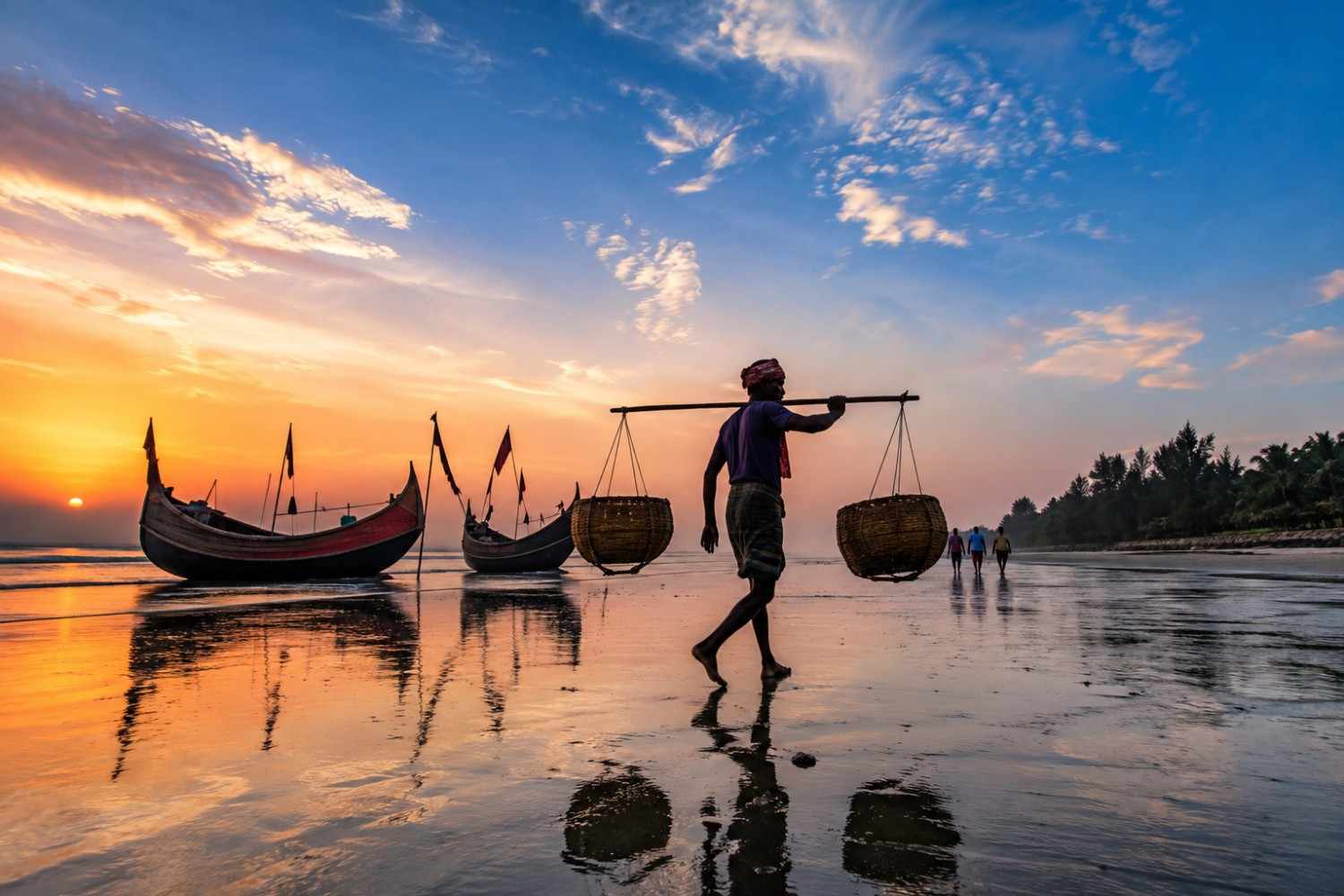
Cox’s Bazar stretches for 120 kilometers along the Bay of Bengal, making it the world’s longest unbroken natural sea beach. For Cox’s Bazar photography, that scale is only part of the appeal. What makes Cox’s Bazar genuinely rewarding to shoot isn’t the beach itself — it’s everything happening on it: wooden fishing boats returning at dawn, Rakhine market traders arranging color against color, cliffside views at Himchari, and a working coastline that hasn’t been staged for tourists.
This guide covers where to go, when to go, and how to photograph Cox’s Bazar the way it actually looks — not the postcard version.
Quick Answer: What You Need to Know
- Best light: Sunrise (5:30–7:00 AM in winter, earlier in summer) for fishing boat activity; sunset (5:00–6:30 PM in winter) for Marine Drive and Laboni Point
- Best season: November to February — clear skies, cooler temperatures, calmer sea
- Top 5 spots: Nazirartek Fishing Village, Marine Drive, Himchari National Park, Inani Beach, Cox’s Bazar Fish Market (Rakhine influence)
- Getting there: ~1 hour flight from Dhaka, or 8–10 hours by bus/train
- Best format: A guided half-day or full-day photography tour, since fishing-boat activity happens early and access to working areas is easier with a local guide
Why Cox’s Bazar Is a Photographer’s Destination
Most beach destinations in Asia have long since traded working shorelines for resort development. Cox’s Bazar hasn’t — not yet. Fishing remains a real, daily livelihood here, not a tourist reenactment. Boats still go out before sunrise and return mid-morning, nets are mended on the sand, and the fish market runs on the same rhythm it has for generations.
That combination — genuine working life plus dramatic natural scale — is rare, and it’s exactly what separates documentary-style travel photography from generic beach snapshots. If you already know Bangladesh through street photography in Dhaka or village life photography, Cox’s Bazar is the natural coastal extension of that same authentic, unscripted visual style — just with open horizons and ocean light instead of narrow lanes.
Best Time of Day to Photograph Cox’s Bazar
Sunrise is the strongest photography window in Cox’s Bazar, and it’s tied directly to the fishing schedule. Boats return with the morning catch starting around first light, which means the best human-activity shots and the best golden light happen at the same time. Arrive at Nazirartek or the main fishing jetty by 6:00 AM in winter to catch boats coming in.
Sunset favors Marine Drive and Laboni Point, where the beach faces open water with an unobstructed horizon. The light turns warm roughly 45 minutes before sunset, and the last 10–15 minutes before the sun drops often produce the strongest color, especially with any cloud cover to catch the light.
Midday is the weakest window — harsh overhead light, heat haze, and a mostly empty beach. If you’re only in Cox’s Bazar for one day, structure your shoot around the two golden-hour windows and use midday for travel between locations, gear rest, or market/street photography in shaded areas instead.
Best Time of Year for Cox’s Bazar Photography
November to February (winter): The strongest season overall. Skies are clear, humidity is lower, and the sea is calmer, which matters for boat photography since choppy water limits how close boats come to shore. This is also peak tourist season, so beaches near the main town get busier — a reason to prioritize sunrise shoots when crowds are thinnest.
March to May: Warmer and hazier, but fishing activity continues and the beach is noticeably quieter. Early morning remains workable; midday heat becomes difficult to shoot in comfortably.
June to October (monsoon): Dramatic skies and storm light can produce striking, moody images, but conditions are unpredictable — heavy rain, rough seas, and reduced fishing-boat activity as many crews wait out the weather. Only recommended for photographers specifically chasing storm and monsoon aesthetics, and only with a guide who can read local conditions.
Top Photography Spots in Cox’s Bazar
Nazirartek Fishing Village
The single best location for authentic fishing-life photography. Boats unload their catch here every morning, and the surrounding drying yards — where fish are laid out on bamboo racks to dry in the sun — offer strong texture, pattern, and color for wide and detail shots alike. Go at sunrise; by mid-morning the most active period has passed.
Marine Drive
A coastal road running roughly 80 kilometers along the shoreline, alternating between open beach views, small fishing hamlets, and dramatic cliff sections. Marine Drive is the best location for wide landscape shots and sunset photography, and it’s also where you’ll find quieter stretches of beach away from the main tourist zone.
Himchari National Park
A short drive south of the main beach, Himchari combines a coastal waterfall (seasonal — strongest just after monsoon) with hillside viewpoints overlooking the Bay of Bengal. The elevated viewpoint here is one of the few spots in Cox’s Bazar where you can shoot the coastline from height rather than beach level.
Inani Beach
Known for a rocky shoreline section that’s unusual for Bangladesh’s coast — the exposed rock formations at low tide create foreground interest that the smooth sand elsewhere doesn’t offer. Quieter than the main Cox’s Bazar beach, and a good choice if you want fewer people in frame.
Cox’s Bazar Fish Market & Rakhine Influence
The town’s markets carry visible Rakhine cultural influence in dress, craft, and trade — a strong option for portrait and market-life photography when you want a change from open-beach shooting. Best photographed mid-morning once the market is in full swing but before the harshest midday light.
Photographing People: A Note on Respect and Access
Fishing communities and market vendors in Cox’s Bazar are working, not performing. A few practices make a real difference, both ethically and in the quality of images you come home with:
- Ask before photographing individuals up close, even with a smile and a gesture — it takes seconds and changes how people respond to the camera
- Spend a few minutes observing before shooting; understanding the rhythm of the work (when boats arrive, when nets are mended) leads to better-timed shots than shooting on arrival
- A local guide who already has a relationship with fishing crews and market traders will get you access and comfort levels that showing up alone won’t — this is one of the practical reasons photographers book a guided tour rather than visiting independently
What to Pack for Coastal Photography in Cox’s Bazar
- A weather-sealed camera body or a rain cover — sea spray and occasional rain are common even outside monsoon season
- A polarizing filter to cut glare off wet sand and water, especially useful at Inani Beach’s rock pools
- A mid-range zoom (24–70mm equivalent) for most beach and market work, plus a longer lens (70–200mm+) if you want compressed shots of boats on the water without wading in
- Lens cloths — salt air leaves residue quickly
- A dry bag or case for moving between boat, beach, and market shooting in one session
A Simple 1-Day Cox’s Bazar Photography Itinerary
- 5:30 AM — Arrive at Nazirartek Fishing Village for sunrise and boat return
- 8:00 AM — Breakfast, then Cox’s Bazar Fish Market for portrait and market-life shots
- 11:00 AM — Drive to Himchari National Park for hillside viewpoint shots (avoiding the harshest midday light on the beach)
- 2:00 PM — Inani Beach for rock-formation detail shots at low tide (check tide times in advance)
- 4:30 PM — Marine Drive for golden hour and sunset
This pace assumes a private vehicle and a guide who knows current tide times and boat schedules, both of which shift throughout the year.
Why Book a Guided Photography Tour Instead of Shooting Independently
Cox’s Bazar rewards timing and access more than almost any other destination in Bangladesh. Fishing-boat activity happens in a narrow early-morning window, tide times affect which beaches are shootable, and the best market and portrait access comes from a guide with existing local relationships — not from arriving as a stranger with a camera.
Bangladesh Explore’s Photography Tour Packages are built around exactly this kind of access: English-speaking guides who plan around light and tide, know the fishing schedule, and can introduce you to market vendors and fishing crews respectfully. If you’re combining Cox’s Bazar with other photography-focused travel in Bangladesh, it also pairs naturally with our Street Photography in Dhaka and general Bangladesh Travel Photography Tour itineraries.
Frequently Asked Questions on Cox’s Bazar Photography
What is the best time of day to photograph Cox’s Bazar? Sunrise is the strongest window, since fishing boats return with the morning catch during the same period as the best golden light — roughly 5:30–7:00 AM in winter. Sunset, around 5:00–6:30 PM in winter, is the second-best window, particularly along Marine Drive.
What is the best month to visit Cox’s Bazar for photography? November through February offers the clearest skies, calmest seas, and most comfortable shooting conditions. It’s also the busiest tourist season, so early mornings are especially valuable for avoiding crowds.
Can you photograph the fishing boats up close? Yes, particularly at Nazirartek Fishing Village during the morning return. Boats come close to shore to unload, and drying yards nearby offer additional close-range subjects. A guide with existing relationships with fishing crews makes closer, more comfortable access possible.
Is a guided photography tour necessary, or can I shoot Cox’s Bazar independently? Independent shooting is possible, but the best material — early fishing activity, market portraits, tide-dependent locations like Inani Beach — depends on timing and access that a local guide provides. Most photographers find a guided tour meaningfully improves both the quantity and quality of usable images in a limited time.
How many days should I plan for Cox’s Bazar photography? A single well-planned day covering sunrise, market, and sunset locations is enough for a solid set of images. Two to three days allows time for weather flexibility, a full Marine Drive exploration, and repeat visits to Nazirartek if the first morning’s light or boat activity wasn’t ideal.
Is Cox’s Bazar safe for photographers traveling alone? Yes, particularly with a local guide, who can also help navigate language differences at the market and fishing village and ensure you’re respectful of working communities while shooting.
Planning a Cox’s Bazar photography trip? Get in touch with Bangladesh Explore to build a guided itinerary around sunrise fishing-boat photography, Marine Drive, and the Rakhine market — timed to the light and tides, not guesswork.