
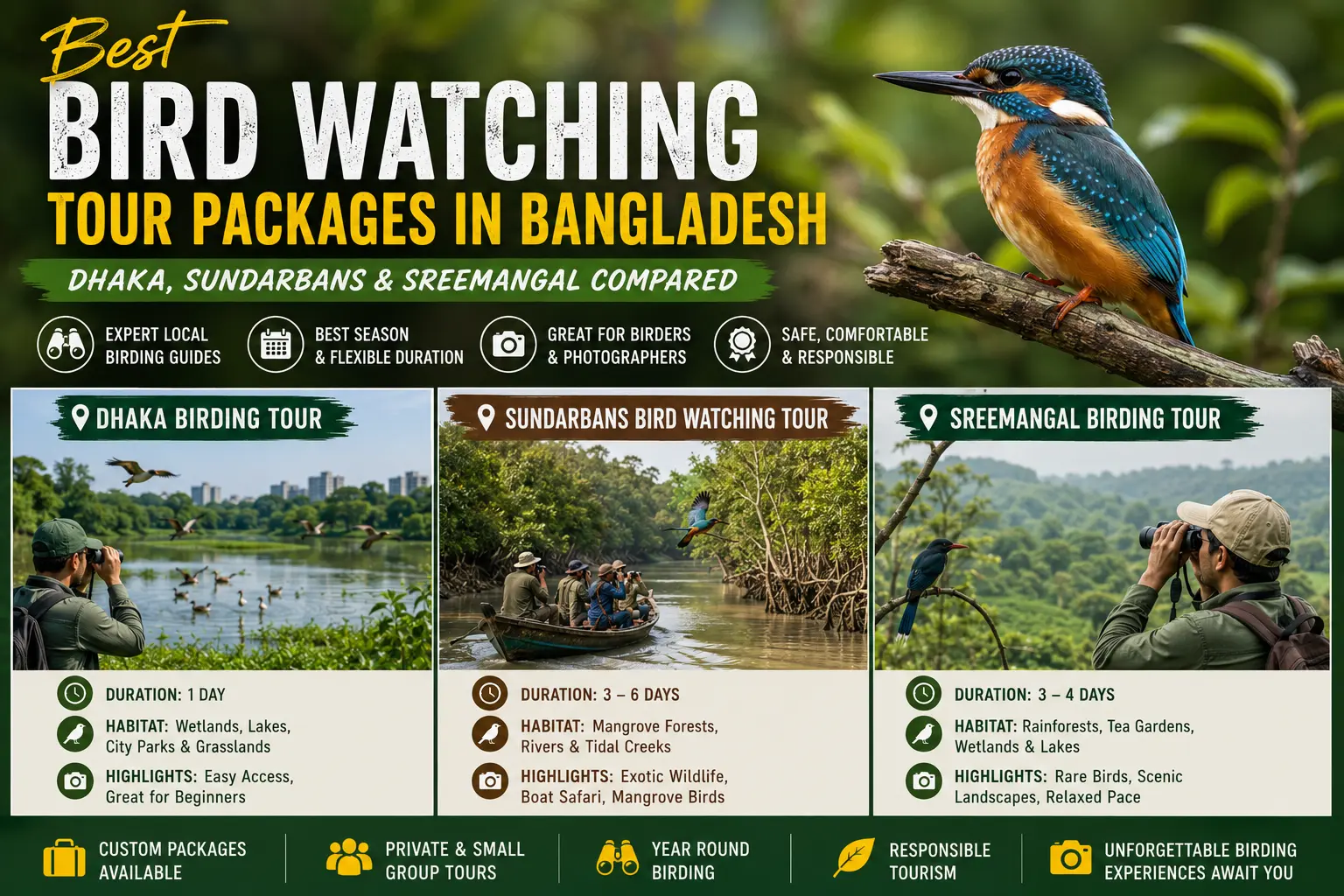
Bangladesh is still an overlooked destination for international birdwatchers. That is part of what makes it interesting.
Within a relatively small geographic area, travelers can move from the wetlands around Dhaka to the mangrove waterways of the Sundarbans and then into the tea-covered hills, rainforests, and wetlands of Sreemangal. Each region offers a completely different birding environment.
For travelers coming from the USA, Canada, Europe, or Australia, the main question is usually not whether Bangladesh has good birdwatching. It is which bird watching tour package in Bangladesh is the right one to book.
Should you choose a short birding day around Dhaka?
Spend several days exploring the Sundarbans?
Head to Sreemangal for wetlands and rainforest birds?
Or combine all three into a longer private birdwatching trip?
The answer depends on your available time, birding experience, photography interests, budget, and the species you hope to see.
This guide compares the main birdwatching destinations and helps you choose the right bird watching tour package in Bangladesh based on your travel plans.
Quick Answer: Which Bangladesh Birdwatching Tour Is Best?
If you only have one day in Dhaka, a Dhaka birding tour is the most practical choice.
If you want a wildlife-focused experience and enjoy exploring by boat, the Sundarbans offers one of the most distinctive birdwatching environments in Bangladesh.
If your interests include rainforest birds, wetlands, tea-country landscapes, and a slower nature experience, Sreemangal is an excellent option.
For serious birdwatchers visiting Bangladesh specifically to build a strong species list, a multi-region itinerary combining Dhaka, Sreemangal, and the Sundarbans is usually the best choice.
| Destination | Best For | Recommended Duration | Main Habitat |
| Dhaka | Short stays and first-time visitors | 1 day | Urban green spaces, wetlands, grasslands |
| Sundarbans | Specialist birding and wildlife | 3–6 days | Mangrove forest, rivers, tidal creeks |
| Sreemangal | Forest and wetland birding | 3–4 days | Rainforest, tea country, wetlands |
| Multi-region tour | Serious birdwatchers | 7–10+ days | Multiple habitats across Bangladesh |
The biggest advantage of Bangladesh is habitat diversity. You are not repeating the same experience in different locations. A morning in the Sundarbans feels completely different from birding at Baikka Beel or searching for birds around Dhaka.
That makes a carefully designed Bangladesh birdwatching tour package particularly attractive for travelers who want variety within one trip.
Why Bangladesh Is Becoming More Interesting for Birdwatchers
Bangladesh sits within an important ecological region and contains an unusually varied mix of habitats.
There are wetlands.
Rivers.
Floodplains.
Mangrove forests.
Evergreen forests.
Grasslands.
Tea estates.
Agricultural landscapes.
Coastal areas.
These habitats support both resident and migratory birds.
For international birdwatchers, especially those accustomed to traveling long distances between major birding regions, Bangladesh offers the possibility of experiencing several ecosystems within one country.
The Sundarbans alone provides a completely different environment from northeastern Bangladesh. Sreemangal combines rainforest and wetland habitats, while the Dhaka region can serve as a practical introduction to local birdlife for travelers arriving through Hazrat Shahjalal International Airport.
Specialist birding operators also design longer itineraries around target species and specific habitats, while broader nature tours combine birdwatching with wildlife, photography, and cultural experiences.
For a first-time visitor, this flexibility is important.
You do not need to commit to a two-week expedition simply because you enjoy birdwatching.
A one-day experience is possible.
A four-day nature trip is possible.
A longer specialist expedition is also possible.
Dhaka Birding Tour: Best for Travelers with Limited Time
A Dhaka birding tour is the best option for travelers who have a short stay in Bangladesh or want to add birdwatching to a broader cultural itinerary.
Dhaka may be one of the busiest cities in South Asia, but birdwatching opportunities exist within and around the city.
Depending on the season and current conditions, a guided day can include green spaces, lakes, wetlands, riverine areas, or open habitats outside the central city.
What to Expect
A typical full-day birding experience may begin early in the morning and include one or more locations around Dhaka.
The route can change depending on recent sightings, weather, migration patterns, and the traveler’s interests.
Possible habitats may include:
- Urban green spaces
- Lakes and wetlands
- Open grassland
- Riverine habitats
- Forest-edge areas
A Dhaka birdwatching tour is particularly suitable for beginners, casual birdwatchers, photographers, and travelers who want to experience Bangladesh’s wildlife without leaving the capital region for several days.
It is also a practical choice if you have a long stop in Dhaka before continuing toward another destination.
Who Should Choose Dhaka?
Choose a Dhaka birding package if:
- You only have one or two days available
- You are arriving or departing through Dhaka
- You want a private guided experience
- You are new to birdwatching
- You want to combine birding with photography or sightseeing
- You are planning a larger Bangladesh itinerary and want to start with a short nature experience
For travelers who also want to understand the city, a birding day can be followed by an Old Dhaka Tour, creating an interesting contrast between Bangladesh’s natural environment and its dense urban life.
Sundarbans Bird Watching Tour: Best for Wildlife and Specialist Birding
The Sundarbans is the most distinctive birdwatching environment in Bangladesh.
This vast mangrove ecosystem is explored primarily through rivers, canals, and tidal waterways. The experience is very different from walking through a national park or observing birds from a fixed wetland viewpoint.
You may spend long periods on a boat.
Birds may appear along muddy banks, within mangrove vegetation, or near narrow forest channels.
The landscape itself becomes part of the experience.
The Sundarbans supports a wide variety of birdlife, including kingfishers, herons, raptors, owls, woodpeckers, and specialist mangrove species. Some specialist tours focus heavily on target birds and may adjust routes according to seasonal conditions and recent sightings.
Why the Sundarbans Is Different
A birdwatching trip here is not simply about moving from one observation point to another.
The journey itself is part of the experience.
You travel through waterways surrounded by mangrove forest.
Early mornings can be particularly rewarding because the forest is quieter and wildlife activity may be higher.
Smaller boats may allow access to narrower channels where larger tourist vessels cannot easily travel.
A good itinerary should balance birdwatching with practical realities such as tides, weather, forest permissions, and travel times.
What a Sundarbans Birding Package May Include
Depending on the package, travelers may receive:
- Boat accommodation
- Meals during the expedition
- Forest entry arrangements
- Local or specialist guides
- Transportation from Dhaka or Khulna
- Small-boat excursions
- Wildlife observation
- Birdwatching opportunities
- Photography time
Publicly listed packages range from short three-day birdwatching trips to much longer specialist itineraries covering multiple regions and target species.
Who Should Choose the Sundarbans?
The Sundarbans is a strong choice if you:
- Want a multi-day wildlife experience
- Enjoy bird photography
- Are interested in mangrove ecosystems
- Want to combine birdwatching with other wildlife
- Prefer a slower, immersive travel experience
- Have at least three days available
Travelers who want to combine wildlife with history can also consider a Sundarbans and Bagerhat Tour, which adds one of Bangladesh’s most important historical regions to the journey.
Sreemangal Birdwatching Tour: Best for Forest and Wetland Birds
Sreemangal offers a completely different side of Bangladesh.
Known internationally for its tea gardens and natural landscapes, the region also provides access to rainforest and wetland habitats.
For birdwatchers, that combination is particularly useful.
You are not limited to a single ecosystem.
A multi-day itinerary can include forest birding in and around Lawachara National Park and wetland birdwatching around Baikka Beel and the wider Hail Haor region.
Baikka Beel is particularly important because it is a large wetland sanctuary that supports resident and migratory birds. Bangladesh tourism information describes the area as supporting extensive birdlife and year-round birdwatching opportunities, with seasonal migration adding further interest.
Lawachara and Forest Birding
Lawachara National Park provides a different pace from wetland birdwatching.
Instead of scanning open water, you may spend more time listening and looking into the forest canopy.
Birding here requires patience.
Some species are heard before they are seen.
Others may move quickly through dense vegetation.
The forest environment also creates opportunities to observe other wildlife, including primates.
That makes Sreemangal attractive to travelers who enjoy natural history beyond birds alone.
Baikka Beel and Wetland Birding
After forest birding, Baikka Beel provides a change of scenery.
The wetland environment attracts a different range of species, particularly during the more favorable birdwatching seasons.
A watchtower and open-water views can provide useful observation opportunities, while the surrounding wetland landscape also makes the experience attractive for photographers.
Who Should Choose Sreemangal?
A Sreemangal birdwatching package is ideal if:
- You enjoy both forest and wetland habitats
- You want to spend several days in nature
- You are interested in bird and wildlife photography
- You want a more relaxed travel experience
- You also want to explore tea gardens and local communities
- You are traveling with someone who enjoys nature but is not necessarily a serious birder
A longer Sreemangal and Sylhet Tour can be a good option for travelers who want to continue exploring northeastern Bangladesh after their birdwatching experience.
Dhaka vs Sundarbans vs Sreemangal: Which Birdwatching Tour Should You Book?
Choosing between the three depends largely on time.
Choose Dhaka if You Have One Day
Dhaka is the logical choice for short stays.
You can arrange a guided experience without committing to long-distance travel or multiple hotel nights.
It is also useful as an introduction to birdwatching in Bangladesh.
Choose the Sundarbans if Wildlife Is Your Priority
The Sundarbans offers the most immersive wilderness experience of the three.
It requires more time and planning, but the reward is access to a unique mangrove ecosystem.
This is the better choice for travelers who enjoy boat-based wildlife experiences and want birdwatching to be part of a larger nature expedition.
Choose Sreemangal if You Want the Best Balance
Sreemangal is perhaps the easiest choice for travelers who want several types of experiences in one region.
You can combine:
- Forest birdwatching
- Wetland birdwatching
- Nature walks
- Tea gardens
- Photography
- Local culture
- Wildlife observation
For many first-time international visitors, that balance makes Sreemangal one of the most accessible nature destinations in Bangladesh.
How Long Should Your Bangladesh Birdwatching Tour Be?
The ideal duration depends on your goals.
1-Day Birdwatching Tour
Best for:
- Travelers staying in Dhaka
- Short business trips
- Layovers
- Beginners
- Casual birdwatchers
A full-day Dhaka birding experience can focus on one or more habitats within reach of the city.
3-Day Birdwatching Tour
Best for:
- Short Sundarbans experiences
- Travelers who want a focused wildlife trip
- Visitors with limited vacation time
Three days can provide a meaningful introduction to the Sundarbans, although serious birdwatchers may prefer a longer stay.
4-Day Birdwatching Tour
Best for:
- Sreemangal and surrounding habitats
- A combination of rainforest and wetland birding
- Nature photographers
A four-day itinerary provides more flexibility than a rushed overnight trip.
It also allows more time for early-morning birdwatching.
7-Day or Longer Birdwatching Tour
Best for:
- Serious birdwatchers
- Photographers
- Travelers coming specifically for Bangladesh’s birdlife
A longer itinerary can combine multiple regions and habitat types.
This is where Bangladesh becomes particularly interesting because you can move between urban wetlands, mangrove forests, rainforest, tea-country landscapes, and major wetland systems.
Best Time to Book a Bird Watching Tour Package in Bangladesh
For travelers interested in migratory birds, the cooler months are generally the strongest period for planning.
November through February is often considered an important window for birdwatching, although migration timing and local conditions can vary.
Winter also offers more comfortable temperatures for long days outdoors.
Sreemangal, the Sundarbans, and wetlands around Dhaka can all provide different experiences during this period.
However, birdwatching is not limited to winter.
Resident birds can be observed throughout the year, and certain habitats become more interesting during other seasons.
The best time depends partly on what you want to see.
A specialist birdwatcher searching for particular species should discuss their target list before booking rather than simply choosing dates based on general weather advice.
Published specialist itineraries for Bangladesh also schedule different target species around seasonal windows, showing why timing can be important when birdwatching is the main purpose of the trip.
How Much Do Bird Watching Tour Packages in Bangladesh Cost?
There is no single price for a bird watching tour package in Bangladesh.
The final cost depends on the type of trip.
A private one-day birding experience around Dhaka will usually cost less than a multi-day specialist expedition with private transport, accommodation, forest permits, boats, and an experienced birding guide.
Your price may depend on:
- Number of travelers
- Private or shared tour
- Tour duration
- Accommodation standard
- Private transportation
- Specialist guide requirements
- Forest permits and entrance fees
- Boat type
- Meals
- Photography requirements
Published packages currently show a wide range. Shorter local birdwatching and Sundarbans packages are priced very differently from private, foreigner-focused wildlife tours and specialist multi-day birding expeditions, which can reach several thousand dollars depending on duration, group size, accommodation, and target species.
For this reason, the best approach is not to compare prices alone.
Compare what is included.
A lower-priced package may exclude transport, meals, permits, entrance fees, or specialist guiding.
A higher-priced package may include everything from airport pickup to private transport and accommodation.
For international travelers, a clear all-inclusive quotation is often easier to compare than a low starting price with multiple additional costs.
What Should Be Included in a Good Birdwatching Package?
Before booking, ask for a complete list of inclusions.
A well-organized package may include:
- Airport or hotel pickup
- Private transportation
- English-speaking guide
- Specialist birding guide where required
- Accommodation
- Meals
- Drinking water
- Entrance fees
- Forest permissions
- Boat transportation
- Local transportation
- Sightseeing arrangements
You should also ask what is not included.
This is particularly important for:
- Domestic flights
- International flights
- Visa expenses
- Travel insurance
- Alcoholic beverages
- Personal purchases
- Tips
- Camera or drone permits where applicable
A detailed itinerary should also explain the approximate travel time between destinations.
For international visitors, this matters because Bangladesh can look small on a map while road travel takes longer than expected.
A good itinerary should not promise too many activities in a single day.
Birdwatching is usually better when there is enough time to stay in a productive habitat rather than constantly moving between attractions.
Private Tour or Small Group Tour?
For serious birdwatchers, a private or very small group usually provides more flexibility.
If someone spots an interesting bird, the group can stop.
If weather conditions change, the guide can adjust the schedule.
If photography is important, more time can be spent in a productive location.
Larger groups can reduce the per-person cost, but they may move at a different pace.
One traveler may want to photograph a kingfisher for 30 minutes while another wants to continue searching for new species.
For that reason, serious photographers and experienced birders should discuss group size before booking.
A customized itinerary can also combine birdwatching with other interests.
For example, a traveler might spend several days in the Sundarbans and then return to Dhaka for a Street Photography Tour in Dhaka before leaving Bangladesh.
That creates two completely different photography experiences within the same trip.
Birdwatching or Bird Photography: Tell Your Guide Your Priority
These two activities overlap, but they are not exactly the same.
A birdwatcher may be satisfied with a clear view through binoculars and a confirmed identification.
A photographer may need better light, a cleaner background, or more interesting behavior.
That changes the pace of the tour.
If photography is your priority, mention it before booking.
The itinerary can then allow more time during the best morning and late-afternoon light.
You may also want to visit fewer locations rather than rushing across several habitats.
If your main objective is building a species list, the guide may instead focus on habitat diversity and recent sightings.
A good bird watching tour package in Bangladesh should be built around your actual interests rather than following the same fixed itinerary for every traveler.
Why Combine Dhaka, Sreemangal, and the Sundarbans?
Each destination fills a different role.
Dhaka provides accessibility.
Sreemangal provides habitat diversity.
The Sundarbans provides wilderness.
Together, they create a much stronger birdwatching experience than repeating similar habitats.
A possible multi-region journey might begin in Dhaka, continue toward Sreemangal for rainforest and wetland birding, and then move south toward the Sundarbans for mangrove species and boat-based wildlife observation.
Travelers interested in a broader Bangladesh experience can also combine birdwatching with cultural destinations, historical sites, and photography experiences.
For example, a longer itinerary could include World Heritage and Historical Places Tours alongside wildlife destinations.
This approach is particularly suitable for visitors traveling from the USA who may only visit Bangladesh once and want to experience more than one side of the country.
How to Choose the Right Bird Watching Tour Package in Bangladesh
Before booking, answer these questions.
How many days do you have?
This is the most important starting point.
One day suggests Dhaka.
Three or more days opens the possibility of the Sundarbans.
Four or more days allows a more relaxed Sreemangal experience.
A week or longer creates the opportunity to combine regions.
What type of birds are you interested in?
A casual birdwatcher does not need the same itinerary as someone searching for specific species.
Tell your guide whether you are interested in:
- Migratory waterbirds
- Forest birds
- Mangrove specialists
- Raptors
- Owls
- Kingfishers
- Photography
- Building a species list
Are You Traveling Alone?
Solo travelers may find that private tours have a higher per-person cost.
Joining a small group can reduce expenses, while couples or groups may find private transportation more economical per person.
How Important Is Photography?
Photography requires additional time.
If you are carrying a long telephoto lens and want serious wildlife images, avoid itineraries that attempt to cover too many attractions in one day.
What Level of Comfort Do You Expect?
Accommodation and transportation options vary significantly.
Some travelers prefer simple eco-lodges and basic boats.
Others want air-conditioned hotels, private vehicles, and comfortable cabins.
Discuss this before confirming your package.
Final Thoughts: Which Bangladesh Birdwatching Package Offers the Best Value?
There is no single best bird watching tour package in Bangladesh for everyone.
The best package is the one that matches your time, interests, and travel style.
Choose Dhaka if your time is limited.
Choose Sreemangal if you want a balanced nature experience with forests, wetlands, tea gardens, and birdwatching.
Choose the Sundarbans if you want a deeper wildlife experience inside one of the world’s most remarkable mangrove ecosystems.
And if birdwatching is the main reason for your trip to Bangladesh, consider combining regions rather than staying in one location.
That is where Bangladesh offers something genuinely special.
In one journey, you can move between wetlands alive with seasonal bird activity, dense rainforest, tea-country landscapes, and winding mangrove waterways.
Instead of booking a generic sightseeing trip and hoping to see birds along the way, choose an itinerary designed around your interests.
Whether you are a first-time birdwatcher, a wildlife photographer, or an experienced birder with a specific target list, a customized local guide can help you spend more time in the right habitats and less time trying to solve transportation and logistics on your own.
FAQ
What is the best bird watching tour package in Bangladesh?
The best package depends on your interests and available time. Dhaka is best for short birding trips, Sreemangal is ideal for rainforest and wetland birdwatching, and the Sundarbans is best for a multi-day mangrove wildlife experience. Serious birdwatchers may prefer a combined multi-region itinerary.
How many days do I need for birdwatching in Bangladesh?
You can join a one-day birding tour around Dhaka, but three to four days are better for exploring the Sundarbans or Sreemangal. Serious birdwatchers should consider seven days or longer to experience multiple habitats.
What is the best place for birdwatching in Bangladesh?
There is no single answer because each region offers different habitats. The Sundarbans is known for mangrove birdlife, while Sreemangal offers rainforest and wetland birdwatching. Dhaka provides convenient options for travelers with limited time.
What is the best season for birdwatching in Bangladesh?
The winter months, generally from November through February, are popular for migratory birdwatching and more comfortable outdoor travel. However, resident birds can be observed throughout the year, and the best travel period depends on your target species.
Can beginners join a birdwatching tour in Bangladesh?
Yes. A guided birdwatching tour can be suitable for beginners. A local guide can help with bird identification, habitat selection, binocular use, and planning the day around the best available locations.
Is the Sundarbans good for birdwatching?
Yes. The Sundarbans offers a unique mangrove environment with opportunities to observe kingfishers, herons, raptors, owls, woodpeckers, and other resident and specialist species. The experience is often combined with broader wildlife observation.
Is Sreemangal good for birdwatching?
Yes. Sreemangal is one of the best regions for combining forest and wetland birdwatching. Lawachara National Park and Baikka Beel provide very different habitats within the same region.
Can I combine Dhaka, Sreemangal, and the Sundarbans in one trip?
Yes. A longer customized itinerary can combine all three destinations. This is often the best option for travelers who want to experience Bangladesh’s widest range of birdwatching habitats.
Are birdwatching tours in Bangladesh suitable for photographers?
Yes. Bangladesh offers strong opportunities for bird and wildlife photography. If photography is your priority, tell your guide in advance so the itinerary can allow more time for good light and productive locations.
How much does a birdwatching tour in Bangladesh cost?
Prices vary depending on duration, group size, accommodation, transportation, guide specialization, meals, permits, and whether the trip is private or shared. It is best to request a detailed quotation that clearly explains everything included in the package.