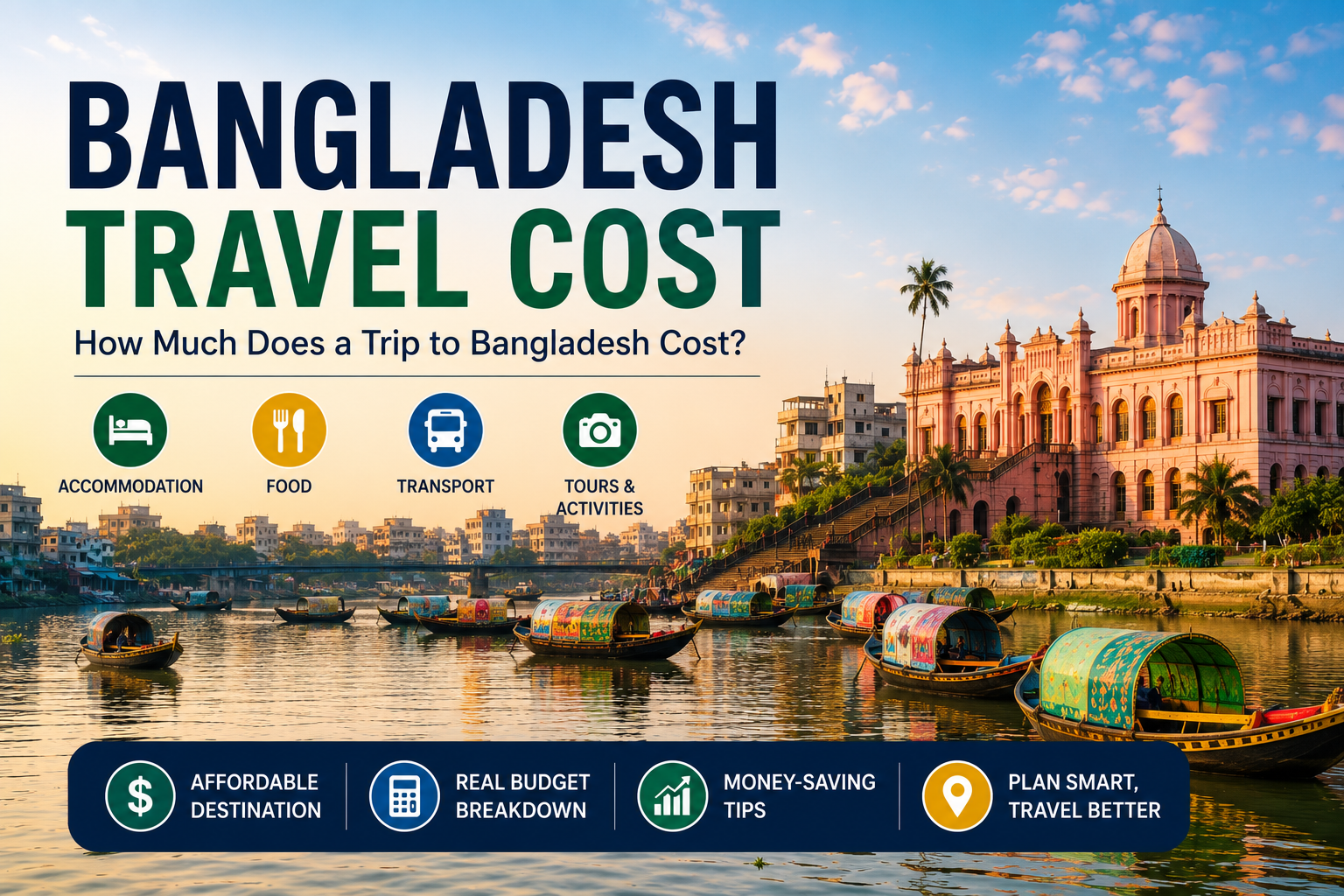
When people ask about Bangladesh travel cost, they’re usually asking one simple question: “Can I experience the country without overspending?”
Bangladesh is one of South Asia’s most affordable destinations, but the total cost of your trip depends far less on the country itself than on how you choose to travel.
A traveler staying in locally owned guesthouses, eating traditional Bangladeshi food, and using trains will spend dramatically less than someone booking premium hotels and domestic flights between every destination. The encouraging news is that even comfortable, mid-range travel in Bangladesh often costs significantly less than a similar trip in many neighboring countries.
If you’re visiting from the United States, Canada, Europe, or Australia, you’ll probably find that your travel budget stretches much further than expected.
This guide breaks down the real costs of traveling in Bangladesh, from accommodation and transportation to food, entrance fees, and guided tours. More importantly, it explains where it’s worth spending a little more—and where you can comfortably save without sacrificing the experience.
Is Bangladesh an Expensive Destination for Tourists?
For most international visitors, the answer is no.
Bangladesh remains one of the more affordable countries to explore in Asia, particularly for travelers who enjoy authentic local experiences rather than luxury resorts. Accommodation, food, and domestic transportation are generally excellent value, allowing visitors to experience far more for the same budget they might spend elsewhere.
That doesn’t mean every trip costs the same.
A backpacker traveling independently will have very different daily expenses from a couple staying in boutique hotels or a family booking private transportation throughout the country.
The good news is that Bangladesh offers flexibility. Whether your budget is modest or more comfortable, it’s possible to build a rewarding itinerary without feeling restricted by cost.
What Influences the Cost of Your Trip?
Before looking at numbers, it’s worth understanding what actually shapes your budget.
For most travelers, accommodation is the largest expense, followed by transportation between regions. Food, surprisingly, is rarely the deciding factor. Eating at local restaurants is both affordable and one of the highlights of visiting Bangladesh.
Your itinerary also matters.
A journey focused on Dhaka, Sreemangal, and Sylhet is generally less expensive than one that includes domestic flights or a multi-day cruise through the Sundarbans. Likewise, choosing guided experiences instead of arranging everything independently may increase the upfront cost, but often saves time, reduces planning stress, and creates a richer overall experience.
Regarding Bangladesh travel cost the question shouldn’t simply be, “How can I spend less?”
A better question is:
“Where does spending a little more create a much better trip?”
How Much Should You Budget Per Day?
There’s no universal travel budget, but most visitors naturally fall into one of three categories.
Budget Traveler
If you’re comfortable staying in simple guesthouses, using public transportation, and eating primarily at local restaurants, Bangladesh is remarkably affordable.
This style of travel is ideal for backpackers, long-term travelers, and visitors who enjoy independent exploration. While it requires more planning and flexibility, it allows you to experience the country on a relatively modest daily budget.
Keep in mind that budget travel shouldn’t mean sacrificing safety or comfort. Choosing well-reviewed accommodation and reliable transport is almost always worth the small additional cost.
Mid-Range Traveler
This is where we think Bangladesh offers exceptional value.
Most international visitors fall into this category. Comfortable hotels, air-conditioned transportation when needed, guided experiences, and meals at both local and international restaurants remain surprisingly affordable compared with many other destinations in Asia.
It’s also the budget level we recommend for first-time visitors.
Rather than worrying about every expense, you’ll have the flexibility to join experiences such as an Old Dhaka Tour, enjoy a Dhaka Food Tour, or extend your trip with a professionally organized Sreemangal and Sylhet Tour without dramatically increasing your overall travel costs.
If we were planning this trip ourselves…
This is the budget we’d choose.
Not because it’s luxurious, but because it removes many of the small inconveniences that can distract from the experience while still offering excellent value for money.
Luxury Traveler
Bangladesh isn’t widely known as a luxury destination, but high-end travel is certainly possible.
International-standard hotels are available in Dhaka and several other major cities, while private transportation, boutique accommodation, and customized tours provide a comfortable way to explore the country.
Even at this level, many travelers are pleasantly surprised by how far their budget goes compared with destinations where luxury travel comes with a much higher price tag.
Where Your Travel Budget Goes
Once you arrive in Bangladesh, you’ll quickly notice something interesting.
It’s rarely the day-to-day expenses that determine the cost of your trip.
A cup of tea, a ride in a rickshaw, lunch at a local restaurant, or an entrance ticket to a historic site costs very little compared with what many international visitors are used to paying.
Instead, your overall budget is usually shaped by three things:
- Where you stay
- How you travel between destinations
- Whether you travel independently or join organized tours
Understanding those three categories makes it much easier to plan a realistic budget before you arrive.
Accommodation Costs
Accommodation is likely to be the largest part of your travel budget, but Bangladesh offers options for almost every style of traveler.
Budget guesthouses can be found in most cities, while comfortable three- and four-star hotels are widely available in Dhaka, Sylhet, Chattogram, and other major destinations. Travelers looking for a premium experience will also find international hotel brands and boutique properties in selected locations.
Here’s what most international visitors can expect to pay per night.
| Accommodation | Typical Price (USD) |
| Budget guesthouse | $10–25 |
| Mid-range hotel | $35–80 |
| Boutique hotel | $80–150 |
| Luxury hotel | $150+ |
If you’re visiting Bangladesh for the first time, we generally recommend choosing comfortable mid-range hotels. The difference in price is often modest, but the improvements in location, cleanliness, and service can make your trip considerably more enjoyable.
Food Costs
Bangladesh is one of those destinations where eating locally isn’t just the most affordable option—it’s often the most rewarding.
Whether you’re enjoying biryani in Old Dhaka, fresh fish in Sylhet, or homemade curries in a family-run restaurant, you’ll discover that authentic Bangladeshi food delivers excellent value.
Approximate meal prices are shown below.
| Dining Style | Typical Price (USD) |
| Street food & snacks | $1–3 |
| Local restaurant | $3–8 |
| Casual café | $5–12 |
| International restaurant | $12–25 |
One of the easiest ways to experience Bangladesh’s food culture is through a Food Tour in Dhaka, where local guides introduce visitors to dishes and restaurants that are difficult to discover independently.
If we were planning this trip ourselves…
We’d happily spend a little more on memorable local food experiences and less on international restaurants. Some of Bangladesh’s best meals are also its most affordable.
Transportation Costs
Transportation costs depend largely on the distances you plan to cover.
Within cities, ride-sharing services and rickshaws make getting around relatively inexpensive. Longer journeys between regions may involve trains, buses, domestic flights, or private vehicles depending on your itinerary.
Typical transportation costs include:
| Transportation | Typical Cost (USD) |
| Rickshaw ride | $1–3 |
| Ride-sharing (city) | $2–8 |
| Intercity train | $5–20 |
| Intercity bus | $5–15 |
| Domestic flight | $40–120 |
| Private car with driver | Varies by route |
For first-time visitors, trains are often the most enjoyable way to travel between Dhaka and Sreemangal, combining comfort with scenic countryside views.
Private transportation becomes particularly valuable when exploring destinations that are less accessible by public transport or when traveling as a family or small group.
Entrance Fees and Guided Experiences
Many of Bangladesh’s museums, archaeological sites, and historical attractions charge relatively modest entrance fees.
Where visitors usually spend more is on experiences rather than admission tickets.
Guided tours, wildlife cruises, and multi-day itineraries include transportation, local expertise, permits, and logistical planning that would otherwise require considerable time to organize independently.
Rather than asking whether a tour is cheaper than traveling alone, it’s often worth asking a different question:
Will it improve the experience enough to justify the cost?
For many first-time visitors, the answer is yes.
An Old Dhaka Tour helps you discover neighborhoods that are easy to miss without local knowledge. A Sreemangal and Sylhet Tour simplifies regional travel, while a Sundarbans and Bagerhat Tour removes the complexity of permits, accommodation, and boat arrangements.
In each case, you’re paying for convenience—but also for context.
That’s often where the greatest value lies.
Sample Travel Budgets
Numbers become much more useful when they’re connected to a real itinerary.
The examples below assume comfortable mid-range travel and are intended as planning estimates rather than fixed prices.
Estimated Cost for a 7-Day Trip
A one-week itinerary covering Dhaka, Sreemangal, and Sylhet typically offers the best value for first-time visitors.
| Category | Estimated Cost (USD) |
| Accommodation | $280–500 |
| Food | $100–180 |
| Transportation | $80–180 |
| Activities & tours | $150–300 |
| Estimated Total | $610–1,160 |
Estimated Cost for a 10-Day Trip
Adding the Sundarbans increases transportation and tour costs but also creates a far more diverse travel experience.
| Category | Estimated Cost (USD) |
| Accommodation | $400–700 |
| Food | $150–250 |
| Transportation | $150–300 |
| Activities & tours | $300–600 |
| Estimated Total | $1,000–1,850 |
Estimated Cost for a 14-Day Trip
A two-week journey provides enough time to explore Bangladesh at a relaxed pace while including destinations such as North Bengal, the Sundarbans, and the tea-growing region.
Rather than increasing your daily budget dramatically, the additional cost comes mainly from spending more days in the country.
For many travelers, the daily average remains surprisingly affordable compared with other international destinations.
How to Save Money Without Missing the Best Experiences
Traveling on a budget doesn’t have to mean cutting the best parts out of your trip.
In Bangladesh, some of the most memorable experiences—sharing tea with locals, exploring centuries-old neighborhoods, cruising along quiet rivers, or eating at family-run restaurants—cost very little. The real challenge isn’t finding ways to spend less; it’s knowing where your money makes the biggest difference.
If you’re trying to stretch your budget, these are the decisions we’d make.
Spend Less on Hotels, More on Experiences
Many first-time visitors assume they should reserve most of their budget for accommodation.
We’d do the opposite.
A clean, comfortable mid-range hotel is usually more than enough in Bangladesh, especially if you’re spending most of your day exploring. The money you save can be invested in experiences that genuinely shape your trip, whether that’s exploring Old Dhaka with a knowledgeable local guide or spending several days in the Sundarbans with an experienced crew.
Years later, most travelers remember the places they explored—not whether the hotel lobby had marble floors.
Eat Where Local People Eat
Bangladesh is one of the few destinations where eating locally is often both the most affordable and the most authentic choice.
Small restaurants serving biryani, fresh fish, curries, and traditional sweets offer excellent food at prices that are difficult to believe for many international visitors.
That doesn’t mean you should avoid international restaurants altogether. They’re easy to find in Dhaka and other major cities if you want a familiar meal. But if your goal is to experience Bangladesh, local restaurants will usually give you a better meal, a more memorable atmosphere, and a much lower bill.
Food is one of the easiest places to save money without feeling like you’re compromising.
Travel a Little Slower
Trying to visit too many destinations usually increases your costs.
Every additional stop means another train ticket, another hotel check-in, another transfer, and another travel day that could have been spent exploring.
Instead of adding another city simply because it’s nearby, ask yourself whether spending one more night where you already are might create a better experience.
More often than not, the answer is yes.
Choose Guided Tours Where They Add Real Value
Not every part of Bangladesh requires a guide.
Exploring neighborhoods, visiting museums, or enjoying local cafés can often be done independently with a little planning.
Other experiences are different.
The Sundarbans is a good example. Organizing permits, transportation, accommodation, and river cruises independently takes considerable time and local knowledge. In situations like this, a professionally organized Sundarbans and Bagerhat Tour isn’t simply a convenience—it’s often the easiest and most rewarding way to experience the region.
The same principle applies in Dhaka. A guided Old Dhaka Tour or Dhaka Food Tour won’t necessarily save money, but it often helps visitors discover places they would otherwise walk straight past.
If we were planning this trip ourselves…
We’d spend less on unnecessary upgrades and more on experiences that help us understand the destination. Those are usually the moments that become lasting memories.
Is Bangladesh Good Value for Money?
We believe so.
Not because it’s one of the cheapest countries to visit, but because of what you receive in return for your budget.
Few destinations allow you to combine UNESCO World Heritage Sites, remarkable wildlife, vibrant cities, tea plantations, river life, and outstanding local cuisine without placing significant pressure on your travel budget.
Whether you’re enjoying street food in Old Dhaka, watching the sunrise over the Sundarbans, or walking through the tea estates of Sreemangal, you’ll often find that the experience feels far more valuable than the amount you’ve spent.
That’s one of Bangladesh’s greatest strengths.
Our Suggested Budget for First-Time Visitors
People often ask us a simple question:
“If this were your trip, how much would you budget?”
Our answer is usually straightforward.
For most first-time visitors, we’d plan around a comfortable mid-range budget of approximately USD $100–180 per person, per day, excluding international flights.
That budget typically allows you to:
- Stay in comfortable, well-reviewed hotels.
- Enjoy a mix of local and international dining.
- Use reliable transportation between destinations.
- Join guided experiences where they genuinely improve the trip.
- Travel without constantly worrying about every small expense.
Could you spend less?
Absolutely.
Could you spend considerably more?
Of course.
But for most travelers, this budget strikes the right balance between comfort, flexibility, and value.
Frequently Asked Questions: Bangladesh Travel Cost
Is Bangladesh cheaper than India or Nepal?
Generally, yes. Bangladesh is often comparable to Nepal and slightly more affordable than many popular tourist regions in India, particularly when it comes to food, local transportation, and accommodation. Costs will vary depending on your travel style and itinerary.
How much cash should I carry in Bangladesh?
You don’t need to carry large amounts of cash, but it’s sensible to have enough Bangladeshi Taka for small purchases, local transport, markets, and restaurants outside major cities. Hotels and larger businesses increasingly accept international cards, especially in Dhaka.
Are guided tours worth the extra cost?
For many first-time visitors, yes.
Guided tours simplify logistics, provide valuable local knowledge, and often make destinations such as the Sundarbans, Sonargaon, or North Bengal much easier to experience. Independent travel works well in many situations, but organized tours can save both time and unnecessary planning.
When is Bangladesh the most affordable to visit?
Prices remain relatively reasonable throughout the year, but accommodation demand is highest during the cooler months between November and March. Traveling during the shoulder seasons may offer better hotel availability while still providing enjoyable weather in many parts of the country.
Can I travel comfortably on a mid-range budget?
Absolutely.
In fact, we think Bangladesh offers some of its best value in the mid-range category. Comfortable hotels, excellent local food, reliable transportation, and memorable guided experiences remain surprisingly affordable compared with many other destinations in Asia.
Final Thoughts
Planning a travel budget isn’t about finding the cheapest possible trip—it’s about spending wisely.
Bangladesh rewards thoughtful travelers. You don’t need luxury hotels to enjoy it, nor do you need an unlimited budget to experience its history, landscapes, and hospitality.
If you prioritize meaningful experiences, travel at a comfortable pace, and leave room for the unexpected, you’ll likely discover something many visitors say after returning home:
Bangladesh delivered far more than they expected, while costing far less than they imagined.