On a traveler’s first morning in Dhaka, Bangladesh can feel wonderfully open.
A tea seller may ask where you are from. A family at the next table may recommend what to order. Someone might help you find the correct street without being asked. By lunchtime, you may have received more questions, smiles and offers of tea than you would normally encounter during an entire week at home.
This warmth is one of the pleasures of traveling in Bangladesh. It can also make first-time visitors wonder how they should respond. Should you shake hands? What should you wear? Is tipping expected? Can you photograph people in a market? What happens when you enter a mosque or someone’s home?
Bangladesh cultural etiquette is less about memorizing rigid rules and more about reading the situation with patience and respect. The country is socially diverse. Behavior that feels completely ordinary in central Dhaka may seem less appropriate in a conservative village, religious compound or family home.
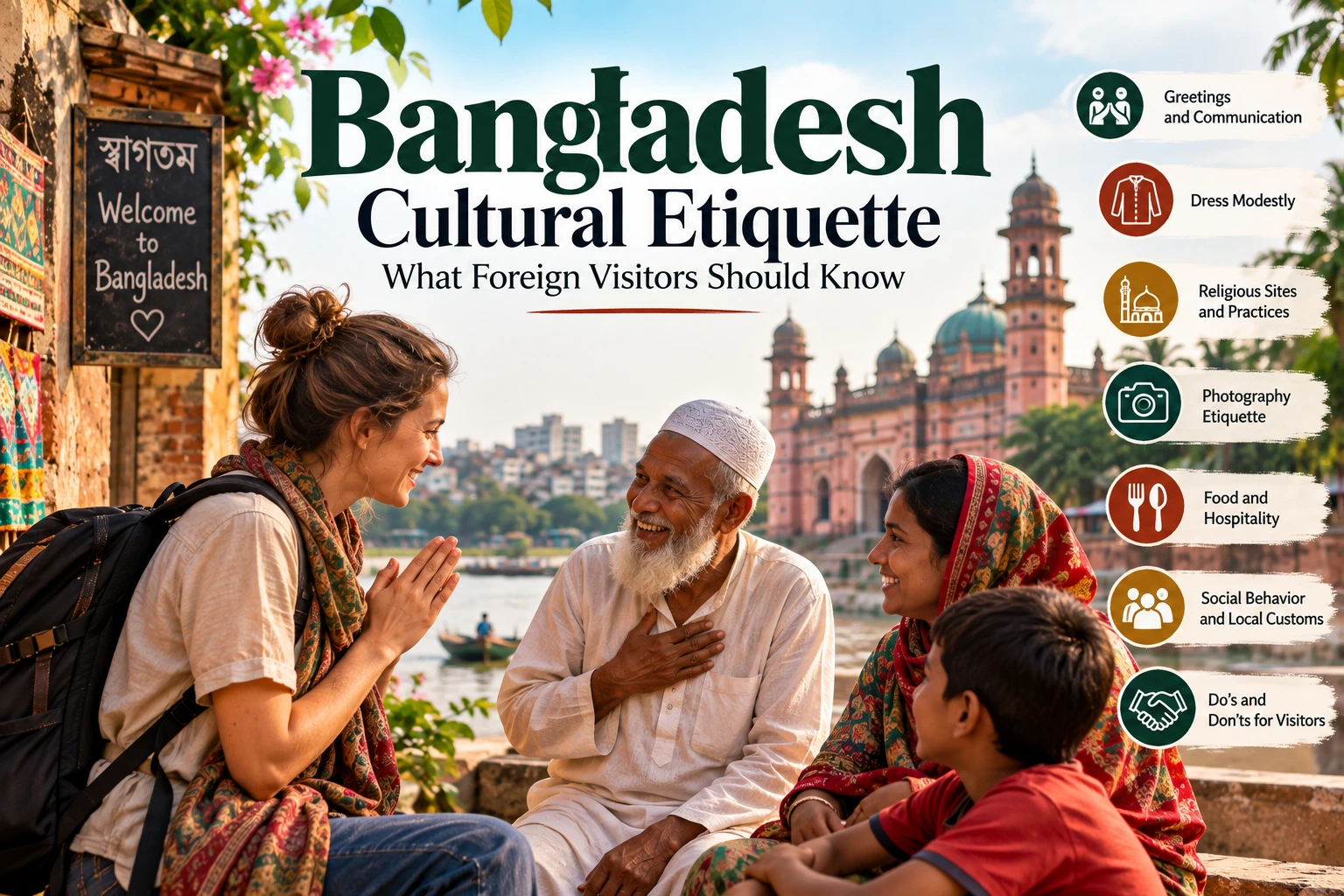
For most visitors, the safest principles are straightforward: dress modestly, greet people politely, ask before photographing them, respect religious spaces and accept hospitality graciously.
This guide was reviewed on September 27, 2026. Cultural practices differ between families, regions, religions and generations. When you are uncertain, ask your host or local guide rather than assuming one rule applies everywhere.
What Is Considered Respectful Behavior in Bangladesh?
Respectful behavior in Bangladesh usually means speaking courteously, showing consideration toward elders, dressing for the setting and avoiding conduct that might embarrass another person publicly.
Bangladeshi hospitality can feel personal very quickly. Someone you have only recently met may ask where you are from, whether you are married, what work you do or how long you will stay in the country. Questions that might feel private in the United States, Canada, Australia or Europe are often intended as friendly conversation.
You do not have to answer anything that makes you uncomfortable. A warm but general answer is usually enough.
Begin with observation rather than assumptions
There is no single set of Bangladesh customs that describes every community.
Dhaka is different from a village in North Bengal. A professional meeting differs from a family lunch. A mosque, Hindu temple, Buddhist monastery and church each has its own expectations. Indigenous communities in the Chittagong Hill Tracts also have distinct languages, customs and social structures.
Observe how local people behave, listen to instructions and ask permission when the situation is unclear. A simple question—“Is it okay if I enter?” or “May I take a photograph?”—prevents most cultural misunderstandings.
Treat curiosity with patience
Foreign visitors frequently attract friendly attention, especially outside established tourist areas. People may ask to take a selfie with you or begin a conversation in English.
You can accept or decline politely. A smile and “Sorry, not now” is sufficient if you do not want a photograph. You are not obligated to participate simply because someone asks.
The same principle should guide your own behavior. Local people have the same right to decline your camera, questions or social-media content.
How Should Tourists Greet People in Bangladesh?
A polite greeting creates an immediate sense of goodwill.
“Assalamu alaikum” is widely used among Muslims and means “peace be upon you.” The usual reply is “Wa alaikum assalam.” “Nomoshkar” is a traditional Bengali greeting used particularly within Hindu communities. “Hello” and “Good morning” are also commonly understood, especially in cities and tourism settings.
You do not need to identify someone’s religion before speaking. A friendly “Hello” works in almost any situation.
Handshakes and personal boundaries
Handshakes are common in professional and tourism settings, particularly between men. However, some women and men may prefer not to shake hands with a person of another gender for personal or religious reasons.
The respectful approach is to pause and let the other person initiate. If no hand is offered, place your right hand lightly over your chest, smile and offer a verbal greeting.
Do not interpret the absence of a handshake as unfriendliness. It may simply reflect a person’s comfort, faith or family custom.
Names and respectful forms of address
Titles and relationship terms are frequently used to show warmth and respect.
You may hear:
- Bhai for an older or similarly aged man, meaning brother
- Apu for a woman, meaning older sister
- Uncle or Aunty for an older person
- Sir or Madam in formal and service settings
Visitors do not have to use these terms constantly. Using a person’s preferred name or professional title is perfectly acceptable.
If you are introduced to someone older, begin slightly more formally. The person will usually indicate if a more relaxed style is appropriate.
What Is the Dress Code in Bangladesh?
Bangladesh does not have one universal tourist uniform. Foreign visitors can wear Western clothing, but modest, lightweight clothes are the most comfortable and culturally adaptable choice.
The UK government advises both men and women to dress modestly in Bangladesh and specifically recommends that women cover their shoulders and legs in public. Bangladesh travel advice
For ordinary sightseeing, consider:
- Loose trousers or a long skirt
- A breathable shirt or blouse covering the shoulders
- A longer top or tunic
- Comfortable walking shoes or sandals
- A lightweight scarf for religious sites
- Clothing that is not transparent
Modest clothing also protects against strong sunlight, dust, insects and aggressive air conditioning.
Dress guidance for women
Women do not generally need to cover their hair while walking around Dhaka or traveling through Bangladesh. However, carrying a scarf is useful for mosque visits and conservative rural settings.
Loose trousers, ankle-length skirts, tunics, modest dresses and sleeved tops work well. A locally purchased salwar kameez can also be comfortable, but foreign visitors are not expected to adopt Bangladeshi clothing.
Very short shorts, low-cut tops and transparent or extremely tight clothing may attract unwanted attention and can feel out of place at religious, rural or family locations.
Dress guidance for men
Men can normally wear trousers, chinos or jeans with a T-shirt, polo shirt or button-down shirt.
Long trousers are more adaptable than shorts, especially when visiting:
- Mosques and religious compounds
- Rural communities
- Family homes
- Government or institutional buildings
- Heritage locations connected to worship
- Formal restaurants or meetings
Knee-length shorts may be accepted in certain casual tourism settings, but they are not the most versatile option for cultural travel.
Dress according to the place
Clothing suitable for a modern Dhaka hotel may not be appropriate inside a village mosque. Beachwear suitable for a private resort may attract attention on a busy public beach.
The goal is not to erase your identity. It is to recognize that the same outfit communicates differently in different surroundings.
What Is the Etiquette for Visiting a Mosque?
Bangladesh contains historic and contemporary mosques that are active places of worship, not simply architectural attractions.
Visitors should obtain permission before entering, especially when a building does not operate as a formal tourist site. Some mosques may restrict access to prayer areas or limit visits during worship.
Before entering a mosque
Wear clean, modest clothing. Legs and shoulders should be covered. Women may be asked or expected to cover their hair, so carrying a scarf is helpful.
Remove your shoes before stepping onto the prayer-area floor. Place them where your host or the mosque attendant indicates. If you are unsure which entrance to use, ask.
Inside the prayer space
Keep your voice low and put your phone on silent. Avoid walking directly in front of someone who is praying. Do not touch religious books or architectural features unless invited.
Men’s and women’s prayer spaces may be separate. Follow the directions given by the caretaker or your guide.
Photography rules differ. A building may allow exterior photography but restrict photographs inside. Always ask before photographing worshippers, religious leaders or people engaged in prayer.
Avoid scheduling a casual mosque visit during Friday congregational prayer unless you have been invited or are attending for a specific purpose. The space can be extremely busy, and worshippers should have priority.
How Should Visitors Behave at Temples, Monasteries and Churches?
Bangladesh is a Muslim-majority country, but its cultural landscape also includes Hindu temples, Buddhist monasteries, Christian churches and Indigenous spiritual traditions.
Every religious site deserves the same basic respect.
Hindu temple etiquette
Remove your shoes where instructed and dress modestly. Some inner areas may be reserved for worshippers or members of the faith.
Do not touch statues, offerings, lamps or ritual items unless invited. Ask before photographing priests, worshippers or ceremonies.
During festivals, a temple may be crowded and emotionally significant. Give worshippers space instead of treating the ceremony as a performance arranged for visitors.
Buddhist monastery etiquette
Speak quietly, wear modest clothing and follow instructions regarding shoes. Avoid touching monks, sacred objects or religious images.
Physical-contact customs can differ by community and gender. Allow your host or guide to lead the interaction.
Church etiquette
Church access is often straightforward, but visitors should remain quiet during services and ask before photographing worshippers. Dress modestly and avoid walking around during prayers or sermons.
How Should You Behave During Ramadan?
Ramadan is a sacred month during which many Muslims fast from dawn until sunset. The rhythm of cities and communities can change considerably.
Restaurants may have different daytime hours. Traffic often becomes heavy before sunset as people travel home for iftar, the meal that breaks the fast. Offices and attractions may also adjust their schedules.
Non-Muslim visitors are not expected to fast. However, discretion is appreciated, particularly in conservative areas.
Respecting people who are fasting
You can eat and drink, but avoid making a display of food in front of people who are fasting when a private or designated dining space is available.
Be patient during the late afternoon. Fasting, heat and crowded transport can leave people tired. After sunset, cities often become livelier as families eat, shop and visit relatives.
If you are invited to iftar, arrive on time. The fast ends at a specific moment, so this is not an occasion for casual lateness.
Accepting a date, water or a small portion of food is a courteous way to join the gathering. You do not have to sample every dish.
What Is Dining Etiquette in Bangladesh?
Food is central to Bangladeshi hospitality. A host may offer tea, fruit, sweets or a full meal even when your visit was not planned around food.
Refusing everything immediately may disappoint a generous host. If you can, accept at least tea, water or a small portion. If you have allergies or dietary restrictions, explain them politely and early.
Eating with your hand
Many Bangladeshis eat rice and curry using the fingers of the right hand. Spoons and forks are also widely available, particularly in restaurants.
Foreign visitors are not expected to eat by hand. If you want to try, use your right hand and take a small amount of food at a time. Avoid placing your fingers deeply into shared dishes.
The Cultural Atlas notes that items are commonly passed with the right hand or both hands.
Wait for the host’s direction
At a family meal, wait until your host shows you where to sit and indicates that the meal has begun. Elders or guests may be served first.
Hosts sometimes continue offering food after you say you are full. This often expresses hospitality rather than pressure. Thank them warmly and repeat that you have eaten enough.
If you want to understand how food, family and heritage connect, a thoughtfully managed Dhaka Food Tour can provide much more context than ordering unfamiliar dishes alone.
Dietary needs
Much of the meat served in Bangladesh is halal, but vegetarian travelers should still explain whether they avoid fish, eggs, dairy or cooking ingredients such as shrimp paste.
Food allergies require especially clear communication. Translate the allergy into Bengali before the trip and carry a written card if exposure could be medically serious.
Alcohol is not a normal part of most social meals. Availability and legal restrictions differ, so visitors should follow current laws and licensed-venue rules rather than assuming the norms of their home country apply.
Should You Remove Your Shoes in a Bangladeshi Home?
Yes, in many homes you should remove your shoes before entering the main living area. Look for shoes near the doorway or wait for the host’s instruction.
Some households may tell a foreign guest to keep their shoes on. Follow the host rather than insisting on your interpretation of the custom.
Bringing a small gift
A gift is not mandatory, but fruit, sweets or something modest from your home country can be a thoughtful gesture when visiting a family.
Avoid making the gift too expensive. An elaborate present can create pressure to reciprocate.
If children are present, do not distribute money, sweets or gifts without asking their parent or guardian.
Respecting the household
Family homes are private spaces. Never photograph bedrooms, family members, religious objects or personal possessions without permission.
Do not assume that an invitation into someone’s home includes permission to publish their lives online.
Is Tipping Expected in Bangladesh?
Tipping in Bangladesh is appreciated in many tourism and hospitality situations, but it is not governed by one fixed national rule.
Restaurants, hotels and tour services may already include a service charge. Check the bill before adding anything.
Where a tip may be appropriate
Travelers may choose to tip:
- Restaurant staff when service is not already included
- Hotel porters or housekeeping staff
- Drivers
- Local guides
- Boat crews
- Staff who provide substantial personal assistance
The amount should reflect the service, trip length and your satisfaction. It should not be treated as a compulsory payment.
Give tips discreetly and directly when possible. In a group-tour setting, ask whether gratuities are pooled among the team.
Where tipping can feel inappropriate
Do not offer money to ordinary people simply because you photographed or spoke with them. This can turn a human interaction into a transaction and may create expectations for future visitors.
When photographing an artisan, vendor or performer, purchasing their legitimate product or service may be more respectful than handing over money solely for a picture.
Is Bargaining Acceptable in Bangladesh?
Bargaining is normal in some traditional markets and transport situations, but not everywhere.
You may negotiate at:
- Souvenir stalls
- Some traditional markets
- Certain craft shops
- Informal transport services without a meter or published fare
You should not generally bargain in supermarkets, pharmacies, established restaurants, shopping malls or businesses displaying fixed prices.
Keep negotiation light and courteous. A small amount may mean more to the seller than it does to you. If you cannot agree, thank the person and walk away without insulting the product or the seller.
How Should Foreign Visitors Handle Photography?
Photography is one of the areas where good cultural etiquette matters most.
Dhaka’s streets are visually extraordinary, but a dramatic image is not automatically an ethical image. Markets, factories, river ports and railway areas are workplaces and communities—not photography sets.
Ask before taking identifiable portraits
For a close portrait, establish contact first. Smile, gesture toward the camera or ask directly.
If the person declines, lower the camera immediately. Do not attempt the photograph from another angle.
Consent is especially important when photographing:
- Children
- Workers
- People experiencing poverty
- Patients or injured people
- Religious worshippers
- People inside homes
- Women in conservative communities
- Indigenous communities
- Anyone in a vulnerable or distressing situation
Children cannot always provide meaningful consent themselves. Ask a parent or responsible adult.
Avoid poverty-focused storytelling
A photograph of difficult living or working conditions requires context, dignity and a legitimate editorial purpose.
Do not describe people as “poor,” “helpless” or “primitive” merely to create emotional engagement. Avoid captions that reduce an individual to a visual symbol of hardship.
If you cannot explain who the person is, what is happening and why the image should be published, consider whether you should publish it at all.
A responsible Street Photography Tour in Dhaka should prioritize consent, cultural explanation and participant safety—not simply access to visually dramatic people.
Be cautious near sensitive locations
Avoid photographing military facilities, security personnel, checkpoints, government infrastructure and restricted industrial sites without clear authorization.
Rules can change, and a location that appears ordinary may still be sensitive. Follow signs and local instructions.
What Should Visitors Know About Public Affection and Personal Space?
Public displays of affection are generally more restrained than in many Western countries. Holding hands may attract little attention, but prolonged kissing or intimate behavior can cause discomfort.
Affection between friends of the same gender can appear physically warm. Friends may walk closely or hold hands without romantic meaning.
Crowds can also reduce personal space. Markets, buses, ferries and railway stations may feel much closer than visitors are used to. Crowding is usually practical rather than aggressive, although travelers should still protect their belongings.
Couples should behave more conservatively in villages, religious sites and family settings than they might inside an international hotel.
How Does Communication Differ in Bangladesh?
Bangladeshi communication is often relational. A conversation may begin with greetings, tea and personal questions before moving to business or logistics.
Foreign visitors sometimes interpret this as inefficient. Local people may interpret an extremely direct approach as cold or impatient.
A polite response may not be a firm agreement
“Yes” can sometimes mean “I heard you” rather than “I guarantee this will happen.” When confirming transport, opening hours or arrangements, ask a clear follow-up question.
Instead of asking, “The museum is open, yes?” ask, “What time does the museum open today, and when should we arrive?”
This invites specific information without creating embarrassment.
Avoid public confrontation
Correcting or criticizing someone loudly in front of others can cause humiliation. If a problem occurs, speak privately and calmly.
A respectful tone is usually more effective than raising your voice. This is particularly important with service workers, drivers and junior employees who may not control the situation.
Time can be flexible
Professional appointments may follow a structured schedule, but traffic, weather and local events frequently cause delays.
Confirm important arrangements in writing and build extra time into your itinerary. Being flexible does not mean accepting every delay; it means addressing the problem without unnecessary confrontation.
How Should Tourists Interact With Elders and Families?
Age usually carries social respect. Greet older people first when entering a family gathering and allow them to lead conversations about seating or meals.
You do not need to adopt gestures you do not understand. A polite greeting and attentive manner are sufficient.
Family is central to much of Bangladeshi social life. Asking respectful questions about someone’s hometown, food traditions or profession can create a warm conversation. Avoid pushing into sensitive matters such as income, politics or family conflict.
Are Etiquette Expectations Different in Old Dhaka?
Old Dhaka combines dense residential neighborhoods, markets, religious buildings, family businesses and nationally important heritage.
Visitors should remember that its narrow lanes are not preserved museum corridors. People live and work there.
During an Old Dhaka Tour:
- Keep doorways and shop entrances clear
- Ask before entering workshops
- Avoid blocking pedestrian traffic for photographs
- Dress modestly around mosques and residential areas
- Request permission before photographing artisans
- Do not touch food, textiles or religious items without asking
- Follow local advice around crowded markets
A good cultural experience should allow visitors to understand the neighborhood without disrupting it.
How Should You Behave at Panam City and Heritage Sites?
Historic places deserve more than a quick photograph.
At Panam City, archaeological areas and old religious buildings, do not climb on fragile structures, scratch names into walls, remove objects or cross barriers for a better angle.
If your itinerary includes Visiting Panam City, remember that the surrounding Sonargaon area is also a living community with artisans, vendors, families and active religious spaces.
Use an informed local guide where historical context or access rules are unclear. Heritage etiquette protects both the site and the people connected to it.
What Changes When Traveling in Rural Bangladesh?
Rural communities are often hospitable, but they may be more socially conservative and less accustomed to international visitors.
Wear adaptable clothing and ask before:
- Entering a courtyard
- Walking through farmland
- Photographing homes or children
- Visiting a workplace
- Entering a religious building
- Joining a festival
- Recording an interview
- Flying a drone
Do not treat a village visit as an opportunity to inspect people’s private lives.
If a tour includes tea estates, Indigenous communities or craft villages, Bangladesh Explore should arrange visits through appropriate community contacts. Consent should come from the individuals being photographed or interviewed, not only from a tour operator.
Common Cultural Mistakes to Avoid
Most mistakes are forgiven when visitors behave sincerely. The following problems are still easy to prevent:
- Photographing people without consent
- Wearing revealing clothing at religious or rural sites
- Entering a home or prayer space with shoes
- Touching religious objects without permission
- Publicly losing your temper
- Treating curiosity as hostility
- Assuming every Bangladeshi follows the same customs
- Giving children money without parental permission
- Publishing vulnerable people as travel entertainment
- Interrupting worship for photographs
- Bargaining aggressively over a small amount
- Expecting alcohol to be available everywhere
- Making jokes about religion, politics, poverty or national history
Respect is not performance. It is shown by how you behave when there is no photograph, review or social-media post to reward you.
A Simple Etiquette Checklist for Foreign Visitors
Before visiting Bangladesh:
- Pack modest, breathable clothing
- Bring a lightweight scarf
- Learn one or two Bengali greetings
- Prepare translations for allergies
- Read current local-law guidance
- Ask your tour operator about religious festivals
- Decide your photography consent policy
- Check whether your travel dates overlap Ramadan
During the journey:
- Observe before acting
- Let others initiate cross-gender handshakes
- Use your right hand or both hands when offering something
- Remove shoes where indicated
- Ask before photographing people
- Keep affection discreet in public
- Avoid confrontation
- Respect prayer times and religious boundaries
- Follow local instructions at heritage sites
- Accept hospitality graciously without feeling forced
Why Bangladesh Cultural Etiquette Improves Your Experience
Etiquette is not simply a list of restrictions. It gives travelers access to the more personal side of Bangladesh.
When you slow down, ask permission and show genuine interest, interactions change. A market visit becomes a conversation about family recipes. A mosque becomes part of a neighborhood’s living history. A portrait becomes a collaboration rather than an act of taking.
Foreign visitors do not need to perform Bangladeshi identity or behave perfectly. People usually appreciate an honest effort.
The most useful cultural habit is curiosity accompanied by humility: notice what people do, ask when you are uncertain and remember that you are entering someone else’s home, workplace, religious space or community.
Frequently Asked Questions
What should tourists wear in Bangladesh?
Tourists should choose lightweight, modest clothing that covers the shoulders and most of the legs. Women do not normally need to cover their hair in public, but carrying a scarf is useful for mosque visits. Men should choose long trousers when visiting religious, rural or formal locations.
Can women wear Western clothes in Bangladesh?
Yes. Western clothing is widely worn, particularly in cities. Loose trousers, long skirts, modest dresses, tunics and sleeved tops are generally suitable. Extremely short, revealing, tight or transparent clothing can feel inappropriate in conservative settings.
Do female tourists need to wear a hijab in Bangladesh?
No. Non-Muslim women are not generally required to cover their hair while traveling around Bangladesh. A head covering may be expected when entering certain mosques or religious spaces.
Can tourists enter mosques in Bangladesh?
Some mosques welcome respectful non-Muslim visitors, while others may restrict access to particular areas or times. Ask before entering, dress modestly, remove your shoes and avoid visiting during crowded prayers unless invited.
Is tipping expected in Bangladesh?
Tipping is appreciated in tourism and hospitality but is not universally mandatory. Check whether a restaurant or hotel has already included a service charge. Tips for guides, drivers, hotel staff and boat crews should reflect the quality and length of the service.
Is it acceptable to photograph people in Bangladesh?
Ask before taking an identifiable portrait. Consent is particularly important for children, workers, worshippers and vulnerable people. Permission to take a photograph does not automatically include permission to publish it commercially.
Can tourists hold hands in Bangladesh?
Holding hands generally causes less concern than kissing or intimate physical behavior. Couples should keep public affection restrained, particularly in villages, family settings and religious areas.
Should tourists remove their shoes in Bangladeshi homes?
In many homes, yes. Look for shoes near the entrance and follow the host’s direction. Shoes must also be removed before entering mosque prayer areas and many temples.
Is it rude to refuse food in Bangladesh?
A host may interpret an immediate refusal as excessive formality, but visitors are not required to eat food that conflicts with their health, faith or dietary needs. Explain the reason politely and, where possible, accept tea, water or a small portion.
Which hand should I use when eating or giving something?
Use your right hand when eating by hand, passing money, giving a gift or offering an item. Using both hands is also respectful in formal situations.
How should I greet someone in Bangladesh?
“Hello” is always safe. “Assalamu alaikum” is widely used among Muslims, while “Nomoshkar” is common among Hindus and in wider Bengali cultural settings. Let the other person initiate a handshake if you are uncertain.
Is bargaining acceptable in Bangladesh?
Bargaining is common in some traditional markets, informal transport situations and souvenir stalls. It is not appropriate in supermarkets, established restaurants, pharmacies or stores with fixed prices.