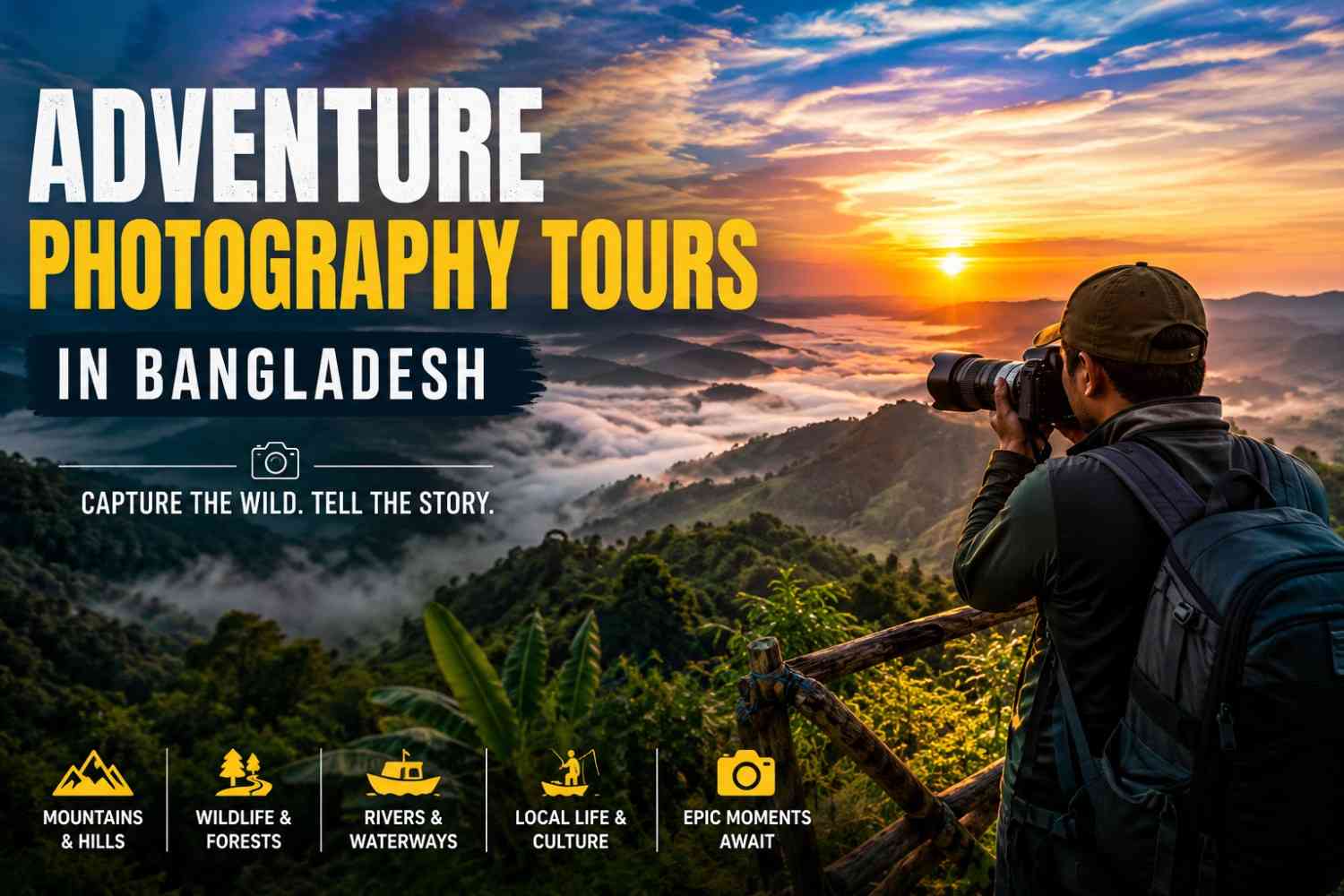
If your idea of travel photography goes beyond standing in front of famous landmarks, Bangladesh deserves a place on your list.
Here, photography can mean following a fishing boat into the morning mist, hiking through the hills of Bandarban, drifting through the waterways of the Sundarbans, walking through tea gardens in Sreemangal, or waiting for the last light over the Bay of Bengal.
The appeal of adventure photography tours in Bangladesh isn’t simply the scenery. It’s the combination of landscapes, people, wildlife, weather, movement and everyday life.
One morning you might be photographing a remote hill trail. The next, you’re surrounded by mangrove waterways. Later in the journey, you could be standing beside fishermen preparing their boats for another day at sea.
For photographers and visual storytellers, that variety is what makes Bangladesh special.
And because many of the country’s most rewarding photography locations require local knowledge, transportation planning and sometimes specialized access, traveling with an experienced local team can make a significant difference.
At Bangladesh Explore, we design journeys for travelers who want to experience Bangladesh while creating meaningful photographs and stories along the way.
Why Bangladesh Is Made for Adventure Photography
Bangladesh isn’t a conventional adventure destination in the way Nepal or Iceland might be.
There are no massive Himalayan peaks or dramatic desert expeditions.
Instead, Bangladesh offers something different: adventure hidden inside everyday landscapes.
Its geography is remarkably diverse.
You can move from:
- crowded urban streets
- to peaceful tea gardens
- from tropical beaches
- to remote hill communities
- from historic towns
- to enormous river systems
- and finally into one of the world’s great mangrove wildernesses.
That diversity creates opportunities for several kinds of photography.
Landscape Photography
Bangladesh’s rivers, wetlands, forests, hills and coastline offer constantly changing compositions.
Morning mist, monsoon clouds, reflections, boats and changing water levels can completely transform familiar locations.
Documentary Photography
For photographers interested in people and stories, Bangladesh is particularly rewarding.
Markets, fishermen, farmers, boatmen, tea workers, craftsmen and rural communities provide opportunities to document everyday life.
But good documentary photography requires more than pointing a camera at people.
Respect matters.
Ask permission when appropriate, particularly for close portraits, and be sensitive around religious ceremonies, private moments and vulnerable communities.
Wildlife Photography
The Sundarbans provides an entirely different photographic challenge.
Instead of chasing wildlife across open landscapes, you’ll often be photographing from waterways and observation areas while dealing with changing light, movement and distance.
Wildlife sightings are never guaranteed — and that’s part of the experience.
Adventure and Outdoor Photography
For photographers who want movement and physical exploration, the hill districts offer hiking, waterfalls, rivers, trails and dramatic viewpoints.
This is where the adventure in adventure photography becomes particularly important.
1. Bandarban: Bangladesh’s Adventure Photography Playground
If we had to choose one destination for photographers looking for adventure, Bandarban would be near the top of the list.
The landscape changes dramatically as you move into the Chittagong Hill Tracts.
Instead of flat delta landscapes, you’ll encounter:
- forested hills
- winding mountain roads
- waterfalls
- remote trails
- rivers
- viewpoints
- indigenous communities
- mist-covered landscapes
For photographers, Bandarban offers the opportunity to combine landscape, travel, cultural and adventure photography in one journey.
Explore the Bandarban Hill Tracts Guide
What to Photograph in Bandarban
The best images aren’t necessarily the famous viewpoints.
Look for:
Mountain roads:
Winding roads disappearing into green hills can create powerful leading lines.
Waterfalls:
During wetter periods, waterfalls and streams become dramatically more photogenic.
Hill communities:
Daily life provides opportunities for environmental portraits and documentary storytelling when photographed respectfully.
Early-morning landscapes:
Mist moving through the hills can completely change the mood of a scene.
Local transportation:
The distinctive vehicles used to navigate the hills can become part of the visual story.
Best Approach
Don’t try to rush Bandarban.
For photography, allow time for changing weather and unexpected opportunities. A planned itinerary is useful, but some of the strongest frames often come from slowing down and allowing the environment to reveal itself.
Bangladesh Explore’s Bandarban experiences include hiking and trekking, waterfalls, cultural experiences and the wider Chittagong Hill Tracts. (Bangladesh Explore)
2. Sundarbans: Wildlife, Waterways and Wilderness
The Sundarbans is where Bangladesh’s adventure photography becomes a completely different experience.
The world’s largest mangrove forest is a landscape shaped by tides.
There are no conventional roads taking you through the forest.
Instead, waterways become your routes.
You photograph from boats, forest trails and observation points while the environment changes around you.
Explore the Sundarbans Tour Experience
What Makes the Sundarbans Photogenic?
Everything moves differently here.
A fishing boat appears around a bend.
A kingfisher crosses the frame.
The sunlight breaks through the mangrove canopy.
A crocodile rests beside a muddy bank.
The river suddenly opens into a much wider landscape.
And sometimes, nothing happens for an hour.
That quiet is part of the photography experience.
Wildlife Photography
The Sundarbans is famous for the Royal Bengal Tiger, but photographers should never approach the forest expecting a guaranteed tiger photograph.
Wildlife is unpredictable.
Instead, come prepared to photograph the entire ecosystem:
- spotted deer
- crocodiles
- birds
- monkeys
- river dolphins
- fishing boats
- mangrove vegetation
- forest waterways
- local river life
A successful Sundarbans photography trip isn’t measured only by whether you photograph a tiger.
It’s about telling the story of the forest.
The Best Light
Early morning and late afternoon can provide particularly atmospheric conditions for photography.
Soft light on the waterways can create reflections and depth, while sunset can transform the river into a completely different landscape.
For photographers, a 3-day or longer Sundarbans experience can be much more rewarding than trying to squeeze the forest into a few hours. Bangladesh Explore’s current Sundarbans guidance similarly recommends a 3 Days / 2 Nights itinerary for many first-time international travelers. (Bangladesh Explore)
3. Cox’s Bazar: Photograph the Life Behind the Beach
Cox’s Bazar is famous for its coastline.
But if you’re traveling specifically for photography, don’t spend your entire trip photographing the beach.
Look beyond the postcard.
The most compelling stories can be found around the people whose lives depend on the sea.
Fishing boats, fishermen, seafood markets, drying yards, coastal communities and changing shoreline light create a completely different photographic experience.
Explore Bangladesh’s Coastal Photography Experiences
What to Photograph
Try looking for:
- traditional fishing boats
- fishermen preparing nets
- boats returning from sea
- fish markets
- coastal workers
- dry-fish processing
- shoreline communities
- sunrise and sunset
- waves and long exposures
This is where documentary photography and landscape photography overlap.
A photograph of a traditional boat sitting against the horizon is beautiful.
A photograph showing the same boat surrounded by fishermen preparing for another day at sea tells a much bigger story.
That’s the difference between photographing a destination and photographing its life.
4. Sreemangal: Tea Gardens, Forests and Rural Stories
Sreemangal offers a quieter kind of adventure.
The landscape is dominated by rolling tea gardens, forests and rural communities.
For photographers, this destination is particularly interesting because it gives you opportunities to work with:
- repeating patterns
- human scale
- environmental portraits
- green landscapes
- mist
- forest trails
- tea workers
- rural life
Explore the Sreemangal & Sylhet Tour
Photographing Tea Gardens
Tea plantations are naturally photogenic because of their geometry.
Rows of tea plants create repeating lines across the landscape, while workers introduce scale and human movement.
Try different perspectives.
Instead of photographing only the entire plantation, move closer.
Photograph hands picking tea leaves.
Photograph baskets.
Photograph the relationship between workers and the landscape.
Then step back and create the wide environmental frame.
That gives you a complete visual story rather than a collection of pretty landscapes.
5. Barisal: Adventure on Bangladesh’s Waterways
If your photography style focuses on river life, Barisal deserves serious consideration.
Here, waterways aren’t simply scenic attractions.
They are part of everyday life.
Boats function as transportation, workplaces and marketplaces.
The region’s famous floating markets offer an opportunity to photograph an unusual form of commerce where people and products move directly across the water.
What Can You Photograph?
- floating markets
- traditional wooden boats
- fruit traders
- riverbank villages
- fishermen
- reflections
- canals
- rural transportation
- morning river scenes
The visual possibilities become particularly interesting around sunrise when the water is calm and the light is soft.
This is the kind of environment where a 50mm or 85mm lens can be just as valuable as a wide-angle lens because you’re often looking for intimate moments rather than only grand landscapes.
6. Panam City and Sonargaon: Adventure Through History
Adventure photography doesn’t always mean climbing mountains or searching for wildlife.
Sometimes the adventure is simply finding stories hidden in old places.
Panam City in Sonargaon offers exactly that.
The historic street is lined with old merchant buildings whose weathered architecture creates dramatic textures, shadows and layers.
For photographers, the location works particularly well for:
- architectural photography
- documentary storytelling
- environmental portraits
- texture photography
- detail shots
- historical storytelling
Explore Panam City with Bangladesh Explore
The contrast between the old structures and surrounding modern Bangladesh can also create a strong visual narrative.
7. Dhaka: Where Urban Adventure Begins
Don’t underestimate Dhaka.
For an adventure photographer, the city can be one of the most visually intense parts of the journey.
Old Dhaka alone offers an extraordinary combination of:
- narrow streets
- rickshaws
- markets
- river life
- food
- architecture
- workshops
- religious sites
- street vendors
- human interaction
Explore Dhaka with Bangladesh Explore
Sadarghat is particularly powerful for photographers interested in river and documentary photography.
Large launches, small wooden boats, passengers, port workers and the Buriganga create layers of movement that are difficult to reproduce anywhere else.
And unlike a conventional landscape destination, Dhaka constantly changes.
You don’t necessarily need a spectacular viewpoint.
You need to pay attention.
What Makes a Good Adventure Photography Tour?
A good photography tour isn’t simply a normal tour with a camera in your bag.
The itinerary should be designed around light, access, movement and storytelling.
That means considering:
Time of Day
Sunrise and sunset aren’t just beautiful—they can completely change how a location looks.
Travel Time
Spending six hours in a vehicle to photograph a location for twenty minutes isn’t always an efficient photography experience.
Local Access
A local guide can help you understand where to go, whom to approach and how to navigate unfamiliar environments respectfully.
Flexibility
Weather, wildlife and human activity can’t always be scheduled.
A good photography itinerary leaves room for unexpected opportunities.
Different Visual Stories
The strongest trips don’t give you ten versions of the same landscape.
They give you different stories.
Landscape.
People.
Wildlife.
Architecture.
Movement.
Food.
Culture.
Environment.
That’s what makes a photography portfolio feel complete.
What Camera Gear Should You Bring to Bangladesh?
You don’t need a huge camera bag.
In fact, when you’re hiking through hills, moving between boats or walking busy streets, carrying too much equipment can become a disadvantage.
A practical setup might include:
Camera body:
A reliable weather-sealed mirrorless or DSLR body.
Wide-angle lens:
Useful for landscapes, architecture, interiors and environmental storytelling.
Standard zoom:
One of the most versatile options for travel.
Telephoto lens:
Particularly useful for wildlife and distant subjects in the Sundarbans.
Fast prime:
Excellent for portraits, low-light street photography and creating separation.
Extra batteries:
Especially important when you’re spending long periods away from charging facilities.
Memory cards:
Carry more than you think you’ll need.
Rain protection:
Bangladesh’s weather can change quickly, particularly during the monsoon.
Dry bags:
Essential when you’re spending significant time around rivers and boats.
The goal isn’t to bring every lens you own.
It’s to bring the equipment that allows you to keep moving without missing the shot.
Photography Etiquette in Bangladesh
One of the most important pieces of equipment on any photography trip is something you can’t buy:
respect.
Bangladesh is a welcoming country, and people are often curious about foreign photographers.
But curiosity isn’t permission.
Before photographing someone closely, particularly women, children, religious ceremonies or private moments, ask permission where appropriate.
Avoid turning vulnerable situations into entertainment.
Be especially careful around:
- religious sites
- private homes
- ceremonies
- children
- people in distress
- sensitive government or security locations
A good photograph should not come at the expense of someone’s dignity.
For more practical advice, our Bangladesh Travel Guide and travel resources can help you understand the country before you arrive.
When Is the Best Time for an Adventure Photography Tour in Bangladesh?
There isn’t one perfect month for every type of photography.
It depends on what you want to capture.
October to March
Generally more comfortable for many travelers, with cooler and drier conditions across much of the country.
This can be a particularly convenient period for combining multiple destinations.
Monsoon Season
The rainy season transforms Bangladesh.
Rivers expand, vegetation becomes intensely green and waterfalls become more dramatic.
For photographers willing to work around rain, this can produce some of the country’s most atmospheric images.
But wet-weather travel requires more preparation, particularly for camera protection and transportation.
The Real Rule
Don’t simply ask:
“When is Bangladesh most beautiful?”
Ask:
“What do I want to photograph?”
Wildlife, fishing life, tea gardens, waterfalls, rivers and urban photography can all have different ideal conditions.
How to Plan Your Bangladesh Adventure Photography Tour
If photography is your primary reason for traveling, don’t build your itinerary like a conventional sightseeing trip.
Instead, build it around visual stories.
For a Short Trip
Start with:
Dhaka → Cox’s Bazar
This gives you urban, cultural and coastal photography.
For Nature + Culture
Consider:
Dhaka → Sreemangal → Sylhet
You’ll get tea gardens, forests, rural life and landscapes.
For Wildlife + Heritage
Consider:
Dhaka → Bagerhat → Sundarbans
This combination is particularly strong because you can photograph both historic architecture and a wild natural environment.
Bangladesh Explore currently offers a Sundarbans and Bagerhat experience combining UNESCO heritage, mangrove waterways, wildlife and river life. (Bangladesh Explore)
For Adventure
Consider:
Dhaka → Bandarban
This is the route to prioritize if your main interest is hiking, mountains, waterfalls and remote landscapes.
For a Full Photography Expedition
A longer itinerary can combine:
Dhaka → Sreemangal → Bandarban → Cox’s Bazar → Sundarbans
That gives you an unusually broad visual range:
City → Tea → Mountains → Coast → Mangrove Wilderness
Why Choose Bangladesh Explore for a Photography Journey?
Photography travel requires more than finding beautiful places.
You need to know when to be there, how to get there and what is worth waiting for.
That’s where local knowledge becomes valuable.
Bangladesh Explore already designs photography-focused experiences around visual storytelling, including sunrise and sunset timing, hidden access, cultural encounters and diverse environments. Its dedicated Bangladesh Photography Tour combines locations such as Bandarban, Rangamati, Cox’s Bazar and Kuakata with a focus on creating stronger visual stories. (Bangladesh Explore)
The company also works with international and local photographers, filmmakers and content creators, with its current creator service stating experience with more than 25 creators. (Bangladesh Explore)
For travelers who don’t want to spend their trip worrying about every transfer, local transportation, permits, guides or access, that support can make the experience much smoother.
And the biggest advantage is simple:
You can concentrate on photography.
We handle more of the logistics.
You watch the light.
Ready to Photograph the Wild Side of Bangladesh?
Bangladesh isn’t a destination where every photograph comes from a famous viewpoint.
Some of the strongest images may come from a fisherman pulling a net at sunrise.
A boat disappearing into morning fog.
A tea worker moving between endless rows of green.
A hill trail emerging through the clouds.
A rickshaw crossing a chaotic Old Dhaka street.
Or a silent mangrove channel where you wait for something to appear.
That’s what makes an adventure photography tour in Bangladesh different.
You’re not simply collecting photographs.
You’re collecting stories.
If you’re ready to build a photography-focused journey around Bangladesh’s mountains, rivers, forests, coastline and culture, explore the Bangladesh Photography Tour or speak with Bangladesh Explore about creating a private photography itinerary around the locations and stories you want to capture.
Bring your camera. Leave room for the unexpected.
Frequently Asked Questions
Is Bangladesh good for adventure photography?
Yes. Bangladesh offers a wide range of environments for adventure photography, including mountains, forests, mangroves, rivers, beaches, tea gardens, rural communities and dense urban environments.
What are the best destinations for adventure photography in Bangladesh?
Some of the strongest options include Bandarban, the Sundarbans, Cox’s Bazar, Sreemangal, Barisal, Dhaka and Sonargaon/Panam City. Each offers a different photographic story.
What is the best place for wildlife photography in Bangladesh?
The Sundarbans is the country’s standout destination for wildlife photography, offering opportunities to photograph birds, deer, crocodiles, dolphins and other wildlife. A Royal Bengal Tiger sighting is possible but never guaranteed.
Is Bangladesh suitable for photography beginners?
Yes. You don’t need professional equipment or advanced photography skills. A basic interchangeable-lens camera—or even a modern smartphone—can produce excellent travel photographs if you focus on light, composition and storytelling.
Do I need a local guide for an adventure photography tour?
A local guide can be particularly valuable when visiting remote areas, wildlife destinations and culturally sensitive locations. Local knowledge can also help with transportation, timing, access and respectful interaction with communities.
What lens should I bring to Bangladesh?
A versatile standard zoom is an excellent starting point. Add a wide-angle lens for landscapes and architecture and a telephoto lens if wildlife photography is a priority, particularly in the Sundarbans.
Can I create a private photography itinerary in Bangladesh?
Yes. A private itinerary can be built around your preferred photography style, destinations, travel dates and pace. This can be particularly useful for photographers who want more time at specific locations rather than following a fixed sightseeing schedule.