If you’re planning your first trip to Bangladesh, there’s a good chance you’ve asked yourself one question before anything else:
Is Bangladesh safe to travel?
It’s an understandable concern. Bangladesh isn’t yet a mainstream tourist destination, especially for travelers from the United States, Canada, the United Kingdom, Australia, and much of Europe. Unlike Thailand or Japan, it rarely appears on lists of Asia’s most popular vacations, and many people’s first impressions come from international news rather than travel experiences.
That can make it difficult to separate perception from reality.
The truth is that Bangladesh is neither a destination you should fear nor one you should approach without preparation. Like many countries, it has challenges that travelers should understand, but it also offers experiences that are becoming increasingly rare in modern tourism—genuine hospitality, rich cultural traditions, remarkable biodiversity, and destinations that still feel largely undiscovered.
From cruising through the Sundarbans Mangrove Forest, the world’s largest mangrove ecosystem, to exploring the centuries-old streets of Old Dhaka or walking among the tea gardens of Sreemangal, Bangladesh rewards travelers who arrive with curiosity and realistic expectations.
This guide is written for those travelers.
Rather than repeating outdated stereotypes or painting an unrealistically perfect picture, we’ll look at what international visitors actually experience, which destinations are easiest to explore, what practical precautions are worth taking, and how you can travel confidently while making the most of your time in Bangladesh.
Whether you’re planning a cultural journey, a wildlife adventure, or your very first visit to South Asia, this guide will help you make an informed decision.
Quick Answer
For most international travelers, yes—Bangladesh is generally safe to visit when you plan your trip responsibly.
Every year, visitors from around the world travel to Bangladesh to discover UNESCO World Heritage Sites, photograph historic architecture, experience one of South Asia’s most diverse food cultures, and explore landscapes that range from mangrove forests to rolling tea estates. Most complete their journeys without experiencing serious safety issues.
The biggest adjustments are usually practical rather than personal. Traffic can be slower than expected, travel days often take longer than they appear on a map, and understanding local customs makes every interaction more comfortable. Once you prepare for those realities, traveling through Bangladesh becomes far easier than many first-time visitors expect.
Like any destination, staying informed, respecting local culture, and planning your itinerary carefully are the keys to a safe and enjoyable trip.
Why Do So Many People Question Bangladesh’s Safety?
Before deciding whether Bangladesh is safe, it’s worth asking why the question comes up so often in the first place.
For many travelers, Bangladesh is still an unfamiliar country. Unlike destinations that dominate travel magazines and social media, Bangladesh doesn’t have decades of international tourism shaping its image. Instead, many people’s understanding comes from occasional news reports about floods, politics, or other major events.
Those stories are real, but they tell only a small part of the country’s story.
News naturally focuses on unusual events because that’s what makes news. It rarely shows what everyday life looks like or what most travelers experience during their visit.
Talk to people who have actually explored Bangladesh, and the conversation is usually very different.
They remember watching sunrise over quiet rivers in the Sundarbans, wandering through centuries-old neighborhoods in Old Dhaka, sharing tea with locals in Sreemangal, or discovering archaeological sites that receive only a fraction of the visitors found elsewhere in Asia. They talk about hospitality, conversations with strangers, incredible food, and destinations that still feel authentic rather than commercialized.
That doesn’t mean Bangladesh is perfect, and it certainly doesn’t mean travelers should ignore official travel advice.
It simply means that headlines alone don’t provide enough information to judge an entire country.
The best travel decisions come from understanding both the challenges and the opportunities—and that’s exactly what the rest of this guide is designed to help you do.
Is Bangladesh Safe for Tourists?
For most visitors, the answer is yes—but it’s also worth understanding why.
The majority of international tourists spend their time in well-known destinations such as Dhaka, Sylhet, Sreemangal, the Sundarbans, Bagerhat, and parts of North Bengal. These areas are accustomed to receiving both domestic and international visitors, and the kinds of concerns travelers face are often the same practical issues they would encounter in many other countries: navigating busy cities, allowing extra travel time, and staying aware of their surroundings in crowded places.
In other words, Bangladesh rewards preparation more than caution.
Travelers who expect everything to run exactly on schedule may find the pace frustrating. Those who allow a little flexibility usually discover that the country reveals itself in ways guidebooks can’t predict.
You may end up spending longer than planned at a roadside tea stall because someone wants to recommend their favorite place to eat. A short walk through Old Dhaka might turn into an unexpected history lesson from a local shop owner. A boat journey through the Sundarbans may become memorable not because you spotted a Royal Bengal Tiger, but because of the silence, the birdlife, and the vastness of the mangrove forest around you.
Those experiences don’t happen despite Bangladesh—they happen because of it.
Approaching the country with patience, curiosity, and realistic expectations will almost always shape your trip more than worrying about unlikely worst-case scenarios.
What Makes Bangladesh Different from Other Asian Destinations?
One reason travelers either love or struggle with Bangladesh is expectation. Many arrive comparing it with other countries they’ve already visited, only to discover that Bangladesh offers a completely different style of travel. Understanding those differences before you arrive will help you appreciate what the country does exceptionally well.
Tourism Is Still Centered Around Local Life
Unlike destinations where tourism has reshaped entire neighborhoods, Bangladesh remains remarkably authentic. Restaurants serve local families before tourists. Markets exist because communities need them, not because they’re attractions. Visitors become observers of everyday life rather than consumers of curated experiences.
Authenticity Matters More Than Convenience
Travel in Bangladesh isn’t always effortless. Roads can be busy, journeys sometimes take longer than expected, and English isn’t spoken everywhere. Yet those same realities help preserve something increasingly rare in Asia—a destination that still feels lived in rather than designed for visitors.
The Experience Rewards Curious Travelers
Bangladesh isn’t the kind of place where every highlight appears on Instagram. Many of the most memorable experiences happen unexpectedly: a conversation over tea, an invitation to watch fishermen at work, or a recommendation from someone proud of their hometown. Travelers who embrace those moments often leave with stories they never expected to collect.
Which Places in Bangladesh Are Safest for Tourists?
Safety isn’t the same across every part of Bangladesh, just as it isn’t in any other country. Fortunately, the destinations that attract most international visitors are also the ones with the most established tourism infrastructure. Rather than asking which places are “safe” or “unsafe,” it’s more helpful to understand what each destination is like, how people typically explore it, and what kind of preparation makes the experience smoother.
If this is your first visit, focusing on Bangladesh’s main tourism regions will give you a comfortable introduction to the country while allowing you to experience its incredible cultural and natural diversity.
Dhaka: Busy, Rewarding, and Best Explored with a Plan
Dhaka can be overwhelming during your first few hours—and that’s perfectly normal.
As one of the world’s most densely populated cities, it moves at a pace that surprises almost every first-time visitor. The traffic is constant, the streets are lively, and every neighborhood seems to have its own personality.
What often surprises travelers, however, is how quickly the city begins to make sense.
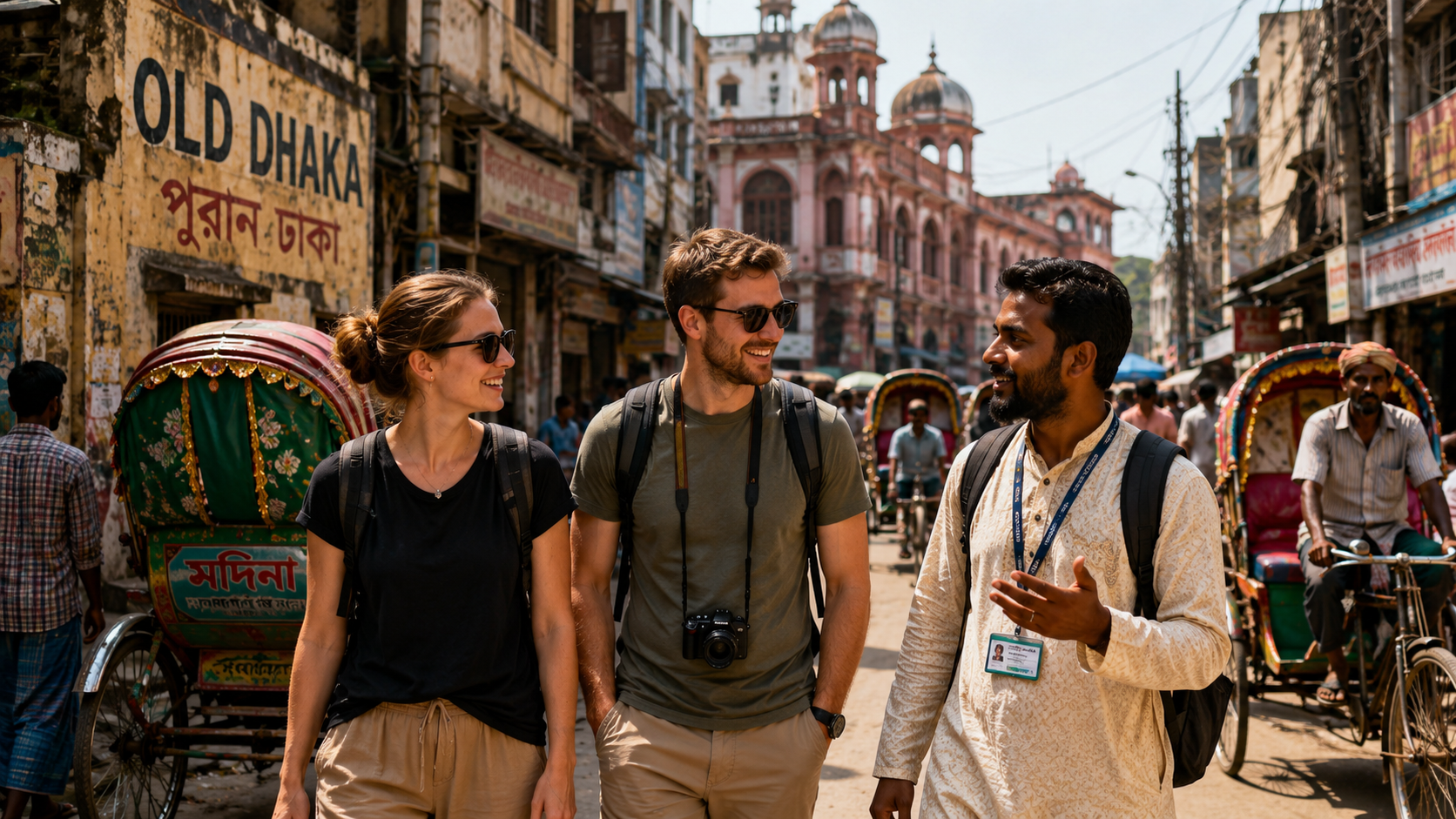
Behind the traffic are Mughal-era landmarks, vibrant markets, historic mosques, colonial architecture, and one of South Asia’s most exciting food scenes. The key isn’t trying to see everything in a single day; it’s exploring one neighborhood at a time.
For visitors with limited time, joining an Old Dhaka Tour, Dhaka Food Tour, or Half-Day Tour Dhaka is often the easiest way to experience the city’s highlights without worrying about navigation or local logistics.
From a safety perspective, Dhaka calls for the same awareness you’d use in any major city. Choose reputable accommodation, keep an eye on your belongings in crowded areas, and use trusted transportation whenever possible.
Sylhet and Sreemangal: Ideal for Travelers Seeking a Slower Pace
After the energy of Dhaka, Sylhet feels like a different country.
Tea estates stretch across rolling hills, rivers wind through quiet countryside, and the pace of daily life becomes noticeably slower. For many international visitors, this region provides the balance they were looking for after spending time in the capital.
It’s also one of the easiest parts of Bangladesh to explore.
Whether you’re walking through tea gardens, visiting tribal communities, photographing waterfalls, or enjoying local cuisine, travel here tends to be relaxed and straightforward.
A well-planned Sreemangal and Sylhet Tour allows you to experience several of the region’s highlights without rushing between destinations, making it particularly suitable for couples, families, photographers, and first-time visitors.
If someone asked us to recommend just one region outside Dhaka for their first trip, Sylhet would almost always be near the top of the list.
The Sundarbans: Safe Exploration Through Responsible Tourism
Few places capture travelers’ imaginations like the Sundarbans.
As the world’s largest mangrove forest and a UNESCO World Heritage Site, it’s famous for its unique ecosystem and the elusive Royal Bengal Tiger. That reputation naturally leads many visitors to ask whether it’s safe.
The answer depends on how you explore it.
Tourists don’t wander through the forest independently. Visits are conducted on licensed boats with experienced crews and trained local guides who understand the waterways, wildlife, tides, and park regulations. This organized approach is one of the reasons the Sundarbans remains both accessible and well protected.
Most visitors never encounter dangerous situations because they’re following established routes designed specifically for tourism.
Choosing a professionally organized Sundarbans and Bagerhat Tour also removes the complexity of arranging permits, transportation, accommodation, and local logistics, allowing you to focus on the experience itself.
North Bengal: Bangladesh’s Underrated Cultural Landscape
While many travelers concentrate on Dhaka and the south, North Bengal offers a very different perspective on the country’s history.
Ancient temples, archaeological sites, Buddhist monasteries, and rural villages create an itinerary that’s especially appealing to travelers interested in history and photography.
Destinations such as Mahasthangarh, Kantajew Temple, Paharpur Buddhist Monastery, and surrounding heritage sites are generally peaceful and far less crowded than Bangladesh’s larger cities.
A thoughtfully planned North Bengal Tour is ideal for travelers who prefer slower travel, cultural experiences, and places that remain largely undiscovered by international tourism.
Are There Places That Require Extra Planning?
Answering this honestly is important because it helps travelers separate practical advice from unnecessary concern.
The vast majority of international visitors spend their time in destinations that are well established for tourism. However, like many countries, Bangladesh also has areas where additional planning is recommended.
Border Regions and Restricted Areas
Some remote border regions and parts of the Chittagong Hill Tracts may occasionally have travel restrictions, permit requirements, or updated government guidance depending on local conditions.
These areas are not typically included in first-time itineraries, and most travelers exploring Bangladesh’s major attractions will never need to consider them.
Checking the latest travel advice before your trip—and again shortly before departure—is a sensible habit regardless of where you’re traveling in the world.
Why Local Knowledge Makes a Difference
One advantage of exploring Bangladesh with an experienced local operator is that small logistical challenges rarely become major problems.
Road conditions, seasonal weather, ferry schedules, and festival dates can all influence travel plans. Having local guidance helps you adapt without missing the experiences that brought you to Bangladesh in the first place.
If you’re planning a broader itinerary that combines Dhaka with heritage sites, wildlife, or tea country, working with the Best Tour Agency in Bangladesh often provides a smoother and more rewarding experience than trying to coordinate everything independently.
Should You Be Concerned About Official Travel Advisories?
Many travelers read official travel advisories before booking a trip, and that’s a sensible habit. The important thing is knowing how to interpret them.
Travel advisories are designed to help people make informed decisions, not to discourage tourism altogether. They often take a cautious approach because they’re written for every type of traveler—from business visitors to aid workers—not just tourists following established routes.
For most leisure travelers, the practical questions are much simpler.
Is your itinerary focused on popular tourist destinations?
Are you staying informed before departure?
Are you avoiding demonstrations or restricted areas if advised?
If the answer is yes, official guidance becomes another planning tool rather than a reason to cancel your trip.
The most experienced travelers don’t ignore travel advisories—but they also don’t rely on them as the only source of information.
They combine official advice with current local knowledge, realistic planning, and an understanding of the destinations they’re actually visiting.
Practical Tips Before You Travel to Bangladesh
By now, you should have a clearer picture of what traveling in Bangladesh is actually like. The final step is making sure you’re prepared before you board your flight.
Most first-time visitors don’t run into problems because Bangladesh is difficult to travel. They run into small inconveniences that are easy to avoid with a little planning. The following tips come from the questions international travelers ask most often before visiting the country.
Buy a Local SIM Card Soon After Arrival
Reliable internet makes traveling anywhere easier, and Bangladesh is no exception.
International roaming can be expensive, so many visitors choose to buy a local SIM card at the airport or from an authorized mobile operator after arriving. Providers such as Grameenphone, Robi, Banglalink, and Teletalk offer prepaid tourist-friendly packages with generous data allowances.
Having mobile data will help you navigate cities, book transportation, communicate with hotels, and stay connected throughout your trip.
Carry Some Cash Alongside Your Bank Cards
Credit and debit cards are accepted in many hotels, shopping malls, and larger restaurants, particularly in Dhaka.
Outside major cities, however, cash remains the preferred method of payment.
Local cafés, markets, small guesthouses, river transport, and family-run businesses may not accept international cards. Carrying a reasonable amount of Bangladeshi Taka for daily expenses makes travel much more convenient.
Rather than relying entirely on cash or entirely on cards, most experienced travelers use both.
Dress for the Weather and the Culture
Bangladesh has a warm, humid climate for much of the year, so lightweight and breathable clothing is usually the most comfortable choice.
At the same time, you’ll notice that local people generally dress modestly, especially outside major cities. Visitors don’t have to completely change their wardrobe, but clothing that covers the shoulders and knees is appropriate in most situations and especially appreciated when visiting religious sites or rural communities.
Comfort and cultural awareness usually go hand in hand.
Leave Extra Time Between Destinations
One of the easiest ways to enjoy Bangladesh is to avoid planning every hour of the day.
Traffic conditions, weather, and local events can all affect travel times. Instead of scheduling attractions back-to-back, leave some flexibility in your itinerary.
That extra time often becomes an opportunity rather than an inconvenience. It might be spent enjoying an unexpected meal, discovering a neighborhood you hadn’t planned to visit, or simply slowing down and appreciating your surroundings.
Travel Insurance Is Worth Considering
Most trips to Bangladesh are completed without major incidents, but travel insurance remains a sensible precaution for any international journey.
A comprehensive policy that covers medical treatment, cancellations, and lost baggage can provide additional peace of mind, particularly if your itinerary includes domestic flights, river cruises, or extended travel across multiple regions.
It’s one of those purchases you’ll hopefully never need—but will appreciate having if something unexpected happens.
Common Mistakes First-Time Visitors Make
Every destination has a learning curve, and Bangladesh is no different. Fortunately, most first-time mistakes are easy to avoid once you know what to expect.
Trying to See Too Much
Bangladesh looks compact on a map, but travel takes time.
Instead of attempting to cover the entire country in one trip, choose a few regions and explore them well. Many travelers discover that spending three nights in one destination is far more rewarding than rushing through three destinations in three days.
Underestimating Travel Times
A two-hour journey can occasionally become three or four depending on traffic, weather, or ferry crossings.
Building flexibility into your itinerary reduces unnecessary stress and makes unexpected delays much easier to manage.
Ignoring Seasonal Weather
The experience of visiting Bangladesh in January is very different from visiting during the monsoon.
Before finalizing your plans, consider what you want from the trip. Cooler months are ideal for sightseeing, while the rainy season offers lush landscapes, dramatic rivers, and excellent photography opportunities.
Choosing the right season can shape your entire experience.
Expecting Bangladesh to Feel Like Other Tourist Destinations
Perhaps the biggest mistake is arriving with expectations based on somewhere else.
Bangladesh isn’t designed around international tourism, and that’s part of its appeal.
The country rewards curiosity more than comparison. Travelers who embrace its pace, culture, and everyday rhythms often leave with a much deeper appreciation than those who spend their trip measuring it against other destinations.
Is Bangladesh Safe to Travel? Our Final Verdict
So, is Bangladesh safe to travel?
For most visitors, yes.
Not because it’s a country without challenges, but because those challenges are usually practical, predictable, and easy to manage with sensible planning.
If you stay informed, respect local customs, choose reliable transportation, and allow yourself enough time to explore, you’ll likely discover the same thing many international visitors do: Bangladesh feels far more welcoming than they expected.
It’s a destination where conversations often become memories, where heritage sites remain refreshingly uncrowded, and where nature still feels wonderfully wild.
Bangladesh won’t appeal to every traveler—and that’s perfectly fine.
But if you’re looking for authentic cultural experiences, remarkable landscapes, genuine hospitality, and a side of South Asia that many international visitors have yet to discover, it’s a country that deserves a place on your travel list.
Whether you’re exploring the historic lanes of Old Dhaka, joining a Dhaka Food Tour, discovering the tea gardens on a Sreemangal and Sylhet Tour, cruising through the Sundarbans and Bagerhat Tour, or extending your journey with a North Bengal Tour, you’ll quickly understand why more travelers are beginning to see Bangladesh differently.
Sometimes the best destinations aren’t the ones everyone is talking about.
They’re the ones you’ll still be talking about long after you return home.
Frequently Asked Questions
Is Bangladesh safe for American tourists?
Yes. American tourists visit Bangladesh every year for cultural, historical, and wildlife experiences. Following local advice, using reputable transportation, and staying informed about current travel guidance are generally sufficient for a safe trip.
Is Bangladesh safe for solo female travelers?
Many women travel independently in Bangladesh without major issues. Dressing modestly, arranging transportation in advance, and choosing reputable accommodation are practical steps that help create a comfortable experience.
What is the safest time to visit Bangladesh?
The most popular season is from November to March, when temperatures are cooler and rainfall is low. This period is ideal for sightseeing and outdoor travel.
Do I need a guide to travel around Bangladesh?
Not necessarily. Independent travel is possible, particularly in major cities. However, guided tours are often the most convenient option for destinations such as the Sundarbans, North Bengal, and rural heritage sites where local knowledge enhances the experience.
Is Bangladesh expensive for tourists?
Compared with many destinations in Asia, Bangladesh is generally affordable. Accommodation, food, transportation, and guided tours often provide excellent value, making it suitable for both budget-conscious and mid-range travelers.