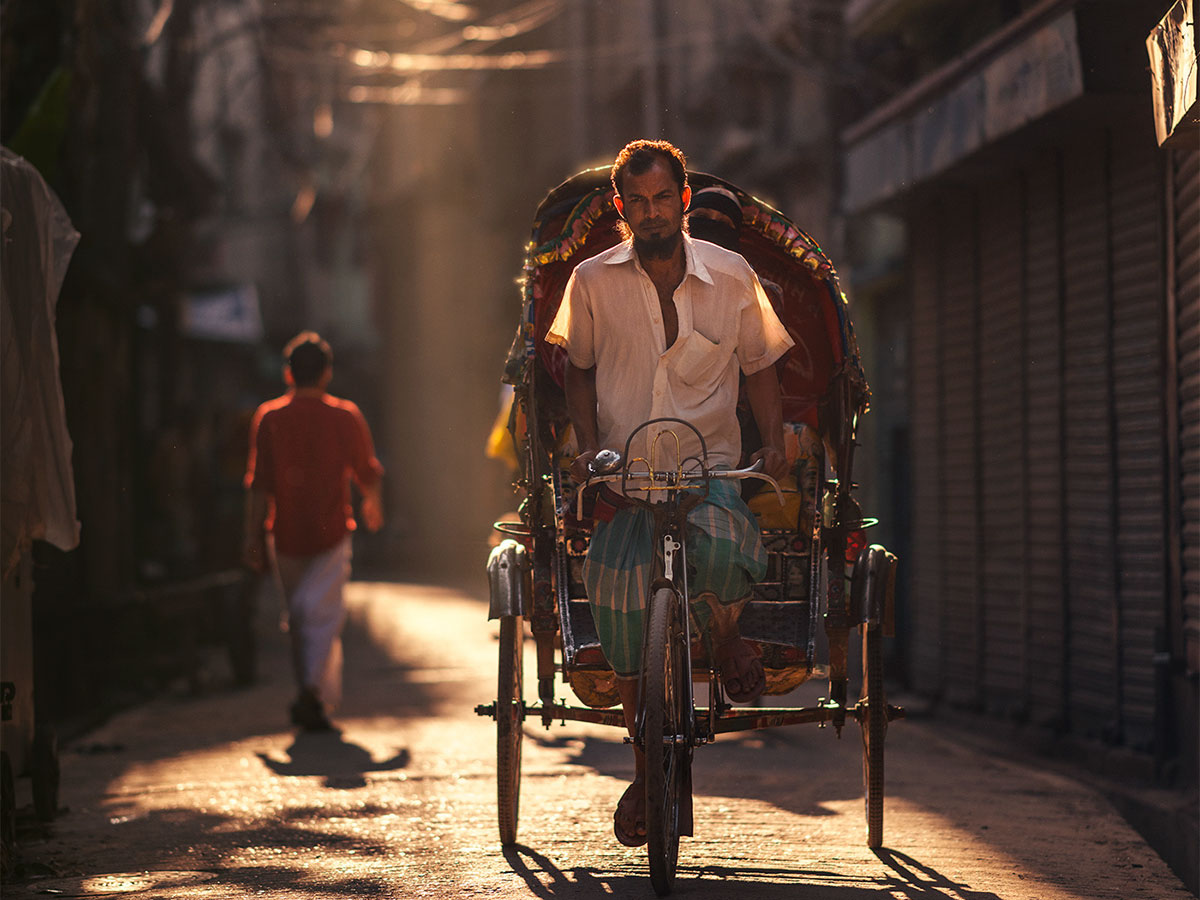
A rickshaw bell cuts through the traffic. Morning light touches the faded wall of an old merchant house. A tea seller passes a glass across a crowded counter while, a few steps away, workers prepare goods for another day in one of the world’s busiest cities.
These moments are not arranged for visitors. They are part of Dhaka’s daily rhythm.
That is why Dhaka street photography feels different. The city does not depend on polished viewpoints or carefully staged attractions. Its visual strength comes from relationships: people and work, heritage and modernity, movement and stillness, architecture and daily life.
For photographers visiting from the United States, Canada, Australia, New Zealand, the United Kingdom or Europe, Dhaka offers a rare opportunity to create photographs with context. The challenge is not finding something visually interesting. The challenge is slowing down, understanding what is happening and photographing people with dignity.
Why Is Dhaka Important for Street Photography?
Dhaka is important for street photography because history, architecture, labor, commerce, faith and everyday life remain closely connected within its streets.
A photographer can observe a historic neighborhood, a working river, traditional craftsmanship and rapidly changing urban life within the same city. However, Dhaka’s value is not simply the number of subjects available. It is the depth of the stories connecting them.
The strongest photographs from Dhaka usually reveal:
- How people use historic streets and buildings
- How traditional skills survive in a modern city
- How river transport continues to support urban life
- How rickshaws influence color, movement and visual identity
- How markets connect rural production with city households
- How people adapt to density, weather and constant change
- How faith and community shape public space
- How ordinary work sustains an extraordinary city
Dhaka is therefore more than a colorful background. It is a living visual narrative.
Dhaka Rewards Photographers Who Look Beyond the Obvious
A first-time visitor may initially notice congestion, noise and crowds. These impressions are real, but they are only the surface.
Street photography begins to become meaningful when the photographer stops treating the city as a spectacle. Instead of photographing “chaos,” look for the systems inside it. Notice how a rickshaw puller reads the movement of traffic, how a vendor organizes a narrow space or how pedestrians communicate without stopping.
What appears disorderly from a distance often contains its own rhythm.
Movement Happens in Layers
Dhaka rarely produces a completely empty frame. People, vehicles, signs, buildings and commercial activity frequently overlap. For a photographer, this creates opportunities to develop layered compositions.
A foreground action may lead toward a second story in the middle of the frame, while architecture or signage supplies cultural context in the background. The result can be a photograph that reveals more each time it is viewed.
This complexity also requires patience. Shooting every passing subject usually creates visual confusion. A stronger approach is to choose a position, study the flow and wait for separate elements to connect.
Everyday Actions Carry Meaning
Some of Dhaka’s most expressive moments are small:
- Tea being poured at the beginning of a working day
- A passenger negotiating space on a river crossing
- An artisan checking a handmade object
- A shopkeeper raising an old metal shutter
- A family navigating a crowded lane
- A rickshaw artist adding the final detail to a painted panel
- Workers sharing a quiet break away from public activity
These scenes are valuable because they explain how the city lives. They do not require drama, staging or intrusion.
History Is Still Visible in Everyday Life
Dhaka’s historical identity does not survive only inside museums. It remains visible in street patterns, religious buildings, merchant houses, river connections, traditional businesses and the occupations of long-established communities.
Old Dhaka is especially significant because history and daily life occupy the same physical space. A historic facade may contain a family business. A centuries-old street may still function as a commercial route. A religious building may remain central to the surrounding community.
This creates an important distinction between architectural and street photography.
Architectural photography may isolate a building as an object. Street photography asks how people continue to use, protect, alter and understand that building.
Architecture Provides Context, Not Just Background
Dhaka contains architectural influences from different periods, including Mughal, colonial, Indo-Saracenic and modernist traditions. Yet a meaningful street photograph should do more than place a person in front of an old wall.
The architecture should help explain the scene.
A narrow lane might reveal how a neighborhood developed before motor traffic. A shaded arcade may show how buildings responded to climate. A weathered courtyard might demonstrate how private and public life overlap.
When the building has a role in the story, architecture and human experience become part of the same photograph.
Heritage Is a Living Process
Heritage should not be treated as something frozen in the past. It survives through use, memory, craftsmanship and community participation.
In Dhaka, photographers may encounter people maintaining traditional occupations, preparing objects for religious observance, producing decorative work or adapting inherited spaces for present-day needs.
The strongest heritage photographs connect three elements:
- The person or community
- The practice, object or place
- The reason it still matters
That relationship gives an image historical and cultural value beyond its appearance.
Rickshaws Give Dhaka a Distinct Visual Language
Few objects are as closely associated with Dhaka’s street identity as the cycle rickshaw.
A rickshaw is transport, livelihood, public art and part of the city’s soundscape. Painted panels, decorative canopies and hand-applied patterns introduce color into streets where concrete, metal and dust might otherwise dominate.
However, a meaningful photograph should not reduce the rickshaw to a colorful prop.
The driver, passenger, route, surrounding neighborhood and purpose of the journey all contribute to the story. A close-up of painted details may document craftsmanship, while a wider frame can show how rickshaws interact with pedestrians, shops and historic streets.
In 2023, UNESCO inscribed rickshaws and rickshaw painting in Dhaka on the Representative List of the Intangible Cultural Heritage of Humanity. This recognition reflects the cultural value of the painting tradition and the knowledge shared among artists, workshops and communities. UNESCO’s official rickshaw and rickshaw-painting entry can provide useful background when developing an accurate photo essay.
The Buriganga Connects the City’s Past and Present
Dhaka developed through its relationship with the Buriganga River. Although roads now dominate movement through the capital, the river continues to carry passengers, goods and workers.
For street and documentary photographers, the Buriganga offers more than reflections and boats. It reveals how the city functions.
A boatman negotiating river traffic, passengers stepping onto a small wooden vessel and workers moving goods between shore and market all tell parts of a larger story. The river also provides a visual connection between Old Dhaka’s historic identity and its continuing commercial life.
Photograph Relationships, Not Isolated Objects
Boats are naturally photogenic, but an image of a boat alone may say little about Dhaka.
Instead, consider:
- Who depends on the boat?
- What is being transported?
- Where is the journey beginning or ending?
- How does the river connect two communities?
- What does the river reveal about work and mobility?
- How does the old city appear from the water?
These questions help turn an attractive image into a visual record.
Markets Reveal the Systems Behind the City
Dhaka’s markets are full of color, movement and human interaction. Yet their deeper photographic value lies in the systems they reveal.
A wholesale market connects farmers, transporters, porters, traders, retailers and households. Goods may pass through several hands before reaching a family’s kitchen. Photographing that chain can create a richer story than collecting unrelated market portraits.
Follow One Process
Instead of trying to capture an entire market, select one process:
- A delivery being unloaded
- Produce being sorted
- A transaction between traders
- Tea being prepared for workers
- Goods moving from wholesale to retail
- A stall opening before sunrise
- A vendor closing after a long day
An establishing photograph, environmental portrait, action frame, detail and closing image can create a concise photo essay.
This approach is particularly effective for foreign photographers because it encourages observation before interpretation.
Dhaka’s Light Is Unpredictable—and Useful
Dhaka does not always offer clean, golden sunlight. Humidity, haze, cloud, monsoon weather, dust and surrounding structures can soften or obstruct the light.
That unpredictability is part of the city’s photographic character.
Morning Light
Early morning usually offers cooler temperatures, fewer vehicles and softer light. Wholesale activity, transport and preparation for the working day can provide strong documentary subjects.
However, some locations operate under artificial lighting before sunrise. Rather than correcting every color difference, photographers can use the contrast between artificial and natural light to show the transition into morning.
Midday Light
Midday can produce strong contrast, especially where narrow lanes create alternating areas of light and shade. Instead of avoiding harsh conditions entirely, look for subjects moving through defined pockets of light.
Historic arches, covered markets, doorways and building shadows can become natural frames.
Monsoon and Overcast Conditions
Cloudy weather reduces contrast and may help with environmental portraits. Rain changes reflections, movement, clothing, transportation and the way people use public space.
Protect your equipment, but do not assume poor weather means poor photography. A change in weather often reveals a different version of the city.
Dhaka Encourages a Documentary Approach
Street photography can focus on coincidence, gesture, composition or humor. Documentary photography usually develops a subject across multiple images and adds greater context.
Dhaka supports both approaches, but it becomes especially rewarding when a photographer works in sequences.
Possible non-exploitative story themes include:
- The working life of a traditional craftsperson
- One morning in a wholesale market
- The journey of goods from river to shop
- The people who maintain and decorate rickshaws
- How a historic street changes through the day
- Small businesses operating inside heritage buildings
- Public transport as a shared social space
- A neighborhood preparing for a cultural or religious event
A sequence can include a wide establishing scene, human interaction, working details, an environmental portrait and a closing image. Together, these frames explain more than one dramatic photograph can.
The Photographer’s Responsibility Comes Before the Photograph
Dhaka’s openness can make visitors feel that every scene is available to photograph. It is not.
Public visibility does not automatically equal meaningful consent. Ethical street photography requires judgment, especially when photographing children, vulnerable people, private workplaces, religious activity or emotionally sensitive situations.
Do Not Use Poverty as a Visual Attraction
Poverty is not a tour product, photographic genre or shortcut to emotional impact.
Photographing someone solely because their hardship appears visually dramatic removes context and can reinforce stereotypes about Bangladesh. It may also create an unequal relationship in which the photographer benefits while the subject has no meaningful control over how the image is used.
A responsible photographer should ask:
- Does this image preserve the person’s dignity?
- Does the caption explain the situation accurately?
- Would I make the same photograph if the subject understood its intended use?
- Am I showing agency, skill and context—or only hardship?
- Could publication expose the person to embarrassment, danger or exploitation?
- Is the photograph necessary to tell the story?
If the answers are uncomfortable, do not take or publish the image.
Children Require Additional Protection
Do not photograph an identifiable child in a sensitive environment merely because the moment appears emotionally powerful.
For planned portraits or documentary access, obtain appropriate adult or guardian consent and assess how the image may affect the child. Never request entry to a workplace for the purpose of photographing child labor as entertainment.
Potential labor abuse should be approached through qualified journalism, safeguarding procedures and legal review—not a casual photography tour.
Ask Before Entering Workplaces
Workshops, factories, shipyards, railway facilities and industrial spaces may be privately controlled or hazardous. Access should be obtained from an authorized person.
Permission from one worker may not equal permission from the facility owner or operator. Photographers must follow safety instructions, use required protective equipment and avoid interrupting work.
Bangladesh Explore should never promise access to a restricted workplace unless written permission has been confirmed.
Respect Religious and Private Moments
Ask before photographing worshippers at close range. Observe dress requirements, restricted areas and instructions from religious authorities.
Avoid photographing people during prayer, grief, medical treatment, family conflict or other private moments without informed permission.
Consent Is an Ongoing Conversation
A smile or friendly gesture does not always mean someone has agreed to publication.
When making a close portrait:
- Establish respectful communication.
- Indicate that you would like to take a photograph.
- Accept refusal immediately.
- Show the image when appropriate.
- Explain intended commercial, editorial or social-media use.
- Obtain a model release where the use requires one.
Ethical practice does not weaken street photography. It produces more informed photographs and better relationships.
Practical Street Photography Advice for Dhaka
Travel Light
A compact camera with a small prime lens or lightweight zoom is easier to manage in crowded areas. Excessive equipment can attract attention, slow your response and make subjects uncomfortable.
A 28mm or 35mm equivalent lens works well for environmental scenes. A 50mm lens provides more distance but may make layered scenes harder to frame in narrow streets.
Protect Against Heat, Humidity and Dust
Carry water, a microfiber cloth, spare batteries and basic rain protection. Moving between air-conditioned rooms and humid outdoor conditions may cause condensation, so allow equipment time to adjust.
Avoid changing lenses unnecessarily in dusty or wet environments.
Plan Around Traffic
Dhaka traffic can make a geographically short journey unexpectedly long. Build a photography session around one connected area instead of trying to cross the city repeatedly.
For a complete list of places, timings and subject types, use Bangladesh Explore’s separate photography locations in Dhaka guide. This article intentionally explains why the city matters rather than duplicating that location guide.
Work with a Local Photographer or Guide
A local guide can explain cultural context, communicate with subjects, identify restricted spaces and help a visitor understand what is happening before the camera is raised.
The guide should not pressure people to pose, promise unauthorized access or create artificial scenes. Their role is to improve understanding, safety and respectful communication.
Who Will Find Dhaka Most Rewarding?
Dhaka suits photographers who are interested in:
- Human-centered street photography
- Documentary photo essays
- Living heritage and craftsmanship
- Architecture in everyday use
- River-based urban life
- Markets and working communities
- Layered compositions
- Environmental portraiture
- Visual anthropology
- Responsible travel photography
It may be less suitable for photographers expecting quiet streets, unrestricted access or predictable travel times. Dhaka asks for patience, flexibility and cultural awareness.
Those qualities are precisely what make the experience valuable.
Why a Photograph from Dhaka Can Matter
A successful street photograph does not simply prove that the photographer visited an unfamiliar place. It helps a viewer understand something they did not previously notice.
Dhaka offers countless opportunities to create that kind of work because its history, architecture and daily life have not been separated into isolated tourist zones. They continue to interact.
A rickshaw passes a historic building because both remain part of the city. An artisan works in a narrow neighborhood because craft and community developed together. A river worker moves goods beneath an evolving skyline because the old and modern economies still depend on each other.
These relationships give Dhaka’s photographs meaning.
The city will provide the movement, light and human interaction. The photographer’s responsibility is to bring patience, accuracy and respect.
Experience Dhaka with a Local Photography Guide
Independent photography is possible, but Dhaka’s density, language, traffic and access conditions can make a first visit challenging.
Bangladesh Explore’s Street Photography Tour in Dhaka is designed to help international visitors understand the city’s visual stories with local guidance. The experience should prioritize cultural context, safe movement, consent and realistic access—not staged poverty or guaranteed entry to private workplaces.
Before booking, confirm the current duration, starting time, guide, transport arrangements, included services, cancellation policy and photography-access conditions on the product page.
Frequently Asked Questions
Why is Dhaka good for street photography?
Dhaka is good for street photography because history, commerce, transport, craftsmanship, faith and everyday life remain closely connected. Its dense streets create layered compositions, while its communities provide opportunities for human-centered visual storytelling.
What makes Dhaka different from other photography destinations?
Dhaka’s strength is not based on famous viewpoints. It comes from living relationships between people and place. Historic neighborhoods still function as residential and commercial spaces, while rickshaws, markets and river transport remain part of daily life.
Is street photography allowed in Dhaka?
Photography in public spaces is generally possible, but access and restrictions vary. Government buildings, security installations, railway facilities, airports, factories and private workplaces may prohibit or limit photography. Follow posted rules, seek permission and comply with instructions from authorized personnel.
Do I need permission to photograph people in Dhaka?
Permission is strongly recommended for close portraits, children, vulnerable people, private workplaces and sensitive situations. Even where a candid public photograph may be possible, photographers should consider dignity, privacy and intended use before taking or publishing it.
What is the best time for street photography in Dhaka?
Early morning often provides softer light, cooler temperatures and active markets or transport scenes. Late afternoon can offer warmer light and longer shadows. The best time ultimately depends on the story and location rather than one universal schedule.
What lens is best for Dhaka street photography?
A compact 28mm or 35mm equivalent lens is useful for layered scenes and environmental portraits. A 50mm lens provides more working distance. A lightweight 24–70mm zoom can be practical for photographers who want flexibility without carrying several lenses.
Is Dhaka suitable for solo foreign photographers?
Foreign photographers can explore independently, but traffic, language, access restrictions and dense working environments can be difficult to navigate. A responsible local guide can improve cultural understanding, route planning and communication. Normal urban safety precautions remain necessary.
Can photographers visit factories or industrial workplaces?
Only with appropriate authorization. Factories, shipyards and industrial sites are active workplaces with privacy and safety requirements. Bangladesh Explore should not guarantee access unless permission has been confirmed by an authorized facility representative.
Is photographing poverty ethical?
Photographing hardship without context, dignity or meaningful consent can be exploitative. Responsible documentary work should explain the wider situation, avoid stereotypes, protect vulnerable individuals and consider how publication may affect the person photographed.
Can I photograph children working in a factory?
Child labor should never be marketed as a photography-tour attraction. Any investigation or documentation of suspected abuse requires safeguarding procedures, lawful access, qualified editorial oversight and careful protection of the child’s identity and welfare.