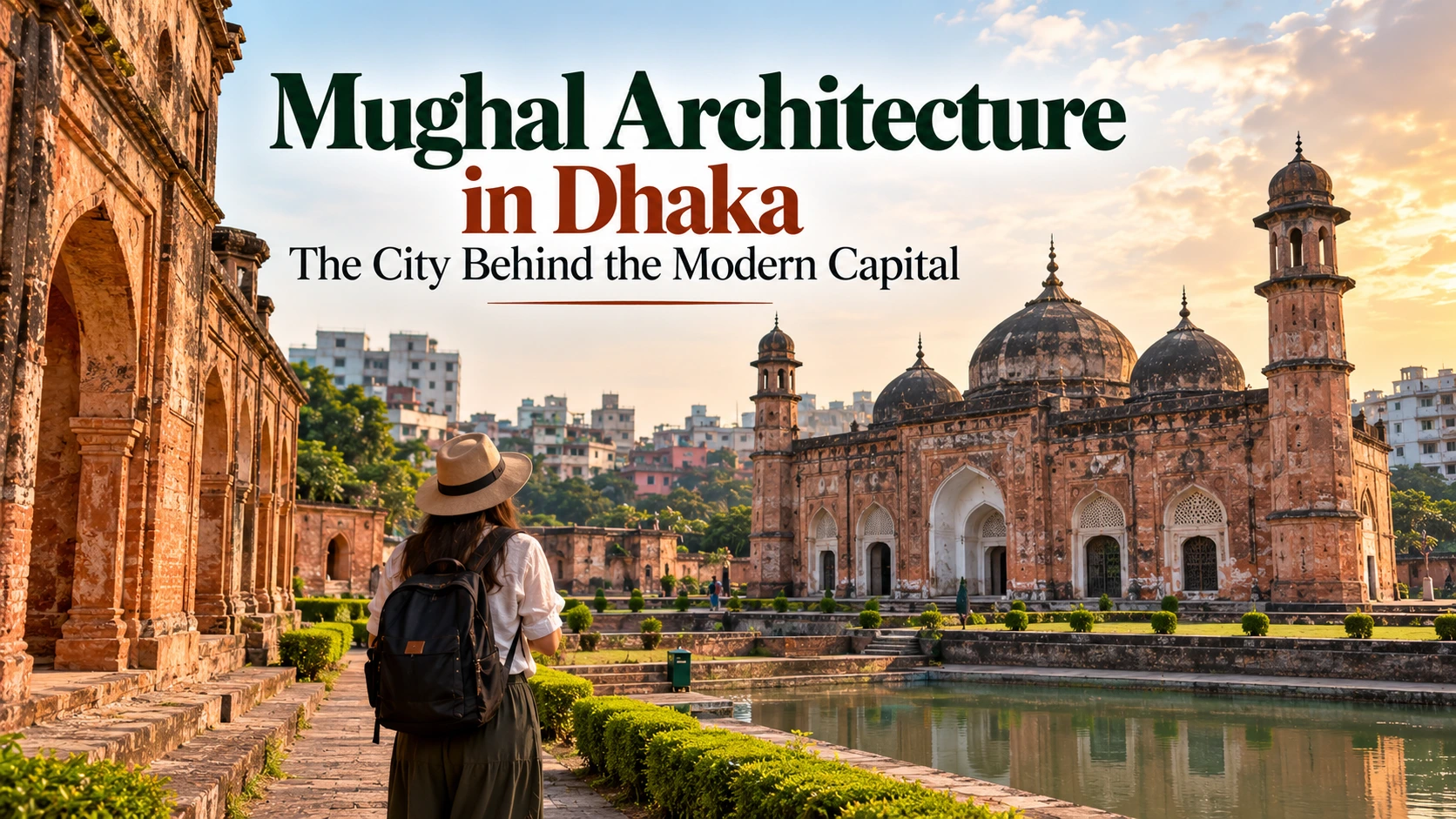
Modern Dhaka rarely reveals itself all at once. Its traffic, concrete towers, flyovers, markets and restless movement can make the city appear entirely contemporary. Yet behind that first impression is another Dhaka—a capital created around rivers, imperial administration, mosques, caravanserais, gardens, forts and trading neighborhoods.
The most meaningful examples of Mughal architecture in Dhaka are not gathered inside a single preserved heritage district. They survive between homes, shops, schools, workshops and crowded streets. Some are protected monuments. Others remain active places of worship. A few have been reduced to gateways, walls or fragments that require historical imagination to understand.
That scattered condition is precisely what makes Mughal Dhaka important. Its buildings are not simply isolated attractions. Together, they explain how a river settlement became an imperial capital and how that capital shaped the commercial and cultural identity of the city that followed.
For travelers interested in architecture, urban history and living heritage, Mughal Dhaka offers something different from a perfectly restored historical center. It invites visitors to read the modern city in layers.
What Is Mughal Architecture in Dhaka?
Mughal architecture in Dhaka refers to forts, mosques, tombs, gateways, caravanserais, bridges, gardens and civic structures constructed during Mughal rule in Bengal, particularly from the early seventeenth to the early eighteenth century.
In Dhaka, the style was adapted to Bengal’s river environment, climate, locally available materials and existing building traditions. Brick was more practical than the monumental stone commonly associated with Mughal architecture in Delhi, Agra or Lahore. Builders used lime plaster, domes, arches, corner towers, raised platforms, enclosed courtyards and water-management features to create architecture suited to the region.
The short answer
Dhaka’s Mughal architecture is a regional interpretation of imperial design. It combines Mughal planning and decorative ideas with Bengal’s brick-building tradition, heavy rainfall, waterways and dense urban conditions.
This direct relationship between architecture and geography is essential. Mughal Dhaka was not designed as an inland ceremonial capital. It was a river city whose political authority, military defense, commerce and communication depended on water.
How Dhaka Became a Mughal Capital
Dhaka’s transformation accelerated when Mughal governor Islam Khan Chishti established the city as the capital of Bengal in 1610 and renamed it Jahangirnagar in honor of Emperor Jahangir. Banglapedia records that Islam Khan occupied Dhaka, made it his capital and used it as a base for consolidating Mughal authority in Bengal.
The location offered major strategic advantages. Dhaka stood within a network of rivers connecting agricultural regions, textile-producing centers, military routes and trading settlements. Rivers functioned as commercial highways, defensive corridors and communication channels.
The imperial administration brought governors, military officers, merchants, craftspeople, religious scholars and builders. New structures were needed for worship, accommodation, defense, administration and trade.
Dhaka’s river geography shaped its development
To understand Mughal Dhaka history, imagine the rivers as part of the city’s infrastructure rather than as boundaries outside it. Officials and goods moved by boat. Fortifications monitored waterways. Trading quarters grew near landing points. Important buildings were positioned in relation to river routes that have since shifted, narrowed or disappeared.
This helps explain why some surviving Mughal buildings may appear strangely placed in present-day Dhaka. Their original relationship with water is no longer immediately visible.
Jahangirnagar was a working capital
The city was not created only to display imperial grandeur. It had to govern an enormous and economically valuable province. Dhaka developed as a center of administration, military activity, textiles and long-distance commerce.
Its famous muslin industry connected the city and its surrounding production areas to merchants from Asia and Europe. Architecture supported that larger economic system through markets, residences, caravanserais, mosques and protected transportation routes.
What Makes Mughal Architecture in Dhaka Distinctive?
Visitors familiar with northern Indian Mughal monuments may expect extensive marble, enormous gateways and highly symmetrical imperial complexes. Dhaka’s Mughal heritage presents a different architectural language.
Brick construction
Brick was the principal building material because suitable building stone was not readily available in the delta. Brick walls were commonly covered with lime plaster, creating smooth surfaces that could receive molded or painted decoration.
The widespread use of brick did not make the buildings architecturally simple. Builders developed sophisticated solutions involving arches, vaults, domes, towers, platforms and carefully arranged façades.
Three-domed mosques
A three-domed prayer hall became one of the recognizable forms associated with Mughal mosque architecture in Bengal. The central dome was often emphasized, while the side domes completed a balanced composition.
According to Banglapedia’s overview of mosque architecture, Mughal congregational mosques in Bengal were generally smaller than the enormous imperial mosques of northern India and frequently used a three-domed form. Banglapedia
This compact design was well suited to neighborhood congregations and local patronage.
Curved cornices and corner towers
Curved cornices had deep roots in Bengal’s architectural tradition and helped direct monsoon rainwater away from walls. Corner towers strengthened the visual edges of a building and gave relatively small structures a more monumental appearance.
Raised platforms
Several historic mosques were constructed on raised platforms. The elevation protected buildings from damp ground and seasonal water while also giving them greater prominence in the surrounding neighborhood.
Khan Mohammad Mridha Mosque near Lalbagh is a particularly instructive example. Its elevated prayer hall and open platform demonstrate how religious architecture could address both climate and urban visibility.
Arches, niches and plaster ornament
Mughal buildings in Dhaka use pointed or cusped arches, recessed panels, decorated mihrabs, parapets and plasterwork. In many cases, proportion and rhythm create more architectural interest than expensive surface materials.
Water and garden planning
Water was both practical and symbolic in Mughal design. At Lalbagh Fort, water channels, fountains and garden divisions formed part of the spatial composition. They provided cooling, movement and visual order while drawing upon the broader Mughal garden tradition.
Lalbagh Fort: Dhaka’s Most Complete Mughal Ensemble
Lalbagh Fort is the best-known example of Mughal architecture in Dhaka, but it is more useful to understand it as an unfinished palace-fort complex than as a conventional military castle.
Construction began in 1678 under Prince Muhammad Azam, a son of Emperor Aurangzeb who served as Mughal governor of Bengal. His successor, Shaista Khan, did not complete the complex. The site that survives today contains defensive walls and gateways, landscaped grounds, a mosque, the tomb of Pari Bibi and a building traditionally associated with the audience hall and hammam.
The Bangladesh Tourism Board describes Lalbagh as an incomplete seventeenth-century Mughal fort complex, while Bangladesh’s Department of Archaeology manages the protected site.
The fort’s architecture is about relationships
The most revealing feature of Lalbagh is not a single building. It is the relationship among the buildings, garden divisions, water channels and walls.
The complex demonstrates the Mughal preference for ordered space. Structures are positioned within a planned landscape rather than placed randomly inside a defensive enclosure. The arrangement combines residential, ceremonial, religious and memorial functions.
The tomb of Pari Bibi
The tomb occupies a visually important position within the complex. Its materials and interior treatment distinguish it from many surviving Mughal structures in Bengal.
Visitors should be careful with popular stories surrounding Pari Bibi. Local retellings often present the fort’s abandonment as the direct result of her death. That story is culturally significant, but some details remain debated. A trustworthy guide should distinguish documented history from later legend.
The mosque
The fort mosque represents the compact, three-domed Mughal mosque form associated with Bengal. Its balanced façade and repeated arched openings make it a useful place to study how architectural rhythm produces monumentality without enormous scale.
The hammam and audience building
The hammam complex offers insight into elite domestic and administrative life. Bathing spaces, water systems and audience functions remind visitors that Lalbagh was conceived as a working political residence, not merely as a defensive fort.
For entrance details, opening schedules and complete visitor information, use the dedicated Lalbagh Fort travel guide. Keeping practical attraction information on that page prevents keyword cannibalization.
Bara Katra and Chhota Katra: Architecture of Trade and Hospitality
The word katra refers to a building associated with accommodation, commerce and travelers. Dhaka’s two famous katras help explain the city’s position within regional trading networks.
Bara Katra
Bara Katra was constructed in the seventeenth century during the governorship of Shah Shuja. Banglapedia identifies it as one of Dhaka’s important Mughal-period structures and connects its construction with Mir Abul Qasim.
The complex originally offered a much stronger sense of enclosure and monumental urban presence than its surviving remains convey today. Its great gateway once announced arrival into a controlled commercial and residential space.
Bara Katra is especially important because it broadens the architectural story beyond forts and mosques. It shows that Mughal architecture also served merchants, travelers and the circulation of goods.
Chhota Katra
Chhota Katra was built later and followed a plan comparable to Bara Katra, although on a smaller scale. Banglapedia notes that the structure had gateways on its northern and southern sides.
The surrounding neighborhood has changed dramatically, and surviving fabric has been affected by later construction. Visitors should therefore approach the site as a vulnerable urban artifact rather than expecting an intact monumental complex.
Why the katras matter today
The two katras connect architecture with everyday economic history. They help visitors understand how accommodation, storage, security, trade and street life operated together.
They also reveal one of Dhaka’s greatest conservation challenges: historic structures remain embedded inside densely occupied neighborhoods where land, housing, business and heritage protection compete for space.
Historic Mughal Mosques in Dhaka
Mosques provide some of the clearest surviving evidence of Mughal patronage in the city. They were commissioned not only by governors but also by officials, judges, military figures and wealthy residents.
Many continue to function as places of worship. That living use gives them authenticity, but it also requires visitors to behave with greater sensitivity than they might at a museum.
Khan Mohammad Mridha Mosque
Located west of Lalbagh Fort, Khan Mohammad Mridha Mosque is one of the strongest examples of an elevated Mughal mosque in Dhaka.
The prayer hall stands above a high platform reached by a staircase. The open elevated terrace creates separation from the street and gives the mosque a striking silhouette. Its three domes, corner towers, arches and proportions reflect the architectural vocabulary of the period.
Historical inscriptions associate its construction with the early eighteenth century. Sources vary slightly when translating the inscription’s date into the Gregorian calendar, commonly placing it around 1704–1706. A careful article should acknowledge that variation rather than presenting disputed precision as certainty.
Sat Gambuj Mosque
Sat Gambuj Mosque, often translated as the Seven-Domed Mosque, is associated with the late Mughal period. Its familiar name counts the building’s three principal domes together with four domed corner towers.
The mosque once had a stronger relationship with waterways and a less obstructed landscape. Modern development has changed that setting, but the building remains valuable for understanding how Mughal religious architecture interacted with Dhaka’s riverine environment.
Haji Khwaja Shahbaz Mosque
This mosque and its associated tomb form a compact religious complex. Its relatively restrained scale provides an opportunity to observe the proportions, domes, arches and corner elements of a neighborhood Mughal mosque without the distraction of a vast monumental site.
Musa Khan Mosque
Musa Khan Mosque stands within the Dhaka University area. Its location makes it useful for travelers exploring the architectural layers around the university, including later colonial buildings and modern national monuments.
The mosque helps connect the early seventeenth-century political transition with the growth of Mughal Dhaka. Its setting also demonstrates how older monuments can become enclosed within later institutional landscapes.
Mosque etiquette for international visitors
Historic mosques are sacred spaces first and architectural sites second.
Visitors should:
- Wear clothing that covers shoulders and knees.
- Remove shoes before entering prayer areas.
- Avoid visiting during congregational prayer unless invited.
- Ask permission before photographing worshippers.
- Keep voices low.
- Follow any gender-specific access guidance.
- Accept that some interior spaces may not be open to casual visitors.
A local guide can help explain architectural details while preventing accidental disruption.
Dhaka Gate and the Idea of the Mughal City
Dhaka Gate, also associated with Mir Jumla, survives near the university area. Although later restoration and changes to the surrounding roads have altered its context, the gate remains an important symbol of entry, movement and urban authority.
A gate is more than an ornament. It marks a transition between spaces. It can regulate traffic, communicate political control and give visual identity to a city.
For visitors, Dhaka Gate provides an opportunity to think beyond individual monuments. Mughal Dhaka had routes, boundaries, landing points and strategic approaches. Much of that historical geography has disappeared beneath later urban development, but surviving structures preserve fragments of it.
Mughal River Forts and the Defense of Dhaka
Dhaka’s architecture cannot be separated from its waterways. Mughal authorities developed a defensive network that included forts near important river approaches.
UNESCO’s Tentative List describes a group called Mughal Forts on Fluvial Terrains in Dhaka, consisting of Lalbagh Fort and the naval forts of Hajiganj, Sonakanda and Idrakpur. These sites are on Bangladesh’s Tentative List; they are not currently inscribed World Heritage Sites. whc.unesco.org
That distinction is essential for factual accuracy.
Hajiganj Fort
Hajiganj Fort guarded an important river route in the Narayanganj area. Its walls, bastions and location illustrate how the Mughals used fortification to monitor movement through the delta.
Sonakanda Fort
Sonakanda Fort also formed part of the defensive landscape around the river approaches to Dhaka. Its circular artillery platform and fortified enclosure reflect the needs of river-based defense.
Idrakpur Fort
Idrakpur Fort in Munshiganj occupied another strategic position within the region’s water network. Its elevated circular structure is one of its most recognizable features.
These forts deserve a dedicated article or itinerary. This page should introduce them only as evidence that Mughal Dhaka functioned within a wider river-defense system.
A Storytelling Walk Through Mughal Dhaka
A meaningful architectural journey should not become a race between monuments. Dhaka’s traffic, climate and density make an overly ambitious checklist frustrating.
Begin with Lalbagh
Start at Lalbagh Fort while energy and attention are high. Study the overall plan before focusing on the individual structures. Look at how the mosque, tomb, audience building, garden and water features relate to one another.
Continue to Khan Mohammad Mridha Mosque
The short geographical distance from Lalbagh creates a strong architectural comparison. Lalbagh represents imperial planning, while Khan Mohammad Mridha Mosque shows how Mughal forms worked at a more intimate neighborhood scale.
Enter the commercial history of Old Dhaka
Continue toward the katra area with a knowledgeable local guide. The surviving fabric may appear modest, but the story is substantial: merchants arriving, goods being stored, travelers finding accommodation and river commerce feeding the city.
A structured Old Dhaka Tour can connect these architectural fragments with bazaars, religious sites, food traditions and the Buriganga River without turning the day into an unsupported self-guided search.
Finish at the river
End near the Buriganga to restore the missing geographical context. From the river, it becomes easier to understand why Dhaka developed where it did and why water mattered to Mughal power.
Travelers with limited time can use a Half-Day Tour Dhaka to focus on a smaller selection of historic sites. Visitors wanting to compare Mughal, colonial and modern architecture can Discover Dhaka City through a broader city experience.
How to Read Mughal Architecture Like a Traveler
You do not need to be an architectural historian to understand these buildings. A few questions can transform the experience.
What was the building designed to do?
Was it used for prayer, defense, accommodation, administration, bathing or commemoration? Function explains many design decisions.
How did people enter and move through it?
Look for gates, stairs, courtyards, corridors and transitions between public and private spaces.
How did the building respond to weather?
Notice raised platforms, thick walls, openings, shaded areas, water systems and drainage.
What has disappeared?
Try to imagine missing gardens, river channels, adjoining rooms or open views. Present-day density can conceal the logic of the original site.
Is the building still used?
A living mosque has a different relationship with its community than a museum monument. Continued religious use can preserve cultural meaning even when the surrounding architecture changes.
Responsible Heritage Travel in Old Dhaka
Mughal heritage in Dhaka is vulnerable. Pollution, vibration, moisture, unplanned construction, overcrowding and insensitive alterations can all affect historic structures.
Visitors can support responsible tourism through simple choices.
Do not touch fragile surfaces
Old plaster, brick and decorative details can be damaged by repeated contact. Avoid leaning on walls or climbing onto architectural elements for photographs.
Ask before photographing people
Historic neighborhoods are not open-air film sets. Residents, worshippers, children, workers and shopkeepers deserve privacy and dignity.
Avoid poverty-centered storytelling
Photographing hardship without consent or context reduces people to visual subjects. Ethical travel photography should prioritize human dignity over dramatic imagery.
Hire knowledgeable local guides
A responsible guide does more than provide transportation. Good interpretation separates documented history from legend, explains community etiquette and helps travelers understand structures that may otherwise appear visually incomplete.
Spend within historic neighborhoods
Buying refreshments, handicrafts or services from responsible local businesses allows tourism revenue to reach the communities that live around heritage sites.
Why Mughal Dhaka Matters Today
The surviving architecture is not important simply because it is old. It explains how political authority, religion, trade, defense, climate and waterways shaped the city.
Lalbagh Fort shows imperial ambition and incomplete planning. The katras reveal commercial networks. Neighborhood mosques record local patronage and living faith. The river forts demonstrate that Dhaka’s defense extended beyond its streets into a regional water system.
Together, these places challenge the idea that Dhaka is a city without visible history. Its history remains present, but it requires context to recognize.
For an international traveler, the reward is not a collection of perfectly preserved monuments. It is the experience of discovering how fragments of an imperial city continue to influence the identity of one of South Asia’s most dynamic capitals.
Frequently Asked Questions
What is the best example of Mughal architecture in Dhaka?
Lalbagh Fort is the most complete and accessible Mughal architectural ensemble in Dhaka. Its mosque, tomb, audience and hammam building, gateways, gardens and water features allow visitors to study several aspects of Mughal planning in one location.
When did Dhaka become a Mughal capital?
Islam Khan Chishti made Dhaka the capital of Mughal Bengal in 1610 and renamed it Jahangirnagar after Emperor Jahangir. en.banglapedia.org
Which Mughal buildings can travelers see in Dhaka?
Important examples include Lalbagh Fort, Bara Katra, Chhota Katra, Khan Mohammad Mridha Mosque, Sat Gambuj Mosque, Haji Khwaja Shahbaz Mosque, Musa Khan Mosque and Dhaka Gate. Preservation and access conditions vary significantly.
Is Lalbagh Fort a UNESCO World Heritage Site?
No. Lalbagh Fort is not currently an inscribed UNESCO World Heritage Site. It is included within Bangladesh’s “Mughal Forts on Fluvial Terrains in Dhaka” property on UNESCO’s Tentative List.
What are the main characteristics of Mughal architecture in Dhaka?
Common characteristics include brick construction, lime plaster, domes, arched entrances, corner towers, raised platforms, enclosed courtyards, water-management features and adaptations suited to Bengal’s climate.
Are historic mosques open to non-Muslim visitors?
Access varies. Many mosques may welcome respectful visitors outside prayer times, but permission should be requested before entering or taking photographs. Dress modestly and follow instructions from mosque authorities.
Can I explore Mughal Dhaka without a guide?
Lalbagh Fort can be visited independently, but several other sites are difficult to locate or interpret. A knowledgeable guide is particularly helpful around the katras and active neighborhood mosques.
How much time is needed to explore Mughal architecture in Dhaka?
Allow at least half a day for Lalbagh Fort and selected nearby sites. A full day offers a more thoughtful experience, including Old Dhaka’s commercial heritage and the Buriganga riverfront. The river forts require a separate excursion.
What is the best time to photograph Mughal buildings in Dhaka?
Morning generally provides softer light, lower temperatures and less intense congestion. Late afternoon can also be atmospheric, but traffic and closing times should be checked before planning the route.
Why are some Mughal buildings difficult to recognize?
Dhaka has changed substantially since the seventeenth century. Rivers shifted, neighborhoods became denser, buildings were altered and original complexes lost important sections. Historical interpretation is therefore necessary to understand many surviving fragments.