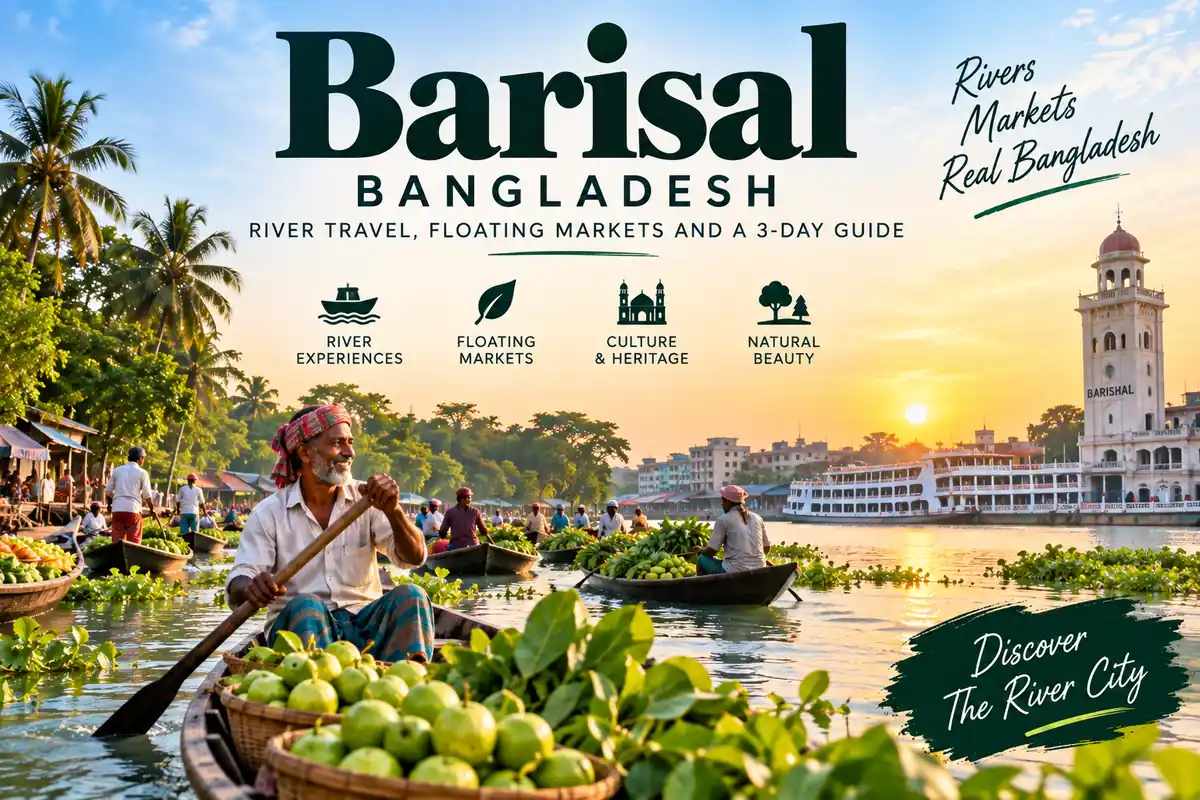
Barisal in Bangladesh is not a single sightseeing stop. It is a river city, a transport gateway and the most practical base for exploring the canal country of south-central Bangladesh. Travelers come for the overnight journey from Dhaka, but the more memorable experience begins after arrival: early-morning produce boats, guava orchards, village waterways, historic buildings and the wide Kirtankhola River.
This Barishal travel guide is designed for visitors from the United States and other international markets who want clear logistics without losing the human side of the journey. It explains where the famous floating markets actually are, when to go, how much time to allow, what to see in the city and how to build a realistic three-day itinerary.
The guide deliberately does not reproduce a cabin-by-cabin overnight-cruise article. That separate page should own detailed launch booking, vessel and boarding questions. Here, the launch is one way to reach the destination; Barisal and its surrounding backwaters are the destination.
Barisal in Bangladesh at a Glance
Is Barisal Worth Visiting?
Yes, especially for travelers interested in rivers, markets, agriculture, photography and everyday life beyond Bangladesh’s most familiar attractions. Barisal is less polished than a resort destination and less monument-heavy than Old Dhaka, but that is part of its appeal. The experience is built around movement through the landscape: arriving by water, crossing the Kirtankhola, traveling down narrow canals and seeing produce move from orchard to market.
Allow three days and at least two nights. A one-night visit usually becomes a rushed transport exercise. Three days provide enough time for the city, an early floating-market excursion and one quieter rural or heritage route.
Barisal or Barishal: Which Spelling Is Correct?
Barishal is the current official English spelling used for the city and division. Barisal remains extremely common in guidebooks, tour searches and everyday English. They refer to the same place. This article uses both naturally so a traveler searching for “Barisal Bangladesh” and one using “Barishal travel guide” can reach the same accurate destination page.
Essential Visitor Facts
- Location: South-central Bangladesh, on the Kirtankhola River
- Best length of stay: Three days and two or three nights
- Best comfortable weather: Generally November through February
- Best-known guava-market period: Usually July and August, depending on rainfall and harvest timing
- Main arrival choices from Dhaka: Overnight passenger launch, intercity bus, domestic flight or private vehicle
- Best local arrangement: Reserved vehicle plus a locally hired country boat for the backwaters
- Travel style: Culture, river landscape, rural life, markets and documentary photography
- Important distinction: The best-known floating guava markets are outside central Barishal, mainly in the neighboring backwater region around Jhalokathi and Pirojpur
Why Barishal Is Bangladesh’s River Gateway
Maps can make Barishal look like an ordinary regional city. On the ground, water explains almost everything. Rivers and canals have shaped settlement, trade, agriculture and transportation across the region. The city works as the logistical gateway because it has major road and river connections, accommodation and services, while the surrounding districts supply the landscape that foreign visitors usually imagine when they hear “floating market Barisal.”
That distinction matters. A visitor should not expect to step off a launch in downtown Barishal and immediately find hundreds of guava boats. Reaching the best-known market areas requires an early road journey and a smaller boat. The city is the base; the backwaters are the excursion.
Barishal also connects naturally with longer southern journeys. Travelers interested in mosque architecture and the mangrove delta can continue through a Sundarbans and Bagerhat Tour, while those focusing on people, crafts and waterways can keep Barishal as the central chapter of A Cultural Tour. These are complementary itineraries, not substitutes for a focused city guide.
Best Things to Do in Barisal
Begin at the Kirtankhola Riverfront
The Kirtankhola gives the city its orientation. Passenger launches, small boats, cargo movement and riverside commerce create a constantly changing scene around the terminal. Early morning is energetic as overnight passengers arrive; late afternoon offers softer light and a calmer introduction to the river.
Treat the terminal as a working transport zone. Keep clear of gangways, ropes and porters carrying loads. Surfaces can be wet, uneven and crowded. Ask before photographing crew members or passengers at close range, and never step onto a vessel simply for a photograph without permission.
The riverfront is also the best place to understand the difference between a passenger launch and a sightseeing cruise. Large launches are intercity public transport. A country boat used in the canals is smaller, privately arranged and suited to slow exploration. Both are valuable experiences, but they require different planning and safety expectations.
Visit Oxford Mission Church
Oxford Mission Church, also known as the Epiphany Cathedral, is one of the city’s most distinctive landmarks. Its red-brick Gothic character, large grounds and long association with Christian education make it unusual within Bangladesh’s architectural landscape.
It remains an active religious institution. Visitors should dress respectfully, speak quietly and request permission before entering buildings or photographing people. Access can change because of services, school activities, maintenance or institutional rules. A local guide can help confirm whether a visit is possible on the day rather than treating the property as an always-open attraction.
Walk Through Bangabandhu Udyan and the City Center
The large open space historically known as Bell’s Park and now called Bangabandhu Udyan provides a pause from the density of the city. It is more useful as a window into local recreation than as a conventional attraction. Families, walkers and students gather here, particularly when the heat eases.
Combine the park with a city drive or walk that includes civic buildings, commercial streets and the Kirtankhola. Barishal rewards observation more than checklist tourism. Tea stalls, fruit sellers, cycle rickshaws and ferry traffic often reveal more about the city than a sequence of formal monuments.
Explore the Barishal Divisional Museum
The divisional museum can provide context for the region’s archaeology, folk culture and history. Displays, opening hours and gallery access may change, and English interpretation may be limited. Verify locally before making it the fixed centerpiece of a day.
The museum is most useful when visited with a guide who can connect objects to the river landscape, local communities and nearby heritage. Allow more flexibility than you would for a major museum in Washington or London. Government holidays, maintenance and staffing can affect access.
Experience Local Markets and Food Streets
Central markets introduce travelers to rice, fish, vegetables, spices and seasonal fruit moving through the regional economy. Visit in the morning for active trading or toward evening for street snacks. Choose busy vendors, eat food cooked hot in front of you and use bottled or properly treated water.
Markets are excellent for photography, but consent remains essential. Ask with a gesture or a few words before making a close portrait. Avoid blocking trade, standing in the path of loaded carts or turning a vendor’s work into a staged performance. Travelers who want help reading these social cues may prefer an organized Street Photography Tour in Dhaka before heading into smaller regional markets independently.
Take a Half-Day Heritage Excursion
Guthia’s Baitul Aman Jame Masjid complex and Durga Sagar at Madhabpasha can be combined as a half-day route from Barishal, subject to traffic and access. The mosque complex is a living place of worship, so modest clothing and prayer-time awareness are necessary. Durga Sagar is a large historic pond whose atmosphere changes with water level, weather and seasonal birdlife.
Neither stop should replace the floating-market day. They work best on the final morning or afternoon when a traveler wants a land-based contrast to the canals.
Floating Market Barisal: What Travelers Need to Know
Where Is the Floating Guava Market?
The label “floating market Barisal” is convenient but geographically imprecise. The most photographed trading areas are associated with the waterways around Vimruli, Kuriana and Atghar in the greater southern backwater region, particularly Jhalokathi and adjoining Pirojpur areas. Depending on the selected landing point, road conditions and water route, reaching them from Barishal city can take a substantial part of the morning.
This is why an experienced local operator matters. The market is not a fixed performance with guaranteed boats at a single pin on a map. Agricultural activity shifts by day, crop, weather, water level and the stage of the harvest. A guide or boatman should confirm the most active location immediately before the trip.
When Is the Best Time to See the Guava Market?
The best-known guava season generally falls in July and August, during the monsoon, though the useful window can move. Fruit maturity, rainfall and local trading conditions determine what visitors actually see. The market is normally most active early in the morning. Competitor itineraries commonly plan observation around roughly 7:00 to 9:00 a.m.; treat that as a planning pattern, not a permanent official schedule.
Leave Barishal well before the market’s active window. A late hotel breakfast can mean arriving after the most interesting wholesale trading has ended. Ask the operator the night before whether the harvest is strong, which market is active and what departure time is required.
What Happens at the Market?
Farmers and traders bring guavas and other produce by small wooden boats. Transactions occur on the water or near landing points, with fruit then moving toward larger markets. The appeal is not only the number of boats. It is the relationship between orchards, canals, homes, collection points and regional commerce.
This is a working market rather than a tourist show. Do not ask boatmen to obstruct trade for photographs. If you buy fruit, agree on the amount and price first. Avoid climbing into a loaded produce boat unless its owner clearly invites you and your own boatman confirms it is safe.
How to Arrange a Boat
A practical excursion usually combines a road transfer from Barishal with a reserved country boat near the market area. Confirm the route, approximate duration, boat type, life jackets, rain cover, pickup point and total price before departure. Also ask whether the quotation includes the vehicle, boat, guide, meals, parking, tolls and waiting time.
The cheapest boat is not automatically the best value. For international visitors, a stable vessel, a competent boatman, usable life jackets and a guide who understands the route are more important than saving a small amount. During rain, protect phones, passports and camera equipment in a dry bag.
Floating Gardens Are Not the Same as Floating Markets
Search results often combine Bangladesh’s floating gardens with its floating produce markets, but they are different entities. A floating market is a place or moving cluster where goods are traded from boats. A floating garden is an agricultural method in which crops are cultivated on buoyant beds built from aquatic plants and organic material.
The Food and Agriculture Organization recognizes Bangladesh’s floating garden agricultural practices as a Globally Important Agricultural Heritage System. The practice occurs across wetland areas that include parts of Barishal, Pirojpur and Gopalganj and has developed over generations as an adaptation to prolonged waterlogging.[1]
A market trip may pass floating cultivation, but it should not promise it at every stop. If floating-bed agriculture is a priority, tell the operator in advance so the route can be designed around an active cultivation area. The best conditions vary by season and farming cycle.
How to Travel from Dhaka to Barisal
Overnight Passenger Launch
For many visitors, the river journey is the most atmospheric arrival. Passenger launches normally leave the Dhaka riverfront in the evening and reach Barishal early the next morning, but sailing times, vessels, berths and cabin inventory change. Verify the current departure directly with the operator, a recognized ticketing service or the Bangladesh Inland Water Transport Authority before travel.[2]
This destination guide intentionally stops at that overview. Detailed cabin categories, booking instructions, terminal navigation and vessel comparisons belong on Bangladesh Explore’s existing overnight-cruise article. Internally linking to that page with descriptive launch-focused anchor text will help users while preventing both pages from competing for the same query.
If spending the day in the capital before sailing, an Old Dhaka Tour can fit naturally because Sadarghat lies in the historic city. Leave generous buffer time: Dhaka traffic is unpredictable, and a launch will not wait for a delayed sightseeing group.
Bus or Private Vehicle via the Padma Bridge
Road travel is now a practical alternative. Buses operate between Dhaka and Barishal, and a private vehicle provides greater control over stops and luggage. Actual journey time depends heavily on the Dhaka departure point, traffic, breaks and road conditions.
Online fares observed during research in September 2026 ranged broadly from about BDT 500 to BDT 1,200 for common bus services. Treat that only as a planning band, not a quote. Coach class, operator and holiday demand change prices. Confirm the boarding point carefully because “Dhaka counter” can refer to several distant terminals.
Domestic Flight
A flight can reduce travel time when a current service operates. At the time of research, direct Dhaka–Barishal service was limited rather than daily across multiple airlines. Schedules can change quickly, so check the airline directly before building the itinerary around a flight.[3]
The advertised airborne time does not include reaching Dhaka airport, check-in, baggage collection or the transfer from Barishal airport. For some travelers, the bus is simpler; for others, a flight preserves a full afternoon. Compare the entire door-to-door journey.
Where to Stay in Barisal
Choose accommodation based on early departure logistics rather than décor alone. A central hotel or a property with reliable vehicle access makes it easier to leave before sunrise for the floating market. Ask whether reception is staffed overnight, whether breakfast can be packed, and whether the hotel can arrange a known driver.
International visitors should verify air-conditioning, hot water, backup power, Wi-Fi, elevator availability and card acceptance. “Breakfast included” is not useful if service begins after the market departure. Carry enough Bangladeshi taka because smaller hotels, boatmen and rural restaurants may require cash.
Online review scores can help identify recurring problems, but recent detailed reviews are more useful than an old average. Contact the property directly for an arrival after midnight or before dawn. If arriving by launch, ask whether early check-in or luggage storage is possible; do not assume a room will be available at 6:00 a.m.
What to Eat in Barisal
Barishal’s food identity grows from its river and agricultural surroundings. Freshwater fish, rice, lentils, vegetables, coconut and seasonal fruit appear frequently. Guava is the headline during the monsoon harvest, but the region’s everyday meals are more diverse than a single crop.
Try fish or bhorta at a busy local restaurant where dishes are freshly prepared. Ask about bones and spice level. International visitors with dietary restrictions should carry a translated card in Bangla and explain whether the restriction concerns allergy, religion or preference. “Vegetarian” may still include fish or stock unless the request is specific.
Street food can be enjoyable when turnover is high and the food is cooked thoroughly. Avoid raw garnishes washed in uncertain water, unsealed drinks and pre-cut fruit that has been exposed for long periods. Peel fruit yourself and wash or sanitize hands before eating.
A Practical 3-Day Barisal Itinerary
Day 1: Arrival and Barishal City
Arrive in the morning by launch, road or flight. Store luggage or check in, eat breakfast and allow time to recover from the journey. Begin at the Kirtankhola riverfront when the light and heat are manageable, then continue to Oxford Mission Church if access has been confirmed.
After lunch, visit the divisional museum if open and walk or drive through the civic center and Bangabandhu Udyan. End with a local market and an early dinner. Confirm the next morning’s vehicle, boat, guide, weather plan and departure time before going to bed.
Do not overload this day. Overnight transport can be tiring, humidity can be intense and schedules may shift. The goal is to understand the city and prepare for the early excursion.
Day 2: Floating Market, Guava Country and Village Canals
Leave before dawn with a packed breakfast. Travel by road to the agreed boat point, then continue by country boat toward the active trading area. The guide should decide between Vimruli, Kuriana, Atghar or another nearby location based on current information rather than a fixed social-media pin.
Observe the market during its useful early window, then continue through canals and orchards. With permission, stop at a village landing, small market or produce yard. A good itinerary includes time to listen and watch; racing between photo locations weakens the experience.
Return to Barishal in the afternoon. Keep the evening flexible for rest, a riverfront walk or a simple meal. Monsoon travel can take longer than expected, so avoid booking a same-evening departure.
Day 3: Heritage Excursion and Departure
Use the final day for Guthia’s mosque complex and Durga Sagar, or choose a quieter canal route if river life is the main interest. Visitors continuing south can instead depart toward Bagerhat, while those returning to Dhaka can select a daytime road journey, a flight if operating or an evening launch.
This itinerary keeps each day focused: city orientation, backwater economy and regional heritage. It also creates room for weather delays. If the guava market is the sole purpose of the trip, add a fourth day as insurance during unstable monsoon conditions.
Best Time to Visit Barisal
November to February: Comfortable Exploration
The cooler, generally drier months are best for walking, city visits and longer regional travel. Skies and river levels vary, but heat and humidity are usually easier to manage. This period suits first-time visitors who value comfort more than peak guava activity.
July and August: Guava Market Season
Monsoon is the signature season for floating guava-market imagery. The waterways are full, the landscape is intensely green and harvesting is active. It is also hot, humid and wet. Heavy rain can alter road access, boat comfort and photography conditions.
Do not plan from a generic annual calendar alone. Ask for a crop update shortly before travel. A delayed or early harvest can make one week much stronger than another.
March to June: Heat and Storm Planning
Temperatures and humidity rise, and pre-monsoon storms can disrupt transport. This period can still work for city and river travel, but schedule outdoor activities early, carry oral rehydration salts and build extra time around departures.
Barisal Travel Costs for International Visitors
Prices change with fuel, season, group size and service level. The following figures are planning estimates in Bangladeshi taka, researched in September 2026, not guaranteed rates.
- Intercity bus from Dhaka: approximately BDT 500–1,200, depending on operator and class
- Simple local meal: approximately BDT 250–600 per person
- Comfortable local restaurant meal: approximately BDT 600–1,500 per person
- Budget-to-midrange room: approximately BDT 2,000–6,000 per night, with wide variation in facilities
- Reserved backwater excursion: obtain an itemized quote; vehicle, boat, guide, route and waiting time create major differences
- Daily planning budget excluding long-distance transport: roughly BDT 4,000–8,000 for an independent budget traveler and BDT 9,000–18,000 for a traveler using private transport and stronger accommodation
The daily totals are editorial estimates, not published tariffs. Solo travelers pay more per person for private boats and cars. Confirm whether taxes, meals, guide fees, boat hire and driver expenses are included. A Best Tour Agency in Bangladesh comparison should focus on safety, clarity and local coordination as well as price.
Safety, Accessibility and Responsible Travel
Boat and Weather Safety
Ask for usable life jackets before boarding. Balance weight, remain seated when the boat is moving and follow the boatman’s instructions near larger vessels. Avoid night travel in small open boats unless the route and operator are reliable. Check weather and river conditions, especially in monsoon and during storms.
Keep passports in waterproof protection and carry copies separately. A dry bag, rain cover, sun protection, insect repellent and closed shoes with grip are more useful than fashionable luggage on a backwater day.
Health and Food Precautions
Use treated or sealed water and carry any essential medication from Dhaka. Travelers should consult a qualified travel-health professional before departure for individualized advice on vaccines, mosquito-borne illness and medication. This guide is practical travel information, not medical advice.
Heat exhaustion can occur even on cloudy days. Drink regularly, take shade breaks and recognize dizziness or unusual fatigue as a reason to stop. Travel insurance should cover medical care, evacuation and the activities in the itinerary.
Accessibility
Barisal can be challenging for travelers with limited mobility. Launch gangways, country boats, river landings and rural paths may involve steep steps, narrow planks and no handrails. Accessible restrooms are not reliable outside major hotels.
Discuss exact mobility needs before booking. Ask for photos of the boat and boarding point, not just verbal reassurance. A private road itinerary may be adapted more easily than a long country-boat route, but step-free access cannot be assumed.
Photography and Community Respect
Ask before photographing people closely, especially children, worshippers and workers. Never fly a drone without confirming current national, local and site-specific rules. Do not enter orchards, homes or religious buildings without permission.
Buy local products when appropriate, pay agreed boat and guide fees promptly, and avoid giving money to children in exchange for photographs. Responsible tourism keeps the encounter dignified and ensures more value stays in the community.
How Bangladesh Explore Can Build the Right Barisal Trip
Barisal requires real-time coordination. A generic itinerary cannot know which market is active, whether a church is accessible, how the monsoon has affected a road or which boat landing is practical that week. Bangladesh Explore can add value by confirming those details locally and designing the trip around the visitor’s pace, mobility and interests.
Before booking, ask the operator for a written inclusion list, hotel category, vehicle type, boat-safety plan, cancellation terms and an emergency contact. A credible itinerary should acknowledge seasonal uncertainty rather than guarantee a perfect floating-market scene every day of the year.
Frequently Asked Questions
Where Is Barisal in Bangladesh?
Barishal is a city in south-central Bangladesh on the Kirtankhola River. It is the administrative center of Barishal Division and a practical gateway to the surrounding river and canal region.
Is Barisal and Barishal the Same Place?
Yes. Barishal is the current official English spelling, while Barisal remains widely used in travel searches and older publications. Both names refer to the same city and region.
What Is Barisal Famous For?
Barisal is famous for rivers, canals, agriculture, passenger launches and access to floating produce markets and guava-growing areas. The city is also known for Oxford Mission Church and its role as a southern transport hub.
Where Is the Floating Market in Barisal?
The most famous floating guava-market areas are not in downtown Barishal. Visitors commonly travel toward the backwaters around Vimruli, Kuriana and Atghar in neighboring Jhalokathi and Pirojpur areas. The most active location varies with season and trading conditions.
What Is the Best Month for the Floating Guava Market?
July and August are generally the strongest months, but rainfall and harvest timing can shift the season. Confirm current crop and market activity with a local operator shortly before travel.
How Many Days Do I Need in Barisal?
Three days is a sensible first itinerary: one day for the city, one early day for the floating market and canals, and one day for nearby heritage or onward travel. Add a fourth day if the market is essential and monsoon disruption is possible.
How Do I Get from Dhaka to Barisal?
Travelers can use an overnight passenger launch, intercity bus, private vehicle or a domestic flight when scheduled. The launch provides the most distinctive experience, while road travel often offers simpler timing.
Is Barisal Safe for Foreign Tourists?
Most visits are trouble-free with normal precautions, but transport and boat safety deserve attention. Use known operators, secure valuables, avoid isolated areas at night, carry travel insurance and monitor current government travel advice before departure.
Can I Visit the Floating Market Outside Guava Season?
The waterways and some local trading remain interesting outside peak season, but visitors should not expect the same volume of guava boats. Ask what produce, village market or floating cultivation is active before confirming the route.
Is Barisal Suitable for Solo Travelers?
Yes, but a local guide is especially valuable for the backwater day. Early departures, changing market locations, language and boat negotiations are easier to manage with reliable local coordination.